Latest FOBAS Fuel Quality Report finds ISO-compliant fuels are increasingly causing operational problems
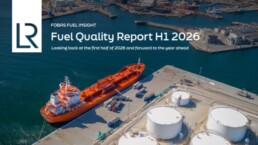

New analysis reveals that the biggest fuel quality risks are no longer confined to off-specification fuels, with some compliant fuels creating operational challenges.
Lloyd’s Register (LR) has warned that ship operators are facing a growing risk from fuels that appear compliant under routine ISO 8217 testing but still present operational risks once onboard.
According to LR’s latest Fuel Oil Bunker Analysis and Advisory Service (FOBAS) Fuel Quality Report, covering the first half of 2026, off-specification fuels remain a persistent challenge. However, some of the most disruptive cases now involve fuels that pass routine compliance testing but show poor stability or compatibility, or contain non-conventional blend components that are only identified through more detailed investigative analysis.
Several incidents investigated highlighted this trend. In March and April, a number of vessels reported operational difficulties after bunkering fuel in a major bunkering hub. Further forensic analysis found that many of the fuels contained elevated concentrations of Estonian shale oil, in some cases estimated to be around 10-15%.
While shale oil is recognised within ISO 8217 as an acceptable blend component, FOBAS investigations found that higher concentrations can be associated with fuel instability and operational issues affecting filters, separators and fuel pumps.
The report also shows that fuel quality variability remains stubbornly high. Off-specification cases remained elevated throughout the first six months of 2026, suggesting that quality issues are no longer isolated events but a more persistent feature of today’s marine fuel supply chain.
The most common recurring issues included sulphur exceedances, excessive water content, sediment and stability problems, elevated catalytic fines, sodium contamination and low flash point distillate fuels.
At the same time, biofuels (especially FAME blends) are continuing to grow without being a primary source of quality issues. Where issues occurred in blended fuels, they were generally associated with the conventional VLSFO component rather than the FAME fraction.
The report concludes that operators will need to adopt a more proactive approach to fuel management as marine fuels become more diverse and fuel quality risks become harder to identify through routine compliance testing alone.
Greater emphasis on fuel stability, compatibility and understanding fuel composition will be critical to reducing operational disruption and maintaining vessel performance.
Murray Kirkwood, Fuel Specialist Consultant, Lloyd’s Register, said: “The findings from our latest report show that fuel quality risk is evolving. The challenge is no longer simply identifying fuels that fail specification. Increasingly, operators are encountering fuels that meet the required limits but still create operational difficulties once they are stored, handled and used onboard.
“As fuel blending becomes more complex, the distinction that matters is increasingly not between on-spec and off-spec fuel, but between fuels that are operationally resilient and fuels that are operationally fragile. Understanding that difference is becoming essential for shipowners and operators.”
The latest findings reinforce FOBAS’ long-standing view that effective fuel management increasingly depends on understanding fuel behaviour rather than relying solely on pass-or-fail specification testing.
By combining routine fuel quality monitoring with forensic investigation of operational incidents, FOBAS provides shipowners with a clearer understanding of emerging fuel quality risks as the industry continues its transition to a more diverse and complex fuel landscape.



Related News.

Navigating the Multi-Orbit Era: In Conversation with Intellian’s Jon Harrison at SMM 2026
At SMM 2026 in Hamburg, the rapid evolution of maritime satellite communications took centre stage. Across the exhibition halls, discussions among…

Cyprus ports need joint energy and investment strategy, shipping agents chief says
Cyprus needs a coordinated strategy for shipping, energy and environmental protection to support port investment and modernisation, Cyprus shipping…

MASO Public Affairs introduces MASO Regulatory Intelligence
A new subscription service helping businesses understand what is changing and what it means for them MASO Public Affairs introduces MASO Regulatory…

Anglo-Eastern helps turn CMBTECH’s ammonia ambition into an operational reality
From early feasibility study and risk-based design to newbuilding supervision, crew readiness and technical management, Anglo-Eastern drew on its…

Escalation of attacks threatens to derail recovery in Middle East oil exports
World oil demand is forecast to fall by 2.5 mb/d y-o-y in 4Q26 and 2.6 mb/d on average in 2026. As the Iran war manifests itself through restricted…

New study finds shipping pays twice its share to EU ETS earmarked revenues should triple to help build market for sustainable fuels and technologies
Shipping is responsible for around 10% of EU ETS emissions but pays almost 20% of the ETS bill. Unlike other sectors, it has never received free…

MSARC strengthens maritime mass rescue readiness through training and national live exercise off Dakar, Senegal
Joint MSARC–FHAS programme combines three days of SAR training with a national multi-agency live exercise The Maritime Search and Rescue Council ,…

Sogese report deliveries are still being delayed as container freight rates fluctuate
FOR IMPORTERS Spot rates into the Mediterranean are back at January levels, Far East to Europe reliability sits at pandemic lows, and nearly…

Glencore begins trading on Australian Securities Exchange
Glencore has begun trading on the Australian Securities Exchange under the ASX code GLC. Gary Nagle, Glencore’s CEO, said it was an exciting day for…

BIMCO Shipping Number of the Week
Suez Canal container ship transits exceed 50% of pre-disruption levels "During the first two weeks of October, weekly container ship capacity…
Subscribe to our newsletter!
if you dont want to swim alone in the ocean of news, sign up for the newsletter, and you will receive daily all the important news of world shipping!
