Enhancing Battery Safety with Spray-Based Cooling
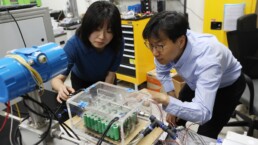

– KIMM develops the world’s first spray-based immersion cooling technology that directly cools lithium-ion battery packs with dielectric liquid –
A spray-based immersion cooling technology capable of effectively cooling lithium-ion battery packs and reducing fire risks using a small amount of dielectric liquid has been developed. The technology demonstrated stable cooling performance under fast charging and discharging conditions of an actual battery pack while reducing liquid consumption by approximately 85% compared to conventional full-immersion cooling systems.
□ A research team led by Dr. Jinsub Kim, Principal Researcher at the Heat Pump Research Center of the Research Institute of Carbon-neutral Energy Machinery at the Korea Institute of Machinery and Materials (KIMM, President Seog-Hyeon Ryu), developed a spray-based immersion cooling technology using dielectric liquid to mitigate thermal runaway and fire risks in lithium-ion battery packs. The technology directly sprays dielectric liquid onto the upper side of the battery pack while partially immersing the lower side, and its cooling performance was validated under rapid charge-discharge conditions of an actual lithium-ion battery pack.
□ The technology developed by KIMM directly removes heat through contact between the dielectric liquid and battery cells. Dielectric liquid is sprayed onto the top of the battery pack, while the lower section remains partially immersed, providing additional cooling through forced convection. By combining spray cooling and immersion-based convective cooling, the system achieved high cooling performance and maintained battery pack temperatures below 35°C even under rapid charging and discharging conditions.
□ Conventional air-cooling and liquid-cooling technologies rely on indirect cooling methods using heat sinks or cold plates, which often face limitations under high-temperature environments or rapid charging and discharging conditions. Although immersion cooling has emerged as an alternative by directly contacting battery cells with dielectric liquid, conventional systems require the entire battery pack to be submerged, resulting in increased liquid consumption, weight, and cost. In contrast, the newly developed spray-based immersion cooling technology reduces liquid usage to only 10~20% of that required by conventional immersion cooling systems while delivering improved cooling performance, simultaneously enhancing thermal stability and reducing system weight.
□ The research team successfully maintained the maximum battery-cell temperature below 35°C under a high charge-discharge rate of 4C, corresponding to rapid charging and discharging conditions. By significantly reducing dielectric liquid consumption, the technology lowers both weight and cost burdens, expanding its applicability not only to electric vehicles but also to large-scale Energy Storage Systems (ESS). In addition, the dielectric liquid possesses non-flammable characteristics and can contribute to fire suppression in the event of a battery fire.
□ As concerns over lithium-ion battery fires and thermal runaway continue to grow, the technology is expected to enhance battery safety across a wide range of applications, including electric vehicles and data center energy storage systems. The research team identified key thermophysical properties of dielectric liquids that maximize cooling performance and plans to expand the research toward discovering new dielectric liquids using AI-based optimization technologies.
□ Dr. Jinsub Kim, Principal Researcher at KIMM’s Heat Pump Research Center, emphasized, “The spray-based immersion cooling technology can effectively cool lithium-ion battery packs and reduce the risks of thermal runaway and fire using only a small amount of dielectric liquid.” He added, “By minimizing liquid consumption and reducing weight and cost, the technology is expected to expand its applications to various fields, including electric vehicles and energy storage systems.”
□ This research was conducted under the Core Technology Development Project for Energy Demand Management of the Ministry of Climate, Energy and Environment, titled ‘Development and Demonstration of Ultra-High-Efficiency Data Center Thermal Management Technology Using Immersion Cooling.’ The research results were published in Applied Thermal Engineering (Vol. 282, 2026), a leading international journal in the field of thermal engineering.



Related News.
Navigating the Multi-Orbit Era: In Conversation with Intellian’s Jon Harrison at SMM 2026
At SMM 2026 in Hamburg, the rapid evolution of maritime satellite communications took centre stage. Across the exhibition halls, discussions among…

Cyprus ports need joint energy and investment strategy, shipping agents chief says
Cyprus needs a coordinated strategy for shipping, energy and environmental protection to support port investment and modernisation, Cyprus shipping…

MASO Public Affairs introduces MASO Regulatory Intelligence
A new subscription service helping businesses understand what is changing and what it means for them MASO Public Affairs introduces MASO Regulatory…
Anglo-Eastern helps turn CMBTECH’s ammonia ambition into an operational reality
From early feasibility study and risk-based design to newbuilding supervision, crew readiness and technical management, Anglo-Eastern drew on its…

Escalation of attacks threatens to derail recovery in Middle East oil exports
World oil demand is forecast to fall by 2.5 mb/d y-o-y in 4Q26 and 2.6 mb/d on average in 2026. As the Iran war manifests itself through restricted…
New study finds shipping pays twice its share to EU ETS earmarked revenues should triple to help build market for sustainable fuels and technologies
Shipping is responsible for around 10% of EU ETS emissions but pays almost 20% of the ETS bill. Unlike other sectors, it has never received free…

MSARC strengthens maritime mass rescue readiness through training and national live exercise off Dakar, Senegal
Joint MSARC–FHAS programme combines three days of SAR training with a national multi-agency live exercise The Maritime Search and Rescue Council ,…
Sogese report deliveries are still being delayed as container freight rates fluctuate
FOR IMPORTERS Spot rates into the Mediterranean are back at January levels, Far East to Europe reliability sits at pandemic lows, and nearly…
Glencore begins trading on Australian Securities Exchange
Glencore has begun trading on the Australian Securities Exchange under the ASX code GLC. Gary Nagle, Glencore’s CEO, said it was an exciting day for…
BIMCO Shipping Number of the Week
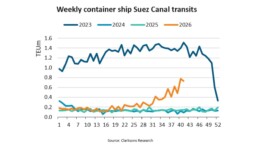
Suez Canal container ship transits exceed 50% of pre-disruption levels "During the first two weeks of October, weekly container ship capacity…
Subscribe to our newsletter!
if you dont want to swim alone in the ocean of news, sign up for the newsletter, and you will receive daily all the important news of world shipping!
