Japan, U.S. seek K-Shipbuilding collaboration
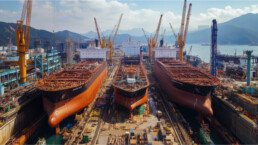

HD Hyundai Heavy Industries dispatched 97 employees to Kawasaki Heavy Industries in Japan in 1972 to learn shipbuilding technology while constructing the Ulsan Shipyard. At the time, South Korea, which had just begun building its shipyard, had to learn from Japan, which held over 50% of the global merchant ship market, starting from the basics like block manufacturing methods. However, the situation has reversed after about half a century. Recently, Japan’s shipbuilding industry officially requested collaboration for the first time, expressing interest in learning liquefied natural gas (LNG) carrier-related technologies from HD Hyundai Heavy Industries and Samsung Heavy Industries.
The U.S. is no different. The U.S. Department of Defense and Navy recently sent Requests for Information (RFIs) to the three major Korean shipbuilders—HD Hyundai Heavy Industries, Samsung Heavy Industries, and Hanwha Ocean—regarding the construction of warships and medium-sized refueling ships. RFIs are preliminary market surveys to assess companies’ technological capabilities, supply capacities, and willingness to participate before project launches. This is interpreted as accelerating the MASGA Project, which was launched in August last year.
Japan and the U.S. are simultaneously sending “love calls” to K-Shipbuilding, highlighting the robust capabilities of Korean shipyards. Only South Korea and China can design and build high-value-added merchant ships like LNG carriers and large container ships, as well as military vessels such as submarines and destroyers. With LNG carrier orders expected to rise in the second half of the year due to the Middle East conflict, and collaboration with Japan and the U.S. gaining momentum, the Korean shipbuilding industry is anticipated to experience another upswing.
According to the shipbuilding industry on the 8th, HD Hyundai Heavy Industries and Samsung Heavy Industries received a collaboration request from a Japanese government-affiliated institution seeking to learn the construction and operation technologies for LNG cargo containment systems, a core component of LNG carriers. While the source technology for LNG cargo containment systems belongs to a French company, Korea has developed its own construction and operational methods. Japan is reportedly lagging in LNG carrier competition due to a lack of these capabilities.
From January to May this year, 49 LNG carriers were ordered globally, with Korea securing 69% (34 ships). China also secured 15 ships, while Japan received none. However, an industry source stated, “While we plan to explore collaboration with Japan within a scope that does not undermine our competitiveness, discussions on cargo containment system technology, a national core technology, will require further deliberation.”
In the U.S., this is the first time the government has officially confirmed the warship construction capabilities of Korean shipyards through RFIs since the launch of the MASGA Project. HD Hyundai Heavy Industries and Hanwha Ocean submitted information on combat ship design, construction records, and production capabilities, while all three companies provided details on refueling ships. The U.S. aims to expand its fleet in response to China’s naval expansion but faces chronic delays due to labor shortages and declining technical capabilities, leading to SOS calls to Korea.
However, actual U.S. military ship orders to Korea would require easing laws restricting overseas construction. Therefore, collaboration is expected to focus on design and production technology cooperation with U.S. shipyards, as well as maintenance, repair, and overhaul (MRO) projects, in the near term.
Expanding collaboration with Japan and the U.S. is expected to further broaden the territory of K-Shipbuilding. The environment is favorable. According to Clarksons Research, from January to May this year, based on CGT (tonnage reflecting shipbuilding difficulty), China secured 72% of orders, while Korea secured 19%. Korea’s average CGT per ship (approximately 49,000 CGT) is 1.5 times that of China’s (27,400 CGT), indicating a focus on high-value-added vessels. The order backlog of the three major shipbuilders also reached 136.096 billion dollars (204.9 trillion Korean won), equivalent to three to four years of work. The average newbuilding price has also risen by 33% compared to June 2021, creating favorable conditions for profitability.
An industry source said, “Increased LNG demand following the Middle East conflict is expected to boost LNG carrier orders in the second half, which will be a positive factor for Korean shipyards.”
Source: The Chosun



Related News.
Hong Kong Global Maritime Trade Summit to return for third edition
The International Chamber of Shipping, in collaboration with the Transport and Logistics Bureau of the Government of Hong Kong and the Hong Kong…

Appetite for US crude oil exports climbs despite high freight
South Korea tops US crude destinations at 568,600 b/d VLCC rates to Asia double, closing arbitrage window European refining margins…
Shipping stocks Rally as Hormuz Traffic plunges 75%
Ship traffic through the Strait of Hormuz — a critical chokepoint handling about 20% of global crude oil and liquefied natural gas shipments — has…
Diana Shipping announces Time Charter Contract for m/v G P Zafirakis with Classic Maritime
Diana Shipping, a global shipping company specializing in the ownership and bareboat charter-in of dry bulk vessels, announced that, through a…
New IMO ESP Code framework for Remote Inspection Techniques
The International Maritime Organisation, through Resolution MSC.584(111) , has adopted amendments to the International Code on the Enhanced…

ABS opens Offshore & Marine Support Center in Bergen
ABS has expanded its capabilities in the Norwegian maritime market with the opening of a cutting-edge support center in Bergen, bringing advanced…
MOL holds giant step memorial ceremony and beach cleanup at Kashima Coast
Memorial and Reflection 20 Years After the Accident: Learning from the Past to Foster an Even Stronger Safety Culture Mitsui O.S.K. Lines, announced…
KEZAD-based Arabian Gulf Steel Industries achieves lowest verified Carbon Footprint for Rebar
CARES UK verified Environmental Product Declaration confirms 139 kg CO₂e per tonne for rebar produced at AGSI’s KEZAD Abu Dhabi facility Arabian…
Indian Register of Shipping announces launch of first fleet support ship INS Surya
Indian Register of Shipping continues to strengthen its role in supporting the Indian Navy and India’s naval shipbuilding capabilities through the…
VLCCs Climbing the Record Charts
LR2 The TC1 75kt MEG/Japan index decreased by only a single point this week to WS928. The corresponding Baltic round-trip TCE fell by $2,000 to…
Subscribe to our newsletter!
if you dont want to swim alone in the ocean of news, sign up for the newsletter, and you will receive daily all the important news of world shipping!
