Human factors must remain central as maritime operations become more complex, The Nautical Institute conference hears
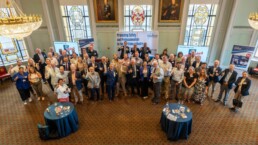

Human factors must be treated as a central part of maritime safety as the industry responds to increasing operational complexity, digitalisation and technological change, speakers told a major conference hosted by CHIRP Maritime and The Nautical Institute.
The Human Factors Conference, held at Trinity House, London, brought together maritime professionals, regulators, training experts, technology specialists and safety leaders to examine how people, systems and organisations interact in real operating conditions.

Left to right: Ivana Maria Carrioni-Burnett, Marine Pilot, Port of London Authority; Dave Watkins, Deputy Director, CHIRP Maritime; Claudene Sharp-Patel, Global Technical Director, Lloyd’s
Register; Fena Boyle, Head of Marine Safety & Assurance, Transport for London; Rogerio Alves, CEng, SFHEA, Principal Lecturer, University
of Hertfordshire, LMA Representative
Hosted by CHIRP Maritime and The Nautical Institute, in collaboration with the International Maritime Human Factors Symposium, the conference focused on three key themes: navigational resilience, safety culture and the integration of non-technical skills into voyage planning.
Opening the conference, Captain John Lloyd FNI, Chief Executive of The Nautical Institute, highlighted the importance of ensuring that change in shipping continues to support the people responsible for safe operations at sea. As the industry responds to digitalisation, decarbonisation, new technologies and evolving regulation, the role of maritime professionals remains critical.
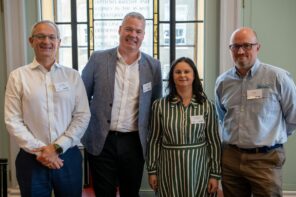
Left to right:Adam Parnell, Director Maritime, CHIRP Maritime; Captain Dave Cudbertson, Programmes Director, OCIMF; Stephanie McLay, Human Factors Advisor Lead, Lloyd’s
Register; Will Tutton, Inspector, MAIB
Speakers emphasised that technology can provide more information, but people determine how that information is interpreted, challenged and acted upon. Discussions throughout the day explored how bridge teams, engineers, shore-based staff and maritime leaders can build resilience when conditions change, systems do not behave as expected or operational pressure increases.
The navigational resilience session examined why people remain central to safe navigation as bridge teams work with greater levels of automation, electronic navigation systems and digital information. Speakers discussed the importance of critical thinking, effective communication, cross-checking and the ability to maintain situational awareness when systems are disrupted or information becomes difficult to interpret.
The safety culture session focused on the difference between safety management on paper and safety as experienced in day-to-day operations. Speakers explored the importance of leadership, psychological safety, speaking up, learning from incidents and understanding the organisational factors that shape behaviour onboard and ashore.
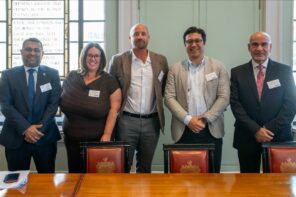
VOYAGE PLANNING session speakers
Left to right: Captain Aly Elsayed AFNI, Senior Technical Advisor,
The Nautical Institute; Jennifer Stanner MNI, Digital Academy Manager, Wärtsilä; Alexander Wiik, Advisor, SGM Technology; Professor Emek Kurt, Reader, University of Strathclyde; Captain Nadeem Anwar, Lead Author of Bridge Resource
Management Vol. 2: Voyage Planning
The afternoon session considered the role of non-technical skills in voyage planning, including communication, leadership, workload management, decision-making and human-machine interaction. Contributors discussed how digital navigation, emerging technologies and increasing volumes of data are changing the way bridge teams plan and monitor voyages.
Captain Nadeem Anwar FNI, lead author of The Nautical Institute’s Bridge Resource Management Volume 2: Voyage Planning, told delegates that maritime education must continue to evolve so that seafarers are prepared not only to use technology, but to think, communicate and work together effectively under pressure.
The conference also provided the setting for the launch of Bridge Resource Management Volume 2: Voyage Planning, the second and final volume in The Nautical Institute’s Bridge Resource Management series. The publication focuses on voyage planning as a live bridge-team discipline, bringing together technical knowledge, practical planning processes and the human factors that support safer decision-making.
The discussions reinforced a clear message: safe shipping depends not only on rules, systems and procedures, but on competent people working within organisations that support good judgement, communication and learning.
The Nautical Institute said the conference underlined the need for the industry to continue investing in professional development, human-centred design, safety culture and practical guidance that reflects the realities of maritime operations.



Related News.
Navigating the Multi-Orbit Era: In Conversation with Intellian’s Jon Harrison at SMM 2026
At SMM 2026 in Hamburg, the rapid evolution of maritime satellite communications took centre stage. Across the exhibition halls, discussions among…
Cyprus ports need joint energy and investment strategy, shipping agents chief says
Cyprus needs a coordinated strategy for shipping, energy and environmental protection to support port investment and modernisation, Cyprus shipping…

MASO Public Affairs introduces MASO Regulatory Intelligence
A new subscription service helping businesses understand what is changing and what it means for them MASO Public Affairs introduces MASO Regulatory…
Anglo-Eastern helps turn CMBTECH’s ammonia ambition into an operational reality
From early feasibility study and risk-based design to newbuilding supervision, crew readiness and technical management, Anglo-Eastern drew on its…

Escalation of attacks threatens to derail recovery in Middle East oil exports
World oil demand is forecast to fall by 2.5 mb/d y-o-y in 4Q26 and 2.6 mb/d on average in 2026. As the Iran war manifests itself through restricted…
New study finds shipping pays twice its share to EU ETS earmarked revenues should triple to help build market for sustainable fuels and technologies
Shipping is responsible for around 10% of EU ETS emissions but pays almost 20% of the ETS bill. Unlike other sectors, it has never received free…
MSARC strengthens maritime mass rescue readiness through training and national live exercise off Dakar, Senegal
Joint MSARC–FHAS programme combines three days of SAR training with a national multi-agency live exercise The Maritime Search and Rescue Council ,…
Sogese report deliveries are still being delayed as container freight rates fluctuate
FOR IMPORTERS Spot rates into the Mediterranean are back at January levels, Far East to Europe reliability sits at pandemic lows, and nearly…

Glencore begins trading on Australian Securities Exchange
Glencore has begun trading on the Australian Securities Exchange under the ASX code GLC. Gary Nagle, Glencore’s CEO, said it was an exciting day for…
BIMCO Shipping Number of the Week
Suez Canal container ship transits exceed 50% of pre-disruption levels "During the first two weeks of October, weekly container ship capacity…
Subscribe to our newsletter!
if you dont want to swim alone in the ocean of news, sign up for the newsletter, and you will receive daily all the important news of world shipping!
