Behind the data: What seafarers really need right now
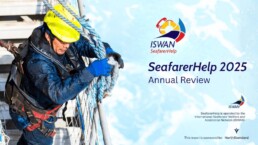

The new SeafarerHelp 2025 Annual Review offers a unique insight into the realities of life at sea through thousands of confidential helpline conversations.
The International Seafarers’ Welfare and Assistance Network (ISWAN) has published its annual report from its 24-hour, multilingual helpline SeafarerHelp, revealing the challenges seafarers and their families are facing as life and work at sea becomes increasingly complex. Drawing on data and insights from thousands of confidential helpline conversations, the report highlights emerging welfare concerns and the action needed across the maritime sector to support seafarers’ wellbeing, safety and dignity.
Because SeafarerHelp is confidential, seafarers are able to speak openly about the challenges they face, offering a valuable insight into the realities of life at sea. The review combines quantitative data with the recurring themes and experiences described by seafarers when they reach out for support to build a clearer picture of the issues affecting the global seafaring workforce.
While these insights represent only one perspective on seafarers’ experiences, they provide an important snapshot of the challenges being shared through a trusted, independent welfare service. Shipping companies and other maritime organisations will have their own workforce intelligence, but SeafarerHelp often hears about issues that seafarers may feel unable or unwilling to raise with their employers or crewmates.
What emerges from the conversations
The report shows that while fewer seafarers contacted SeafarerHelp for straightforward enquiries in 2025, those who did reach out increasingly needed support with complex, interconnected challenges affecting their wellbeing, relationships, finances and safety. New contacts (i.e. calls and messages) decreased, but follow-up contacts increased as more people required ongoing support rather than a single conversation.
Although SeafarerHelp primarily hears from seafarers and family members facing difficulties rather than those having positive experiences, several themes emerged consistently across helpline interactions in 2025. Seafarers described the cumulative emotional impact of long periods away from home, demanding workloads, concerns about family life ashore and uncertainty created by wider industry and geopolitical developments. Many challenges rarely occurred in isolation – mental health concerns were often closely linked to employment issues, onboard culture, financial pressures or experiences of abuse.
The findings also suggest that improving onboard connectivity is changing why people seek help. Many seafarers now use online sources to find practical information themselves, but continue to turn to SeafarerHelp when situations require empathy, professional judgement, specialist knowledge or emotional support. Helpline officers increasingly report that callers want reassurance they are speaking to a real person who understands the realities of maritime life.
Mental health concerns reach record levels for the helpline
One of the clearest findings from the review is the significant rise in mental health-related cases. The number of contacts relating to mental health concerns increased by 35.9% compared with the previous year, reaching the highest level recorded by SeafarerHelp and exceeding levels seen at the height of the COVID-19 pandemic.
Helpline conversations reveal the sustained emotional toll that life at sea can have. Seafarers spoke about stress, worry, isolation and the pressure of balancing responsibilities on board with concerns about family life at home. SeafarerHelp also supported a growing number of people experiencing acute distress, including suicidal thoughts.
In response, ISWAN expanded its mental health support during 2025, including the introduction of a Specialised Support Team providing ongoing mental health support, alongside initiatives such as SEAS (Seafarers’ Education and Awareness Sessions) and the BAYANIHAN mental health initiative in the Philippines.
Safer cultures at sea remain a priority
The report also highlights the continuing impact of abuse, bullying, harassment, discrimination and violence at sea. Women were disproportionately affected, being more than four times as likely as men to raise these concerns with SeafarerHelp.
Conversations with seafarers suggest that experiences of abuse are often compounded by wider workplace pressures, including long hours, limited rest and unsupportive onboard cultures. Many seafarers described concerns about reporting incidents and the potential consequences of speaking up.
To address these challenges, ISWAN continues to develop programmes including its Safe at sea…it takes all of us! campaign and the Social Interaction Matters Project, both designed to help create safer and more supportive working environments on board.
Financial pressure and abandonment add to growing uncertainty
The review also points to increasing financial strain among seafarers and their families. Helpline users described the challenges of managing irregular income, contract gaps, debt and financial responsibilities extending beyond their immediate households. These concerns frequently affected both wellbeing and family relationships.
At the same time, SeafarerHelp supported a growing number of seafarers affected by abandonment, with abandonment-related contacts increasing by 41.2% during 2025 and rising by 158.9% since 2022. Many affected seafarers reported being left without pay, support or a clear route home.
Turning insight into action
The review demonstrates how insights from SeafarerHelp directly shape ISWAN’s work to support seafarers and their families. By identifying emerging issues, listening to lived experiences and working collaboratively with maritime stakeholders, ISWAN develops practical initiatives designed to address the challenges highlighted through helpline conversations.
As the organisation begins its work with consultative status at the International Maritime Organization (IMO) in 2026, ISWAN is committed to ensuring that the experiences shared through its helplines continue to inform discussions about the future of seafarer welfare.
Simon Grainge, Chief Executive of ISWAN, said: ‘The value of SeafarerHelp is not only in the support it provides, but in what it enables us to learn. Every day, seafarers and their families share experiences with us that offer a unique window into life at sea.
‘The themes highlighted in this review reflect the challenges that people are bringing to our helpline at a time of significant change for the maritime sector. Whether it is mental health, workplace culture, financial pressures or abandonment, these issues can have profound consequences for seafarers’ wellbeing and for their families.
‘Our responsibility is to listen, identify emerging themes and work with maritime stakeholders to turn those insights into practical action that improves the lives of seafarers and their families.’
The SeafarerHelp 2025 Annual Review is sponsored by NorthStandard.



Related News.
Hong Kong Global Maritime Trade Summit to return for third edition
The International Chamber of Shipping, in collaboration with the Transport and Logistics Bureau of the Government of Hong Kong and the Hong Kong…

Appetite for US crude oil exports climbs despite high freight
South Korea tops US crude destinations at 568,600 b/d VLCC rates to Asia double, closing arbitrage window European refining margins…
Shipping stocks Rally as Hormuz Traffic plunges 75%
Ship traffic through the Strait of Hormuz — a critical chokepoint handling about 20% of global crude oil and liquefied natural gas shipments — has…
Diana Shipping announces Time Charter Contract for m/v G P Zafirakis with Classic Maritime
Diana Shipping, a global shipping company specializing in the ownership and bareboat charter-in of dry bulk vessels, announced that, through a…
New IMO ESP Code framework for Remote Inspection Techniques
The International Maritime Organisation, through Resolution MSC.584(111) , has adopted amendments to the International Code on the Enhanced…

ABS opens Offshore & Marine Support Center in Bergen
ABS has expanded its capabilities in the Norwegian maritime market with the opening of a cutting-edge support center in Bergen, bringing advanced…
MOL holds giant step memorial ceremony and beach cleanup at Kashima Coast
Memorial and Reflection 20 Years After the Accident: Learning from the Past to Foster an Even Stronger Safety Culture Mitsui O.S.K. Lines, announced…

KEZAD-based Arabian Gulf Steel Industries achieves lowest verified Carbon Footprint for Rebar
CARES UK verified Environmental Product Declaration confirms 139 kg CO₂e per tonne for rebar produced at AGSI’s KEZAD Abu Dhabi facility Arabian…
Indian Register of Shipping announces launch of first fleet support ship INS Surya
Indian Register of Shipping continues to strengthen its role in supporting the Indian Navy and India’s naval shipbuilding capabilities through the…
VLCCs Climbing the Record Charts
LR2 The TC1 75kt MEG/Japan index decreased by only a single point this week to WS928. The corresponding Baltic round-trip TCE fell by $2,000 to…
Subscribe to our newsletter!
if you dont want to swim alone in the ocean of news, sign up for the newsletter, and you will receive daily all the important news of world shipping!
