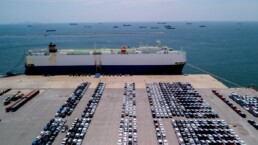

Hyundai Glovis, the logistics affiliate of Hyundai Motor Group, began operating the Glovis Lander, the world’s largest pure car and truck carrier (PCTC) capable of loading more than 10,000 small cars, at the end of last month. It is the third 10,800 CEU (car equivalent unit) class PCTC deployed, following the Glovis Leader delivered at the end of Apr. and the Glovis Lighthouse, which began sailing in early Jun.
At present, the only 10,800 CEU-class car carriers in the world capable of transporting more than 10,000 cars are the three operated by Hyundai Glovis. All three ships were split-built by two shipyards under China State Shipbuilding Corporation (CSSC), the state-owned Chinese conglomerate (Guangzhou GSI and Shanghai SWS). A Korean shipping company from a shipbuilding powerhouse is using all three of the world’s largest car carriers made in China.
China’s solo lead in the car carrier market continues. As Korean shipbuilders focus on more profitable liquefied natural gas (LNG) carriers and have not actively pursued orders, and with Chinese shipyards waging aggressive price competition, they are ceding most of the market. Shipbuilding industry experts said that even if a market is less profitable, giving up the entire market should be avoided.
According to China’s Xinde Marine News and Clarksons Research of the U.K. on the 6th, it is estimated that around 20 car carriers were ordered from January through Jun. This year. Except for two vessels ordered by HD Hyundai Heavy Industries in Apr., all volumes reportedly went to Chinese shipyards.
Norway’s UECC in Mar. ordered two 3,000 CEU-class PCTCs from Nanjing Zhaoshangju Jinling Shipyard for short-sea routes within Europe. U.K.-based Zodiac Maritime in May ordered two 7,000 CEU-class LNG dual-fuel PCTCs from Yantai CIMC Raffles in China.
Zodiac Maritime, led by Israeli shipping magnate Eyal Ofer, currently has a PCTC fleet of 22 ships, more than half of which were built by Yantai CIMC Raffles. Salamm Lines, headquartered in Cyprus, last month ordered four 8,600 CEU-class PCTCs from Xiamen Shipbuilding Industry.
The car carrier market boomed with 60 to 90 ships ordered annually from 2022 to 2024. Even then, Chinese shipyards absorbed a large portion of the volume. According to a monthly report published in Feb. by AXSMarine, a French shipping and logistics data analytics company, of the 276 car carriers delivered or scheduled for delivery from 2023 to 2028, 219 (79.4%) were orders won by Chinese shipyards. Japan followed with 47 ships (17%). Korean shipyards have a minimal presence in the newbuild car carrier market.
As the large batch of orders began to be delivered in earnest, new orders for car carriers fell to about 30 ships last year. With roughly 20 ships ordered in the first half of this year and order growth slowing compared with the boom period, Chinese shipyards’ “cornering” of the market has deepened further.
With relatively ample order backlogs, domestic shipbuilders are filling limited construction slots with higher value-added and more profitable ship types such as LNG carriers and ultra-large container ships.
For example, the contract price per ship for the two LNG carriers ordered by HD Hyundai Heavy Industries in May was 371.9 billion won (about $250 million), about 87% more expensive than the per-ship contract price for the two PCTCs ordered in Apr. (199.2 billion won, about $134.46 million). LNG carriers are also known to have mid-teen profit margins, about double those of PCTCs, which are in the single digits.
Some also say China has seized the market by leveraging cost competitiveness because car carrier construction technology has been standardized. Compared with the prices for the same class of PCTCs ordered from Korean shipyards, Chinese shipyards’ order prices are said to be about 15% to 20% cheaper. Chinese shipyards have lowered unit costs by mass-building car carriers, where technical entry barriers are relatively low, and internalizing components.
Yang Jong-seo, a senior researcher at The Export-Import Bank of Korea’s Overseas Economic Research Institute, said, “Car carriers have simple structures, so the competition is about who can build them cheaper, and when price competition heats up, in a high-cost structure like Korea’s, competitiveness inevitably weakens.”
Experts also cite the rise in China-origin auto export volumes, led by electric vehicles, as a reason for Chinese shipyards’ dominance. Eom Kyung-a, an analyst at Shinyoung Securities, said, “The car carrier market is a specialized and limited transport market that trades a single item—cars—so it is difficult for countries without manufacturers exporting in large quantities to run this business,” adding, “Right now, the area where car cargo volumes are increasing significantly is China’s electric vehicles, so we can see that carrier construction is also taking place in China.”
Experts say domestic shipbuilders should not abandon this market entirely, even if car carriers do not generate significant revenue. Lee Eun-chang, a research fellow at the Korea Institute for Industrial Economics & Trade (KIET), said, “Car carriers are an important ship type in contingencies, so the current situation of excessive reliance on overseas sources is concerning,” adding, “If possible, Korea’s car carriers should be built at Korea’s shipyards, and policies are needed to subsidize the difference between overseas and domestic construction.”
The domestic shipbuilding industry has not completely given up on this market. It is seeking ways to raise future market share, including developing high-spec car carrier technologies. HD Hyundai Heavy Industries is developing an SMR-powered car carrier. Last month, HD Hyundai Heavy Industries received an approval in principle (AIP) from Lloyd’s Register (LR) for a concept design of a large car carrier applying molten salt reactor (MSR) technology, a type of SMR.
An HD Hyundai Heavy Industries official said, “An SMR-powered ship emits no carbon during operation, making it the ultimate eco-friendly vessel suited for the era of carbon neutrality.”
Source: ChosunBiz



Related News.

Hong Kong Global Maritime Trade Summit to return for third edition
The International Chamber of Shipping, in collaboration with the Transport and Logistics Bureau of the Government of Hong Kong and the Hong Kong…

Appetite for US crude oil exports climbs despite high freight
South Korea tops US crude destinations at 568,600 b/d VLCC rates to Asia double, closing arbitrage window European refining margins…

Shipping stocks Rally as Hormuz Traffic plunges 75%
Ship traffic through the Strait of Hormuz — a critical chokepoint handling about 20% of global crude oil and liquefied natural gas shipments — has…
Diana Shipping announces Time Charter Contract for m/v G P Zafirakis with Classic Maritime
Diana Shipping, a global shipping company specializing in the ownership and bareboat charter-in of dry bulk vessels, announced that, through a…
New IMO ESP Code framework for Remote Inspection Techniques
The International Maritime Organisation, through Resolution MSC.584(111) , has adopted amendments to the International Code on the Enhanced…

ABS opens Offshore & Marine Support Center in Bergen
ABS has expanded its capabilities in the Norwegian maritime market with the opening of a cutting-edge support center in Bergen, bringing advanced…

MOL holds giant step memorial ceremony and beach cleanup at Kashima Coast
Memorial and Reflection 20 Years After the Accident: Learning from the Past to Foster an Even Stronger Safety Culture Mitsui O.S.K. Lines, announced…

KEZAD-based Arabian Gulf Steel Industries achieves lowest verified Carbon Footprint for Rebar
CARES UK verified Environmental Product Declaration confirms 139 kg CO₂e per tonne for rebar produced at AGSI’s KEZAD Abu Dhabi facility Arabian…
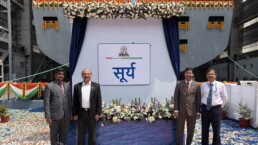
Indian Register of Shipping announces launch of first fleet support ship INS Surya
Indian Register of Shipping continues to strengthen its role in supporting the Indian Navy and India’s naval shipbuilding capabilities through the…

VLCCs Climbing the Record Charts
LR2 The TC1 75kt MEG/Japan index decreased by only a single point this week to WS928. The corresponding Baltic round-trip TCE fell by $2,000 to…
Subscribe to our newsletter!
if you dont want to swim alone in the ocean of news, sign up for the newsletter, and you will receive daily all the important news of world shipping!
