
Unlocking the full value of speed reduction through port call optimisation
Speed reduction is one of the maritime industry’s most effective tools for cutting shipping emissions. Even so, the sector might be underestimating its potential.
When individual vessels reduce their speeds without changes to port scheduling, total voyage time increases and additional ships are needed to maintain transport capacity, weakening the business case. But when taking a full value chain perspective that combines speed reduction with port call optimisation, the picture changes significantly. Reducing unnecessary waiting time at ports allows vessels to complete the same number of voyages at lower speeds, without fleet expansion, delivering greater emissions and savings at lower cost.
This insight brief draws on the World Bank’s marginal abatement cost curve analysis to illustrate this potential and demonstrate that port call optimisation is a practical, near-term measure that policymakers and industry should actively pursue. A future insight brief will build on this by exploring how real-world examples of speed reduction and port call optimisation are being put into practice.
Energy efficiency is one of the most powerful levers for shipping’s net-zero transition, yet it remains underprioritised in policy and industry strategies and discussions. Improving a ship’s efficiency can be achieved through both technical measures, such as wind-assisted propulsion and waste heat recovery, and operational measures such as speed reduction and port call optimisation. The focus of this brief is on the latter: operational measures that can be implemented today, without high upfront capital costs or retrofitting a new technology, which stand out as among the most immediate and cost-effective pathways to decarbonisation of the existing fleet.
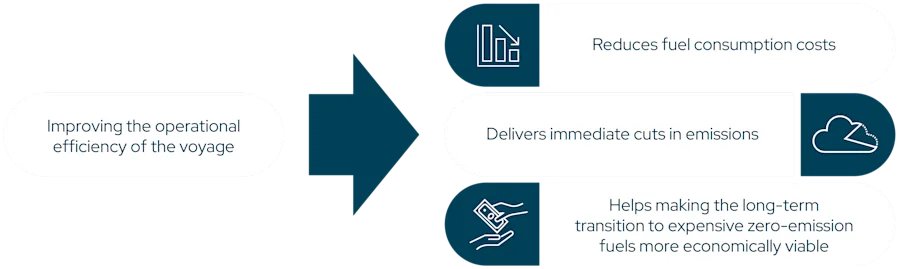
Improving the operational efficiency of voyages offers a clear triple win: while reducing fuel use and operating expenditures, it reduces greenhouse gas emissions, and local air pollutants, today and paves the way for the uptake of more expensive zero-emission fuels in the long run.
Despite the benefits, implementing operational efficiency measures in the maritime sector can be challenging, and uptake remains relatively low. The measures can get lost in the industry’s conversation on decarbonisation, where headlines often focus on the challenge of replacing fossil fuels with greener alternatives.
A report published by the World Bank in October 2025 and presented at the Global Maritime Forum Annual Summit in Antwerp helps rebalance this perspective. It highlights the critical role that energy efficiency improvements can play in reducing ships’ energy consumption and greenhouse gas emissions, while also lowering fuel costs. The analysis examines 30 energy efficiency measures, grouped into 14 categories, and applies marginal abatement cost curves (MACCs) to assess their potential contributions to both emissions reduction and cost savings.
MACCs provide policymakers and industry decision-makers with a useful tool for comparing the relative cost-effectiveness and emissions-reduction potential of different decarbonisation strategies. They have also formed part of the International Maritime Organization’s (IMO) greenhouse gas (GHG) reduction studies and are due to be part of the next study commissioned by the IMO.
MACCs are not without limitations, however. Their outputs depend heavily on underlying assumptions about fuel prices, technology performance, uptake rates, operational behaviour, and policy conditions, meaning results can vary significantly across scenarios. Nevertheless, MACCs remain a valuable analytical framework for informing strategic decision-making, particularly when interpreted alongside broader operational, economic, and policy considerations.
Speed reduction has high impact, but uneven economics across segments
Among the measures assessed by the World Bank, speed reduction stands out as the single largest contributor to emissions abatement potential by 2030. Reducing vessel speed directly lowers fuel consumption, delivering immediate emissions and cost savings.
However, the cost-effectiveness of speed reduction varies across vessel segments.
Cost-effectiveness and abatement potential of individual measures for the total fleet in 2030 under fossil fuel prices

Cost-effectiveness and abatement potential of individual measures for the tanker fleet in 2030 under fossil fuel prices

Cost-effectiveness and abatement potential of individual measures for the bulker fleet in 2030 under fossil fuel prices

Cost-effectiveness and abatement potential of individual measures for the container fleet in 2030 under fossil fuel prices

Figure 1: Marginal abatement cost curves from The World Bank’s ‘Keys to Energy-Efficient Shipping’ report (Figures 2.5-2.8)
These MACCs are to be read from left to right, with the lowest-cost, highest impact measures appearing on the left. The width of each bar represents the annual GHG reduction potential, while its height represents the average cost per tonne of GHG emissions avoided.
The analysis finds that speed reductions for bulk carriers and container ships are generally cost-effective. This is particularly the case for container ships, which have a higher average sailing speed than other segments. For tankers, however, the business case is weaker, as a larger share of energy consumption comes from auxiliary engines, reducing the relative benefit of slower sailing.
Importantly, this picture changes when future fuel scenarios are considered. When the MACC is adjusted to reflect the higher cost of zero-emission fuels, such as ammonia, speed reduction becomes cost-effective across the entire fleet.
Cost-effectiveness and abatement potential of individual measures for the total fleet in 2050 under ammonia prices
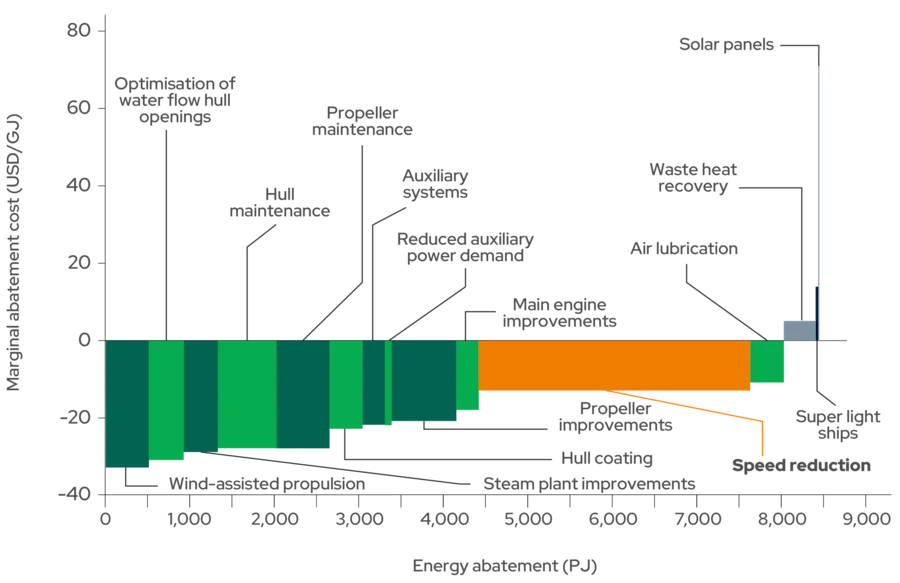
Figure 2: Marginal abatement cost curves from The World Bank’s ‘Keys to Energy-Efficient Shipping’ report (Figure 2.9)
In this context, speed reduction is not only a near-term emissions lever but also a strategic enabler, reducing overall energy demand and making the transition to alternative fuels more economically viable.
Current modelling underestimates the benefits of speed reduction
The World Bank analysis includes different speed-reduction levels, with 10% reductions in its moderate scenario and 30% reductions in its maximum energy efficiency scenario.1 While the upper bound of 30% might be optimistic for many vessels, the analysis is conservative in other important aspects. As acknowledged by the World Bank, the full potential of speed reduction is likely understated because the analysis assumes port time is fixed. This simplification reflects both data limitations from a lack of literature and the study’s defined scope, which focuses on the quantification of ship-level energy efficiency measures rather than system-wide operational changes like port call optimisation.
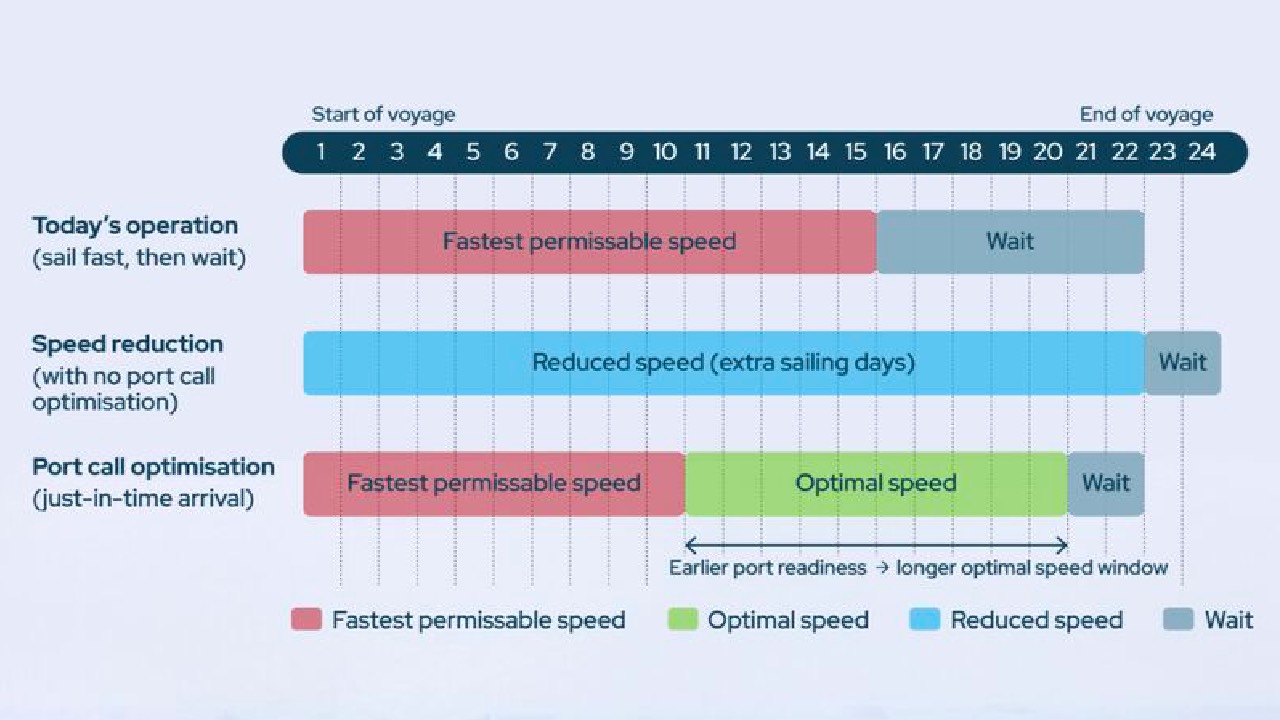
Under this assumption, slower sailing increases total voyage time. To maintain transport output, the model therefore requires additional vessels. For example, as the World Bank illustrates, a vessel that spends 25% of its time in port would spend an additional ~30 days at sea under a 10% speed reduction scenario. Maintaining the same transport output would therefore require an estimated ~8% increase in fleet size. In practical terms, this equates to roughly one additional vessel for every 12 ships in the fleet, increasing both costs for the newbuild ships and reducing the fuel consumption reduction benefits.

Figure 3: An illustration of the increase in new ships required to deliver speed reduction without port call optimisation
This reflects a simplified view of real-world operations. In reality, a significant share of port time is not productive. Ships frequently spend hours or days waiting at anchorage before being called to berth, due to misaligned schedules and limited coordination between ports and vessels. A recent study showed that ships can spend 4-6% of their yearly operations, equivalent to 15-22 days, waiting outside ports, leading to unnecessary fuel consumption and emissions.
The role of port call optimisation
Port call optimisation,2 particularly through just-in-time (JIT) arrivals3, offers a way to recover this lost time and fundamentally change the economics of speed reduction. With effective port call optimisation, the net emissions savings from speed reduction increase and the business cases improve.
With improved scheduling, information sharing, and contractual changes, vessels can adjust their speed to arrive precisely when a berth becomes available, rather than rushing to port only to wait offshore. As illustrated in the diagram below, this reduces idle time4 and total voyage duration.
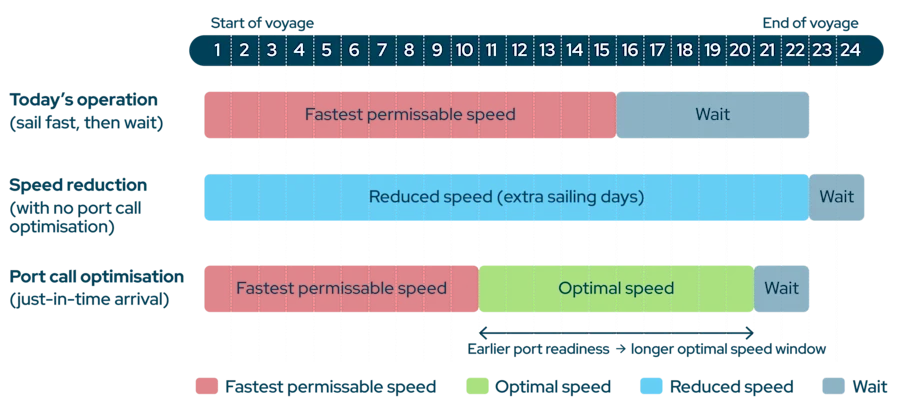
Integrating JIT arrivals into the operational model has several important implications:
- Maintained productivity: Reduced waiting time can offset the additional sailing time from lower speeds, allowing vessels to complete the same number of voyages per year.
- Avoided fleet growth: By maintaining throughput, the need for additional vessels, assumed in the original analysis, can be reduced or eliminated.
- Greater greenhouse gas emissions reductions: Lower speeds, combined with reduced idling, lead to greater overall fuel savings and emissions cuts.
- Reduction in local pollutants in ports: Ships waiting at anchorage emit pollutants, including nitrogen oxides and sulphur dioxide, into the local area. Reducing time spent at anchorage reduces these.
- Reduced hull fouling: Vessels waiting stationary at port are more vulnerable to accumulating marine organisms on the hull, which increases drag and reduces vessel efficiency. Reduced time waiting at port helps minimise this issue.
- Stronger business case: Improved asset utilisation and fuel savings further enhance the economic attractiveness of speed reduction.
These benefits build on those delivered from speed reduction, such as minimising underwater noise that disturbs the marine environment and reducing the vulnerability to fuel price increases and shortages, such as those currently caused by the closure of the Strait of Hormuz.5
The graph below illustrates the potential emission abatement from speed reduction, both with and without increasing the size of the fleet to cover the slower speeds. Whilst the additional costs of port call optimisation need to be factored into the equation, it demonstrates the potential scale of opportunity that the combination of speed reduction and port call optimisation could deliver, at a relatively low cost compared to other carbon abatement measures.
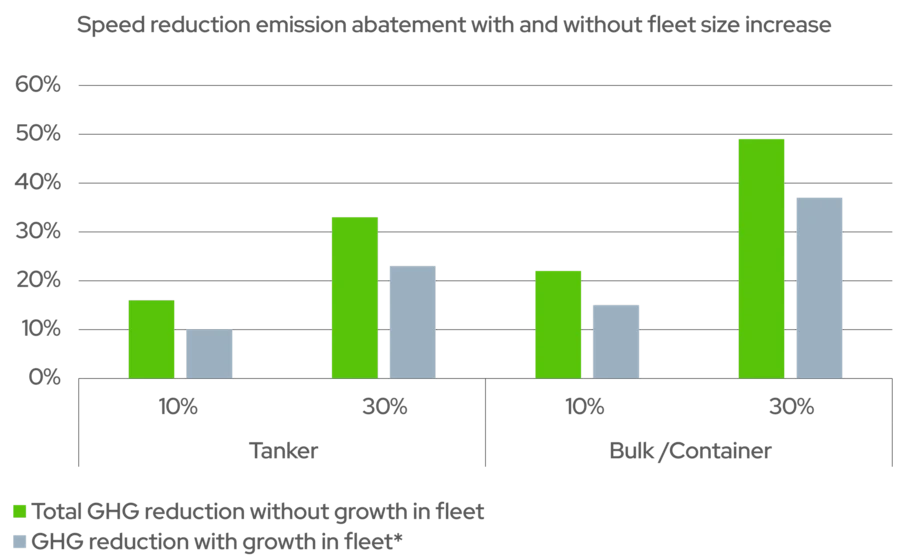
Figure 4: Comparison of GHG reduction emissions with and without an increase in fleet size. Source: The World Bank (2025) Keys to Energy-Efficient Shipping. Table B.1.
*The growth in fleet is based on an assumption of a ship spending 25% of its time in port.
In effect, port call optimisation unlocks a larger share of the theoretical benefits identified in the World Bank analysis.
There are, of course, implementation costs associated with port call optimisation, including coordination between stakeholders, pilot integration, and investment in data-sharing and digital systems. However, these costs are expected to be relatively modest compared to other decarbonisation measures or the additional cost of adding more ships to the fleet.
A further caveat is that the study does not explicitly model the trade and port factors affecting different segments. There will be a significant variation across vessels, so the emissions reductions presented should be viewed as indicative rather than universally achievable across all vessels and operating conditions.
What does this mean for the maritime sector?
This analysis reinforces the idea that operational efficiency measures should be viewed as a core component of shipping’s decarbonisation pathway, rather than a secondary measure alongside the fuel transition. It also highlights the importance of taking a full value chain approach to decarbonisation options. Actions taken by individual actors in isolation, such as vessels sailing slower, are unlikely on their own to unlock the scale of emissions reductions required to meet net-zero ambitions. However, when operational decisions are coordinated across the value chain, the impact can be significantly greater.
For example, a vessel reducing speed based on accurate data on berth availability and optimised arrival times can reduce fuel consumption and emissions without compromising overall transport efficiency. In this way, port call optimisation helps unlock a larger share of the benefits associated with speed reduction by reducing avoidable waiting time and improving the utilisation of existing assets and infrastructure.
Whilst the future shape of the IMO’s Net-Zero Framework remains uncertain, the analysis suggests the sector should not remain in a holding pattern while regulatory and fuel-transition pathways develop. Many operational efficiency measures can generate fuel and emissions savings at relatively low cost, using existing technologies and improved coordination between ports, terminals and vessels. There are challenges to overcome, including contractual barriers, split incentives that deter action, and changes requiring coordination among multiple actors, but these should not be insurmountable. Overcoming these challenges and delivering operational efficiency represents an important opportunity for the sector to deliver near-term emissions reductions while supporting the longer-term transition to zero-emission fuels.
Encouragingly, elements of this approach are already being implemented across parts of the industry. Several companies and ports have made promising progress with forms of port call optimisation, demonstrating both the feasibility of these measures and the practical challenges involved in scaling them. A future insight brief will explore some of these examples and the lessons learned.
Source: Global Maritime Forum by Alice Cheetham Project Manager https://globalmaritimeforum.org/insight/going-slower-to-reach-net-zero-faster/



Related News.

Cyprus Marine Club Welcomes a Full House for Aphentrica’s War Risks Presentation
The Cyprus Marine Club marked its return after the summer break with a full house at Gazebo Mare on Tuesday, 22 September, bringing together members,…

IMO seeks feedback on Maritime Single Window implementation
The International Maritime Organization (IMO) has launched a global survey to assess the implementation and use of Maritime Single Windows (MSWs),…

World Maritime Day industry panel to examine the gap between maritime policy and the reality of life at sea
OneCare Group will bring together crewing, safety, insurance and wellbeing specialists for a World Maritime Day webinar examining how shipping can…

IUMI President – Marine insurers are war insurers
Marine insurers are at the heart of managing war risks to global shipping and must continue to develop the tools needed to support and facilitate…

Seafarer welfare is improving amongst leading companies, but five years of evidence shows this progress is far from the norm
Five years on, the Seafarers’ Rights Code of Conduct is driving more than 1,000 companies to participate in RightShip’s Crew Welfare…
The UK ETS arrives for shipping what it means for charterers
Introduction The UK Emissions Trading Scheme (UK ETS) was extended to domestic maritime activity on 1 July 2026, following the EU ETS, FuelEU…
ABP Southampton invests locally with Marine Cranes to boost capability
Associated British Ports , the UK’s largest port operator, has invested a new marine deck crane aboard Spartina, one of the Port of Southampton’s…
BIMCO Shipping Number of the Week
Caribbean Basin crude oil and heavy product exports jump 45% “Seaborne exports of crude oil and heavy products from the Caribbean Basin have…

xclusiv S&P Report 21th September 2026
Pls find below the [xclusiv] S&P Report 21th September 2026 [xclusiv] 2026_09_21
Marine insurance supply remains stable as geopolitical and technical changes reshape the market, says IUMI President
The global marine insurance market remains in a stable position, with premium growth strongly supported by a weak USD in hull and cargo. Meanwhile…
Subscribe to our newsletter!
if you dont want to swim alone in the ocean of news, sign up for the newsletter, and you will receive daily all the important news of world shipping!
