China’s H1 Crude imports post sharpest drop since war began

EXECUTIVE SNAPSHOT
• China’s crude imports fell ~23% year-on-year in H1 2026, with May marking the low point at nearly 48% below prior-year levels; July data points to stabilization rather than recovery, still tracking ~41% below 2025.
• Freight markets spiked then corrected in tandem with the Strait of Hormuz disruption, with the BDTI easing to 1,850 (‑49% year-to-date), and AG–China VLCC earnings (TD3C-TCE) retreating ~29% month-on-month to ~$286,500/day, though both remain well above pre-crisis norms.
• US–Iran negotiations are easing the disruption but remain unresolved, with the June 17 Islamabad Memorandum and continued Doha talks driving a partial recovery in Hormuz transit.
• The incomplete normalization explains why freight rates have fallen from wartime peaks yet stay elevated, and why Chinese import volumes have yet to rebound.
Spotlight of the Week | Chinese Crude Oil Flows
China Crude Oil Imports Fall 23% in First Half of 202
May marks the low point of the period as vessel-tracking data shows a sharp Q2 decline, followed by signs of stabilization in July
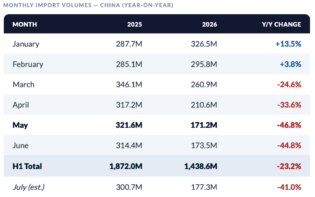
Chinese seaborne crude oil imports fell approximately 23% year-on-year in the first half of 2026, according to Signal Ocean vessel-tracking data, declining from roughly 1.87 billion barrels in H1 2025 to an estimated 1.44 billion barrels in H1 2026.
Imports opened the year above 2025 levels in January and February before turning sharply lower from March onward. May 2026 marked the low point of the period, with tracked imports down approximately 47% year-on-year, the steepest single-month decline observed in the dataset this year. June volumes remained at similarly depressed levels.
Preliminary tracking for July 2026, combined with a modeled month-end estimate, indicates imports of approximately 177 million barrels, a modest increase of around 2% versus June, but still roughly 41% below the same month in 2025. The data suggests the sharp sequential declines seen from March through June have begun to stabilize, though volumes remain well below prior-year levels.
Freight Market Overview – Dirty
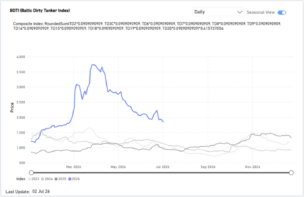
As of early July 2026, the Baltic Dirty Tanker Index had eased sharply to 1,850 points, down 49.2% year-to-date and roughly 50% from its peak, as tanker traffic through Hormuz began to normalize, though it remained approximately 92.5% above year-ago levels. Middle East Gulf-to-China rates (TD3C) had similarly retreated to 293.89 Worldscale points, down 27% monthly.
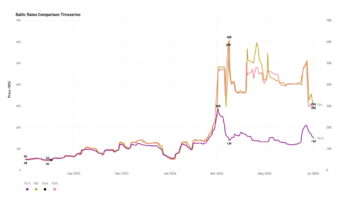
Time-Charter-Equivalent Earnings: The AG–China Route Correction
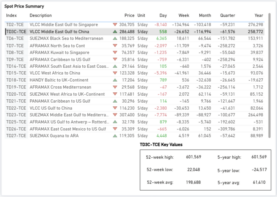
The correction was especially pronounced on time-charter-equivalent (TCE) earnings for the Middle East Gulf-to-China VLCC route (TD3C-TCE), the benchmark most directly tied to Chinese crude buying. As of July 2, 2026, daily earnings on the route stood at approximately $286,500 per day, still elevated at roughly 44% above the 52-week average, but down about $117,000 (‑29%) over the past month and more than 52% below the 52-week high of $601,569 recorded at the height of the crisis. On a year-on-year basis, earnings remained sharply higher (+$258,772), reflecting how depressed the pre-conflict starting point had been.
The retreat in freight earnings tracks the broader trajectory of US–Iran negotiations over the Strait of Hormuz. Following more than three months of conflict that severely disrupted a waterway through which around 20% of global oil trade normally passes, the United States and Iran reached an interim agreement in mid-June 2026 aimed at ending the conflict and reopening the strait, formalized through the Islamabad Memorandum signed on June 17, 2026. As transit conditions gradually improved, freight risk premiums eased, pulling TCE earnings back from their wartime extremes.
The latest round of indirect US–Iran talks in Doha on July 1 underscored that normalization remains incomplete. Mediators reported positive progress on issues linked to the memorandum, and both sides agreed to continue discussions. However, the technical negotiations concluded without resolving the main outstanding issues, with transit arrangements through the Strait of Hormuz remaining the principal point of disagreement. Shipping traffic has recovered only partially and remains well below pre-war levels, helping explain why TD3C earnings, despite retreating sharply from wartime highs, continue to trade well above pre-conflict norms.
Supply Market Trends
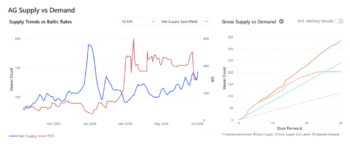
This week, the VLCC AG market takes centre stage, where signals of an oversupplied picture have started to reflect in the freight market sentiment.
VLCC | AG Supply Trends
• VLCC Insights from the Signal Ocean Platform indicate that the TD3C route has shifted into an oversupplied state starting in early July.
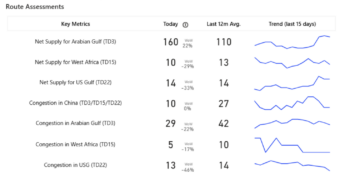
The latest indicators point to an upward trend in the net supply for the Arabian Gulf during the last 15 days, with the latest estimate at 160, up 22% W-o-W.
Dirty Demand (Tonne Miles) | 7D MA – Index View
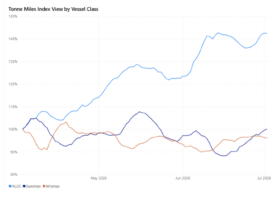
VLCC tonne-mile demand extended its outperformance, rising 6.1 ppts WoW to 142.4% and remaining above historical norms. Suezmaxes recorded a further improvement of 4.6 ppts WoW to 100.1%, returning above the 100% parity threshold. By contrast, Aframax tonne-mile demand softened only marginally, declining 0.6 ppts WoW to 96.1%, indicating almost stable underlying demand.
Source:Signal Ocean



Related News.

Navigating the Multi-Orbit Era: In Conversation with Intellian’s Jon Harrison at SMM 2026
At SMM 2026 in Hamburg, the rapid evolution of maritime satellite communications took centre stage. Across the exhibition halls, discussions among…
Cyprus ports need joint energy and investment strategy, shipping agents chief says
Cyprus needs a coordinated strategy for shipping, energy and environmental protection to support port investment and modernisation, Cyprus shipping…

MASO Public Affairs introduces MASO Regulatory Intelligence
A new subscription service helping businesses understand what is changing and what it means for them MASO Public Affairs introduces MASO Regulatory…
Anglo-Eastern helps turn CMBTECH’s ammonia ambition into an operational reality
From early feasibility study and risk-based design to newbuilding supervision, crew readiness and technical management, Anglo-Eastern drew on its…

Escalation of attacks threatens to derail recovery in Middle East oil exports
World oil demand is forecast to fall by 2.5 mb/d y-o-y in 4Q26 and 2.6 mb/d on average in 2026. As the Iran war manifests itself through restricted…
New study finds shipping pays twice its share to EU ETS earmarked revenues should triple to help build market for sustainable fuels and technologies
Shipping is responsible for around 10% of EU ETS emissions but pays almost 20% of the ETS bill. Unlike other sectors, it has never received free…

MSARC strengthens maritime mass rescue readiness through training and national live exercise off Dakar, Senegal
Joint MSARC–FHAS programme combines three days of SAR training with a national multi-agency live exercise The Maritime Search and Rescue Council ,…
Sogese report deliveries are still being delayed as container freight rates fluctuate
FOR IMPORTERS Spot rates into the Mediterranean are back at January levels, Far East to Europe reliability sits at pandemic lows, and nearly…

Glencore begins trading on Australian Securities Exchange
Glencore has begun trading on the Australian Securities Exchange under the ASX code GLC. Gary Nagle, Glencore’s CEO, said it was an exciting day for…
BIMCO Shipping Number of the Week
Suez Canal container ship transits exceed 50% of pre-disruption levels "During the first two weeks of October, weekly container ship capacity…
Subscribe to our newsletter!
if you dont want to swim alone in the ocean of news, sign up for the newsletter, and you will receive daily all the important news of world shipping!
