Iron Ore Surplus builds as Chinese Steel Margins remain under pressure

KEY TAKEAWAYS
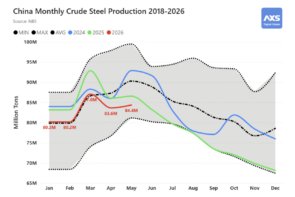
›China crude steel output fell 2.5% YoY in May 2026 to 84.4Mt; rebar margins near decade lows with the forward curve showing no meaningful recovery through year-end.
›Seaborne iron ore arrivals up 4.8% YTD to 636Mt; Brazil and Australia maintain elevated supply with no pullback expected through H2 2026.
›Simandou has shipped 7.4Mt across 35 cargoes since November 2025; Guinea’s rainy season caused a temporary June dip to 1.5Mt — recovery expected as conditions improve.
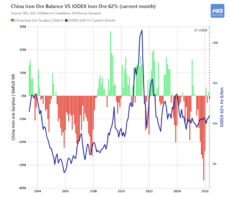
›Iron ore balance in surplus since mid-2025; port inventories at 160Mt. Surplus expected to persist through 2026 — key downside risk is new tariffs on Chinese steel exports.
China’s steel market continues to show signs of softness. The National Bureau of Statistics reported crude steel production fell 2.5% year-on-year in May 2026 to 84.4 million tons, while pig iron — produced via blast furnace — declined 1.5% to 72.9 million tons.
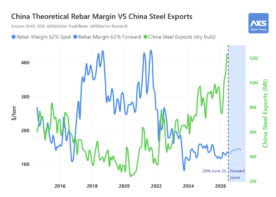
Domestic conditions remain under pressure. China’s theoretical rebar margin* stays near decade lows, a level that has historically shown an inverse correlation with strong steel export volumes**. Elevated exports signal weak domestic consumption, compressing mill profitability. And the rebar margin forward curve, despite being slightly in contango, does not suggest, as end of June, any meaningful improvement.
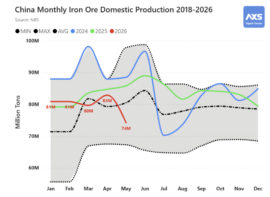
On the supply side, domestic iron ore production — lower-grade than seaborne material — dropped sharply by 13.5% to 74.2 million tons (equivalent to 27.5 million tons at 62% Fe), suggesting some adjustment on the supply side but not enough to rebalance the market.
Despite this domestic pullback, seaborne arrivals continue to flow in, up 4.8% year-to-date to 636 million tons including June discharges expected at 111.6 million tons.
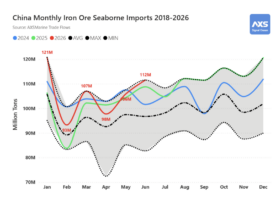
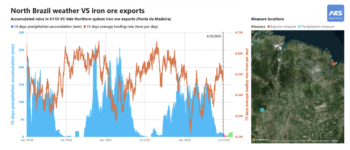
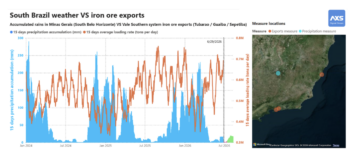
Brazil and Australia are the main drivers of this trend. Also, Brazil volumes from both the Northern and Southern systems are expected to stay elevated until December, when the rain season begins.
Adding to supply pressure, the Baowu/Winning Consortium and Simfer operating the Simandou mine have shipped a combined 7.4 million tons across 35 cargoes since November 2025.
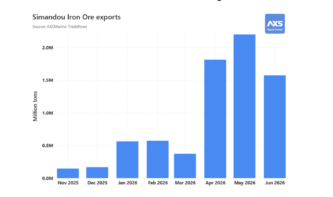
June, however, saw a slowdown: loadings dipped 0.6 Mt to 1.5 million tons, as Guinea’s rainy season is now affecting mining and loading operations — elevated moisture content is visible in recent satellite imagery of the Morebaya stockpile.
The orange coloration in the stockpile reflects elevated moisture, a direct consequence of Guinea’s rainy season. Loading rates are expected to recover once conditions improve.

These supply dynamics point to a market that remains well-supplied. The iron ore balance has been in surplus since mid-2025, triggering a rise in inventories now at 160 Mt according to Steelhome. With Brazilian volumes on an upward trajectory and Simandou ramping up, the balance* is likely to remain in surplus for the rest of 2026 — unless China increases crude steel output or cuts domestic iron ore production further. A key downside risk: should Chinese steel exports face new tariffs, reduced export capacity could push domestic steel inventories higher, weigh on prices, and further compress steel margins which could affect iron ore price on the downside.
Source:Signal Ocean



Related News.

Navigating the Multi-Orbit Era: In Conversation with Intellian’s Jon Harrison at SMM 2026
At SMM 2026 in Hamburg, the rapid evolution of maritime satellite communications took centre stage. Across the exhibition halls, discussions among…
Cyprus ports need joint energy and investment strategy, shipping agents chief says
Cyprus needs a coordinated strategy for shipping, energy and environmental protection to support port investment and modernisation, Cyprus shipping…

MASO Public Affairs introduces MASO Regulatory Intelligence
A new subscription service helping businesses understand what is changing and what it means for them MASO Public Affairs introduces MASO Regulatory…
Anglo-Eastern helps turn CMBTECH’s ammonia ambition into an operational reality
From early feasibility study and risk-based design to newbuilding supervision, crew readiness and technical management, Anglo-Eastern drew on its…

Escalation of attacks threatens to derail recovery in Middle East oil exports
World oil demand is forecast to fall by 2.5 mb/d y-o-y in 4Q26 and 2.6 mb/d on average in 2026. As the Iran war manifests itself through restricted…

New study finds shipping pays twice its share to EU ETS earmarked revenues should triple to help build market for sustainable fuels and technologies
Shipping is responsible for around 10% of EU ETS emissions but pays almost 20% of the ETS bill. Unlike other sectors, it has never received free…

MSARC strengthens maritime mass rescue readiness through training and national live exercise off Dakar, Senegal
Joint MSARC–FHAS programme combines three days of SAR training with a national multi-agency live exercise The Maritime Search and Rescue Council ,…
Sogese report deliveries are still being delayed as container freight rates fluctuate
FOR IMPORTERS Spot rates into the Mediterranean are back at January levels, Far East to Europe reliability sits at pandemic lows, and nearly…
Glencore begins trading on Australian Securities Exchange
Glencore has begun trading on the Australian Securities Exchange under the ASX code GLC. Gary Nagle, Glencore’s CEO, said it was an exciting day for…
BIMCO Shipping Number of the Week
Suez Canal container ship transits exceed 50% of pre-disruption levels "During the first two weeks of October, weekly container ship capacity…
Subscribe to our newsletter!
if you dont want to swim alone in the ocean of news, sign up for the newsletter, and you will receive daily all the important news of world shipping!
