Nordic TSOs: Strong growth in grid connection requests challenges the power system
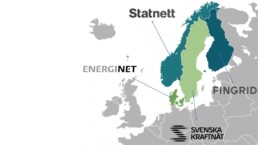

The Nordic TSOs are experiencing an unprecedented increase in grid connection requests. While national frameworks differ, we face many of the same challenges. Close cooperation is essential to learn from one another and explore future-proof approaches.
THE TREND IS NOT UNIQUE TO THE NORDICS, BUT SEEN ACROSS EUROPE AND BEYOND
The Nordic transmission system operators – Fingrid, Energinet, Statnett and Svenska kraftnät – are experiencing a significant increase in demand for grid connections. Across all Nordic countries, requests for capacity now exceed significantly what is currently available in the short to medium term. This is also the trend in many other European countries, where the energy transition and new industrial demand are driving similar pressures.
GRID INVESTMENTS ARE ESSENTIAL BUT CANNOT ALONE SOLVE EVERYTHING
While all the Nordic TSOs are planning substantial grid investments to accommodate growth in both consumption and generation, the volume of connection requests in the Nordics already far exceeds both existing and planned grid capacity. Building on the significant scaling-up of investments in recent years, making full use of the transmission grid increasingly depends on the efficient location of consumption and production. Increased flexibility is essential to make more efficient use of existing capacity and enable higher connection volumes.
THE CHALLENGES ARE LARGELY SHARED AND CALL FOR HOLISTIC PLANNING
The Nordic TSOs operate under largely comparable regulatory frameworks for handling connection requests, but national specificities exist. Despite some differences in the approach, the Nordic TSOs face a set of common challenges.
The number of requests is high, and the size and maturity of projects vary significantly. This results in long queues, increased complexity in processing applications, and challenges related to capacity and delivery timelines. In particular, a limited number of very large projects account for a substantial share of the requested capacity, complicating system planning as the realization – or non-realization – of these projects have a decisive impact on how the system develops over time as well as the possibility to accommodate for other requests.
While the Nordic TSOs are planning substantial grid investments and continuously working to improve our planning and processes, these measures alone will not be sufficient to address the scale of the challenge. In grid development and system planning we must consider the location and development of consumption and generation in conjunction.
ONGOING EFFORTS IN ALL THE NORDIC COUNTRIES
Across all Nordic countries, efforts are ongoing to manage the situation within existing frameworks. This includes further development of connection processes, work on project maturity requirements, measures to ensure a more efficient handling of applications, co-location to utilize the existing grid, and accelerated grid expansion. These efforts are taking place both nationally and through close cooperation between the Nordic TSOs.
In Denmark, Energinet has further developed the connection process, including the use of maturity requirements and payments in early project phases. Work is also ongoing to adjust capacity allocation principles and queue management to better reflect the high level of demand. Limited grid capacity will remain a structural condition in the years ahead. Energinet will not be able to connect all customers where they want, when they want. This calls for a political discussion on how to prioritize customer groups in a period of limited grid capacity.
The request for capacity for new grid connections is now eight times higher than today’s total peak load and some projects are larger than the total Copenhagen area. We cannot handle this development with grid expansion alone. New tools that will enable us to better balance grid expansion, rapid electrification, deployment of renewables and social acceptance could be a prioritization-compass, e.g. in a new regulation. Thomas Egebo, Energinet
In Finland, Fingrid is developing a broader toolbox to address scarcity, including new principles for grid connection process and updated general connection terms, flexible connection agreements and power-based tariffs. These measures complement long-term major grid investments and efforts to improve utilisation of the existing network.
Making flexible connection agreements a permanent tool would significantly enhance the ability of TSOs to connect customers. Such agreements would support more efficient use of the existing grid when peak customer demand can be adjusted. They would also help TSOs to keep up with the fast-growing needs of societies and customers. Asta Sihvonen-Punkka, Fingrid
In Norway, Statnett plans to implement strengthened maturity requirements for large consumption projects. Ordinary and smaller consumption projects are prioritized, and digital tools have improved efficiency in the handling of connection requests. Statnett has made the list of connection requests publicly available to improve transparency. The Norwegian parliament (Stortinget) has adopted amendments to the Energy Act to enable the prioritization of grid connections when necessary to safeguard national security interests.
The growth of requests for grid connection is not just a challenge for Statnett – it is a challenge for society as a whole. The grid alone cannot solve this. To support the pace of development, we need sufficient power generation and a balanced approach where consumption and generation are developed in conjunction across the system. Elisabeth Vike Vardheim, Statnett
In Sweden, Svenska kraftnät applies a structured, stepwise connection process with clearly defined decision points. The process is continuously being developed to better reflect system conditions and support effective queue management, with the aim of enabling more connections to be realised more quickly by ensuring that mature projects are allocated capacity, while less mature projects gradually lose their place in the queue.
New approaches to prioritisation and application handling are being introduced, with an increasing focus on creating incentives for projects to align both their location and connection solutions with available capacity, system conditions, and overall system needs. To this end, Svenska kraftnät plans to in the coming year launch a pilot project relating to the introduction of capacity zones, which will act as a complement to the existing connection process.
In order to achieve a more efficient electricity system stronger incentives for alternative localizations of new generation and consumption are needed. Capacity zones could be a useful tool to highlight locations that are better aligned with the development of the electricity system. Such an approach could reduce grid congestion, lower system costs and enable a faster electrification of society. Thomas Pålsson, Svenska kraftnät
Grid connection and access to capacity remain high on the agenda in all Nordic countries. The Nordic TSOs will continue their collaboration to strengthen the knowledge base and ensure a shared understanding of developments in the Nordic power system.
A SHARED RESPONSIBILITY ACROSS THE ENERGY SYSTEM
Addressing these challenges will also require coordinated action across the energy system. For grid users, including large consumers, generators and project developers, “first come, first served” has in many cases already shifted towards maturity-based assessments. Further adjustments are needed to ensure efficient allocation of capacity. We encourage stakeholders to engage actively, bring forward new ideas, and adapt to more dynamic and flexible access models. Close cooperation with national regulators and policymakers is also essential.



Related News.

Hong Kong Global Maritime Trade Summit to return for third edition
The International Chamber of Shipping, in collaboration with the Transport and Logistics Bureau of the Government of Hong Kong and the Hong Kong…

Appetite for US crude oil exports climbs despite high freight
South Korea tops US crude destinations at 568,600 b/d VLCC rates to Asia double, closing arbitrage window European refining margins…

Shipping stocks Rally as Hormuz Traffic plunges 75%
Ship traffic through the Strait of Hormuz — a critical chokepoint handling about 20% of global crude oil and liquefied natural gas shipments — has…

Diana Shipping announces Time Charter Contract for m/v G P Zafirakis with Classic Maritime
Diana Shipping, a global shipping company specializing in the ownership and bareboat charter-in of dry bulk vessels, announced that, through a…

New IMO ESP Code framework for Remote Inspection Techniques
The International Maritime Organisation, through Resolution MSC.584(111) , has adopted amendments to the International Code on the Enhanced…

ABS opens Offshore & Marine Support Center in Bergen
ABS has expanded its capabilities in the Norwegian maritime market with the opening of a cutting-edge support center in Bergen, bringing advanced…

MOL holds giant step memorial ceremony and beach cleanup at Kashima Coast
Memorial and Reflection 20 Years After the Accident: Learning from the Past to Foster an Even Stronger Safety Culture Mitsui O.S.K. Lines, announced…

KEZAD-based Arabian Gulf Steel Industries achieves lowest verified Carbon Footprint for Rebar
CARES UK verified Environmental Product Declaration confirms 139 kg CO₂e per tonne for rebar produced at AGSI’s KEZAD Abu Dhabi facility Arabian…

Indian Register of Shipping announces launch of first fleet support ship INS Surya
Indian Register of Shipping continues to strengthen its role in supporting the Indian Navy and India’s naval shipbuilding capabilities through the…

VLCCs Climbing the Record Charts
LR2 The TC1 75kt MEG/Japan index decreased by only a single point this week to WS928. The corresponding Baltic round-trip TCE fell by $2,000 to…
Subscribe to our newsletter!
if you dont want to swim alone in the ocean of news, sign up for the newsletter, and you will receive daily all the important news of world shipping!
