Regulation is the only bar to offshore vessel electrification – E-mission zero
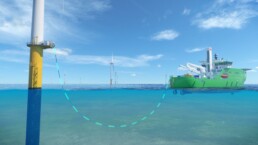

– Panel hosted by Bibby Marine and its E-Mission Zero partners highlighted how vessel electrification will cut costs, reduce emissions and improve energy security for offshore wind operations.
– With vessel and charging technology now ready, panellists said policy and regulatory change is needed to unlock uptake of low-cost low and zero-carbon support vessels
Vessel electrification is no longer a future concept for offshore wind and policy and regulatory alignment is now the main barrier to uptake, a cross-industry panel hosted by Bibby Marine told an audience during Global Offshore Wind on Wednesday.
Speakers from RenewableUK, Corvus Energy, Stillstrom, Tidal Transit and Kongsberg Maritime said rapid progress in vessel and charging technology means electrified vessels now represent an increasingly credible commercial proposition. They argued that better policy alignment and regulatory clarity will be key in unlocking the full value of electrification for developers and their contract partners.

Opening the session, Nigel Quinn, CEO of Bibby Marine, highlighted the growing need for offshore wind’s support infrastructure to keep pace with the sector’s wider ambitions. “Offshore wind is growing quickly, but the supply chain must also look at how it decarbonises its own assets and operations,” he said. “Vessel electrification is no longer just an environmental aspiration. It is becoming a practical way to reduce costs, improve energy security and give operators greater control over long-term operating risk.”
The panel was chaired by Laoiseach Scullion, Policy Manager at RenewableUK, and featured Kevin Brown, Commercial Director at Bibby Marine; Efraim Kanestrøm, Vice President Global Offshore Segment at Corvus Energy; Nikolaj Stald, Chief Commercial Officer at Stillstrom; Leo Hambro, CEO & Co-founder at Tidal Transit; and Euan Duncan, Regional Sales Director at Kongsberg Maritime.
Throughout the discussion, panellists challenged the idea that electrification remains too complex, too costly or too technically immature for offshore deployment. Instead, speakers pointed to rapid progress in battery systems, vessel design, offshore charging and system integration, as well as the growing pressure on operators to manage fuel-price volatility and future carbon-cost exposure.
Kevin Brown, Commercial Director at Bibby Marine, said: “For a long time, electrification was treated as a decarbonisation story alone. What is changing now is the commercial picture. We are demonstrating that electrified vessel operations can be cost-competitive and, in the right operating model, materially cheaper than conventional alternatives, while also reducing exposure to fuel volatility and carbon costs.”
Panellists also pointed to the role of grant funding and innovation support in accelerating progress. Support through initiatives such as UK SHORE and Innovate UK was highlighted as instrumental in helping move vessel electrification and offshore charging from early-stage concept work towards practical delivery.
At the same time, speakers stressed that the next challenge is not proving the technology, but creating the conditions for deployment. That includes integrating offshore charging into project planning earlier, resolving questions around access to offshore electricity, and establishing a clearer regulatory and commercial pathway for charging infrastructure.

Nikolaj Stald, Chief Commercial Officer at Stillstrom, said: “From a technical and operational perspective, offshore charging is ready to move forward. What the market now needs is greater certainty and a more proactive framework from regulators and developers, so that implementation can happen with confidence and at pace.”
Leo Hambro, CEO & Co-founder at Tidal Transit, said: “The sector now needs to move beyond theory and into deployment. The equipment exists, the vessel technology is progressing, and the business case is becoming clearer. The priority now is to demonstrate offshore charging at scale and create the confidence needed for wider adoption.”
Efraim Kanestrøm, Vice President Global Offshore Segment at Corvus Energy, said: “Battery technology and charging infrastructure have advanced significantly in recent years, and the step change in capability is now clear. The next requirement is not more proof that the technology can work, but the confidence, regulation and project commitment needed to deploy it at scale.”
The discussion also highlighted the value of cross-sector collaboration in bringing first-of-a-kind projects forward. Speakers pointed to the growing alignment between vessel owners, charging providers, battery specialists, maritime system suppliers and offshore wind stakeholders as an important sign of momentum in the market.
Euan Duncan, Regional Sales Director at Kongsberg Maritime, said: “What has made progress possible is getting the right partners involved early and designing around a shared objective. That collaboration is helping turn what once seemed ambitious into something practical and deliverable.”
Bibby Marine is playing a leading role in that transition through the development of its first eCSOV, currently under construction and due to enter service in 2027. The vessel forms part of the company’s wider E-Mission Zero vision to support lower-cost, lower-emission offshore wind operations through electrification and industry collaboration.
Looking ahead, panellists agreed that progress over the next 12 months will be measured not only by vessels under construction, but by tangible movement on offshore charging deployment, regulatory certainty and project-level commitment from developers.
Closing the panel, Laoiseach Scullion, Policy Manager at RenewableUK, said: “Today’s discussion showed that electrification is no longer just a future ambition for offshore wind support vessels. The technology is no longer the main question, the challenge now is aligning infrastructure, policy and deployment so the sector can realise the value at scale.”



Related News.

Navigating the Multi-Orbit Era: In Conversation with Intellian’s Jon Harrison at SMM 2026
At SMM 2026 in Hamburg, the rapid evolution of maritime satellite communications took centre stage. Across the exhibition halls, discussions among…

Cyprus ports need joint energy and investment strategy, shipping agents chief says
Cyprus needs a coordinated strategy for shipping, energy and environmental protection to support port investment and modernisation, Cyprus shipping…

MASO Public Affairs introduces MASO Regulatory Intelligence
A new subscription service helping businesses understand what is changing and what it means for them MASO Public Affairs introduces MASO Regulatory…

Anglo-Eastern helps turn CMBTECH’s ammonia ambition into an operational reality
From early feasibility study and risk-based design to newbuilding supervision, crew readiness and technical management, Anglo-Eastern drew on its…

Escalation of attacks threatens to derail recovery in Middle East oil exports
World oil demand is forecast to fall by 2.5 mb/d y-o-y in 4Q26 and 2.6 mb/d on average in 2026. As the Iran war manifests itself through restricted…

New study finds shipping pays twice its share to EU ETS earmarked revenues should triple to help build market for sustainable fuels and technologies
Shipping is responsible for around 10% of EU ETS emissions but pays almost 20% of the ETS bill. Unlike other sectors, it has never received free…

MSARC strengthens maritime mass rescue readiness through training and national live exercise off Dakar, Senegal
Joint MSARC–FHAS programme combines three days of SAR training with a national multi-agency live exercise The Maritime Search and Rescue Council ,…

Sogese report deliveries are still being delayed as container freight rates fluctuate
FOR IMPORTERS Spot rates into the Mediterranean are back at January levels, Far East to Europe reliability sits at pandemic lows, and nearly…

Glencore begins trading on Australian Securities Exchange
Glencore has begun trading on the Australian Securities Exchange under the ASX code GLC. Gary Nagle, Glencore’s CEO, said it was an exciting day for…

BIMCO Shipping Number of the Week
Suez Canal container ship transits exceed 50% of pre-disruption levels "During the first two weeks of October, weekly container ship capacity…
Subscribe to our newsletter!
if you dont want to swim alone in the ocean of news, sign up for the newsletter, and you will receive daily all the important news of world shipping!
