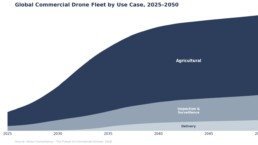

Valour Consultancy’s latest research forecasts that the global commercial fleet of unmanned aircraft systems (UAS), or drones, will exceed 5.6 million aircraft by 2050. Its new report, “The Future of Commercial Drones – 2026”, covers delivery, inspection and surveillance, and agricultural applications, and complements the firm’s recently published “The Future of Advanced Air Mobility” study.
The agricultural market is already mature, particularly in China where DJI alone reports a fleet of over 300,000 spray drones. “It is here, as well as in inspection and surveillance, where the most compelling operational and economic benefits currently exist,” says Summer Staninski, author of the report. “Safety is paramount, while reducing costs and saving time closely follow. Drones improve outcomes across all three metrics, enabling higher-quality agricultural and inspection practices to be carried out more quickly and with less manual labour,” she continued.
Additionally, agricultural and many inspection drones largely operate within visual line of sight (VLOS), meaning adoption has not been constrained by slow-moving regulation around beyond visual line of sight (BVLOS) flight. As such, there have been fewer barriers to deployment than delivery applications, where scalable economics often depend on routine BVLOS operations.
Valour’s forecast calls for the global delivery drone fleet to exceed 500,000 by 2050. Delivery drones present a viable alternative to ground delivery in that aircraft can travel through the air quickly, offer savings on labour costs, aid in meeting sustainability goals and reduce reliance on gig-economy workers. These benefits are strongest in food delivery, where hot meals must be delivered quickly and consumers are willing to pay a premium for such a service. As a result, food dominates the delivery drone segment, driven by a strong case for replacing drivers in suburban markets where road-based delivery can be slow and costly.
For convenience and e-commerce goods, drones will enable premium ultra-fast fulfilment services for time-sensitive orders, similar to the sub-20-minute delivery models already being demonstrated by retailers like Walmart. While drones often work best at solving the “I need this now” problem, for a majority of household and postal items, waiting a day or two is completely fine. Indeed, the economics of a delivery van remain hard to beat.
While growth is forecast to be strong throughout the 2025-2050 timeframe under analysis, Staninski recognises that much hinges on removal of regulatory barriers. “In order for the overall commercial drone market to scale, we need to see legislation enable routine BVLOS operations. Until then, it’s very difficult for firms to offer widespread services such as home delivery and inspection of linear assets like powerlines,” she says. However, as the industry moves towards standardised frameworks to approve autonomous BVLOS flight, drones are expected to become a critical layer of industrial and commercial infrastructure worldwide.



Related News.

Navigating the Multi-Orbit Era: In Conversation with Intellian’s Jon Harrison at SMM 2026
At SMM 2026 in Hamburg, the rapid evolution of maritime satellite communications took centre stage. Across the exhibition halls, discussions among…

Cyprus ports need joint energy and investment strategy, shipping agents chief says
Cyprus needs a coordinated strategy for shipping, energy and environmental protection to support port investment and modernisation, Cyprus shipping…

MASO Public Affairs introduces MASO Regulatory Intelligence
A new subscription service helping businesses understand what is changing and what it means for them MASO Public Affairs introduces MASO Regulatory…

Anglo-Eastern helps turn CMBTECH’s ammonia ambition into an operational reality
From early feasibility study and risk-based design to newbuilding supervision, crew readiness and technical management, Anglo-Eastern drew on its…

Escalation of attacks threatens to derail recovery in Middle East oil exports
World oil demand is forecast to fall by 2.5 mb/d y-o-y in 4Q26 and 2.6 mb/d on average in 2026. As the Iran war manifests itself through restricted…

New study finds shipping pays twice its share to EU ETS earmarked revenues should triple to help build market for sustainable fuels and technologies
Shipping is responsible for around 10% of EU ETS emissions but pays almost 20% of the ETS bill. Unlike other sectors, it has never received free…

MSARC strengthens maritime mass rescue readiness through training and national live exercise off Dakar, Senegal
Joint MSARC–FHAS programme combines three days of SAR training with a national multi-agency live exercise The Maritime Search and Rescue Council ,…

Sogese report deliveries are still being delayed as container freight rates fluctuate
FOR IMPORTERS Spot rates into the Mediterranean are back at January levels, Far East to Europe reliability sits at pandemic lows, and nearly…

Glencore begins trading on Australian Securities Exchange
Glencore has begun trading on the Australian Securities Exchange under the ASX code GLC. Gary Nagle, Glencore’s CEO, said it was an exciting day for…
BIMCO Shipping Number of the Week
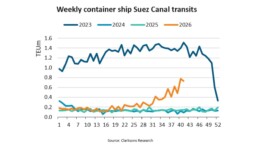
Suez Canal container ship transits exceed 50% of pre-disruption levels "During the first two weeks of October, weekly container ship capacity…
Subscribe to our newsletter!
if you dont want to swim alone in the ocean of news, sign up for the newsletter, and you will receive daily all the important news of world shipping!
