Wattlab launches WEstack a standardised battery system for inland shipping
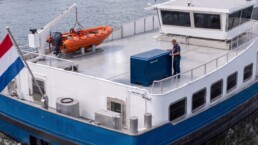

Rotterdam-based technology company Wattlab introduces WEstack: a standardised battery system for inland shipping that can be installed on board within a single working day. With the introduction of WEstack, Wattlab aims to remove one of the key barriers to decarbonisation in the sector: the high cost and long installation times associated with traditional marine battery systems.
Where existing systems are often fully customised and require weeks of installation work, WEstack is fully assembled and tested in Wattlab’s workshop. Once delivered on board, the system only needs to be connected. This reduces installation time from several weeks to just one day.
According to Wattlab, this represents a major opportunity for inland shipping. “Generators on vessels operate most of the time at only 10 to 15 percent of their capacity,” says Bo Salet, founder and CEO of Wattlab. “That is extremely inefficient. At low loads, a generator consumes relatively large amounts of fuel. By adding a battery pack, the generator can charge the battery at its optimal operating point, after which the battery supplies power to the vessel.”
Diesel generators: up to 90% fewer operating hours
WEstack is designed to reduce generator running hours by as much as 80 to 90 percent. According to Wattlab, this results in significant fuel savings, lower maintenance costs, and a substantial reduction in CO₂ emissions. In addition, the system improves onboard comfort by reducing noise, vibrations, and exhaust fumes, while also reducing dependence on shore power.
The battery system is available in four standard capacities: 100, 200, 300, and 400 kWh. This standardisation enables faster production and installation while keeping costs lower than those of traditional custom-built systems.
WEstack is installed on the aft deck of the vessel and is designed for both newbuild and retrofit projects. According to Wattlab, the system can be applied to a wide range of inland vessels, from older dry cargo ships to modern tankers and small coastal vessels.
In addition to direct fuel savings, Wattlab sees an important role for battery systems in future emissions regulations and port operations. “More and more ports want to reduce emissions and noise pollution,” says Salet. “With a battery system, vessels can operate silently and emission-free for much longer periods without relying on shore power.”
Energy efficiency is the fastest route to reducing emissions
Wattlab was founded in 2017 and previously developed solar energy systems for the maritime sector. The company gained international recognition through large-scale solar installations on inland vessels and is currently also developing Solar Flatrack systems for seagoing vessels.
With the introduction of WEstack, Wattlab is taking the next step in the decarbonisation of shipping. “Alternative fuels are likely to remain scarce and expensive for the foreseeable future,” says Salet. “That is why we believe energy efficiency is the fastest and most cost-effective route to reducing emissions in the sector.”



Related News.

Navigating the Multi-Orbit Era: In Conversation with Intellian’s Jon Harrison at SMM 2026
At SMM 2026 in Hamburg, the rapid evolution of maritime satellite communications took centre stage. Across the exhibition halls, discussions among…

Cyprus ports need joint energy and investment strategy, shipping agents chief says
Cyprus needs a coordinated strategy for shipping, energy and environmental protection to support port investment and modernisation, Cyprus shipping…

MASO Public Affairs introduces MASO Regulatory Intelligence
A new subscription service helping businesses understand what is changing and what it means for them MASO Public Affairs introduces MASO Regulatory…

Anglo-Eastern helps turn CMBTECH’s ammonia ambition into an operational reality
From early feasibility study and risk-based design to newbuilding supervision, crew readiness and technical management, Anglo-Eastern drew on its…

Escalation of attacks threatens to derail recovery in Middle East oil exports
World oil demand is forecast to fall by 2.5 mb/d y-o-y in 4Q26 and 2.6 mb/d on average in 2026. As the Iran war manifests itself through restricted…

New study finds shipping pays twice its share to EU ETS earmarked revenues should triple to help build market for sustainable fuels and technologies
Shipping is responsible for around 10% of EU ETS emissions but pays almost 20% of the ETS bill. Unlike other sectors, it has never received free…

MSARC strengthens maritime mass rescue readiness through training and national live exercise off Dakar, Senegal
Joint MSARC–FHAS programme combines three days of SAR training with a national multi-agency live exercise The Maritime Search and Rescue Council ,…

Sogese report deliveries are still being delayed as container freight rates fluctuate
FOR IMPORTERS Spot rates into the Mediterranean are back at January levels, Far East to Europe reliability sits at pandemic lows, and nearly…

Glencore begins trading on Australian Securities Exchange
Glencore has begun trading on the Australian Securities Exchange under the ASX code GLC. Gary Nagle, Glencore’s CEO, said it was an exciting day for…

BIMCO Shipping Number of the Week
Suez Canal container ship transits exceed 50% of pre-disruption levels "During the first two weeks of October, weekly container ship capacity…
Subscribe to our newsletter!
if you dont want to swim alone in the ocean of news, sign up for the newsletter, and you will receive daily all the important news of world shipping!
