The AI Race is being fought in the wrong place


The enterprise AI race is quickly becoming a contest over interfaces.
Every week brings another announcement about smarter copilots, more capable agents, or new orchestration layers designed to automate work across the enterprise. The progress is undeniable. But much of the market is not optimizing for how businesses operate.
That distinction is more important than many realize. Because enterprises do not run on prompts. They run on execution.
A global manufacturer deciding how to reroute inventory during a supply chain disruption needs more than simply an answer. It must evaluate supplier alternatives, inventory availability, customer commitments, and financial tradeoffs simultaneously. A CFO forecasting liquidity exposure during market volatility needs context that a simple chatbot interaction can’t provide. These are interconnected operational decisions shaped by dependencies, preferences, approvals, financial consequences, and tradeoffs that ripple across the business in real time.
In countless conversations I’ve had with executives over the past year, the discussion inevitably shifts from AI capability to operational reality. The models are improving quickly. The harder question is whether AI understands the business environments it is operating within.
Today, too much of the AI conversation still assumes that better models alone will produce better business outcomes. They will not. Enterprises are discovering that intelligence disconnected from operational context – the processes, the data, the rules and policies that govern and protect your organization – can generate activity without creating much progress. In some cases, it can create more fragmentation and risk.
A generated recommendation may sound convincing while missing critical dependencies elsewhere in the system. An AI agent may automate one workflow efficiently while disrupting planning assumptions in another. Enterprises do not suffer from a shortage of AI outputs. They suffer from a shortage of AI systems capable of understanding operational consequences.
That is the real challenge now emerging in enterprise AI and solving it requires something deeper than orchestration. It requires context.
For decades, enterprise software has quietly served as the operational backbone of the global economy. Finance systems, supply chains, procurement networks, workforce planning platforms, manufacturing operations, and customer fulfillment processes all run through interconnected systems that capture not just information, but the logic of how businesses function. They contain years of accumulated process knowledge and data, governance structures, authorizations, policies, and economic relationships that shape every decision a company makes. They are the institutional memory of the enterprise.
In the AI era, that business context becomes enormously valuable. Without it, AI’s outputs remain educated guesses rather than grounded judgments.
When AI is grounded directly inside operational processes, it can begin to reason across the full reality of the enterprise. That changes the role software plays inside organizations. Enterprise systems are beginning to participate directly in execution itself.
AI can identify risks earlier, coordinate responses across functions, recommend actions in real time, and automate routine execution within defined boundaries. Not as isolated agents operating independently, but as intelligence connected to the economic and operational fabric of the enterprise itself.
Importantly, autonomy in enterprise does not mean removing humans from decision-making. It means reducing the friction, fragmentation, and administrative drag that prevents organizations from operating with speed and coherence at scale. People still define priorities, make judgment calls, and hold accountability. But AI can help coordinate and execute the operational work surrounding those decisions.
Consider a supplier disruption affecting a critical manufacturing component. Most AI systems today can summarize the issue or predict likely delays based on learned patterns. But operationally grounded AI can move beyond insight into coordinated execution. It can identify affected production schedules, evaluate inventory positions globally, assess alternative sourcing options, estimate financial exposure, flag customer delivery risks, and recommend actions across procurement, logistics, finance, and customer operations simultaneously.
That is not simply workflow automation. It’s an entirely new way for humans and systems to interact.
This is also why I believe the AI era will increase the strategic importance of enterprise systems, not diminish it.
As AI moves closer to execution, the systems that matter most will be the ones capable of grounding intelligence in operational and transactional reality. The value shifts toward systems that understand permissions, policies, dependencies, processes, financial consequences, and organizational accountability at enterprise scale.
This shift also changes how leaders should think about transformation.
The first phase of enterprise AI adoption focused heavily on experimentation. Companies tested copilots, deployed pilots, and automated isolated tasks. Few delivered productivity gains and fewer fundamentally changed how organizations operate.
The companies that lead in the next phase will approach AI differently. They will connect intelligence directly to the operational systems where decisions carry real economic consequences. They will recognize that trustworthy AI depends not only on governance, but on context, data quality, process integrity, and transactional understanding.
Most importantly, they will understand that successful AI adoption in enterprises is not only a technical shift. It is a change management challenge. Real value comes to life only if AI agents, processes, and humans work in concert.
The future belongs to enterprises that strike this balance: humans defining priorities and holding accountability, while intelligent systems coordinate and execute with precision – enabling businesses to navigate an increasingly complex world with greater resilience, productivity, and intelligence.



Related News.

Navigating the Multi-Orbit Era: In Conversation with Intellian’s Jon Harrison at SMM 2026
At SMM 2026 in Hamburg, the rapid evolution of maritime satellite communications took centre stage. Across the exhibition halls, discussions among…
Cyprus ports need joint energy and investment strategy, shipping agents chief says
Cyprus needs a coordinated strategy for shipping, energy and environmental protection to support port investment and modernisation, Cyprus shipping…

MASO Public Affairs introduces MASO Regulatory Intelligence
A new subscription service helping businesses understand what is changing and what it means for them MASO Public Affairs introduces MASO Regulatory…

Anglo-Eastern helps turn CMBTECH’s ammonia ambition into an operational reality
From early feasibility study and risk-based design to newbuilding supervision, crew readiness and technical management, Anglo-Eastern drew on its…

Escalation of attacks threatens to derail recovery in Middle East oil exports
World oil demand is forecast to fall by 2.5 mb/d y-o-y in 4Q26 and 2.6 mb/d on average in 2026. As the Iran war manifests itself through restricted…

New study finds shipping pays twice its share to EU ETS earmarked revenues should triple to help build market for sustainable fuels and technologies
Shipping is responsible for around 10% of EU ETS emissions but pays almost 20% of the ETS bill. Unlike other sectors, it has never received free…

MSARC strengthens maritime mass rescue readiness through training and national live exercise off Dakar, Senegal
Joint MSARC–FHAS programme combines three days of SAR training with a national multi-agency live exercise The Maritime Search and Rescue Council ,…
Sogese report deliveries are still being delayed as container freight rates fluctuate
FOR IMPORTERS Spot rates into the Mediterranean are back at January levels, Far East to Europe reliability sits at pandemic lows, and nearly…

Glencore begins trading on Australian Securities Exchange
Glencore has begun trading on the Australian Securities Exchange under the ASX code GLC. Gary Nagle, Glencore’s CEO, said it was an exciting day for…
BIMCO Shipping Number of the Week
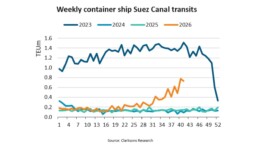
Suez Canal container ship transits exceed 50% of pre-disruption levels "During the first two weeks of October, weekly container ship capacity…
Subscribe to our newsletter!
if you dont want to swim alone in the ocean of news, sign up for the newsletter, and you will receive daily all the important news of world shipping!
