Use of scrubbers in the Mediterranean Sea Emission Control Area Med ECA

From 1 May 2025, ships operating within the Mediterranean Emission Control Area became subject to full compliance with the applicable sulphur requirements under the International Convention for the Prevention of Pollution from Ships (MARPOL) Annex VI, as amended by IMO Resolution MEPC.361.
Geographical area
The Med ECA is not defined by countries, but as a single continuous sea area under MARPOL Annex VI (Appendix VII), covering the entire Mediterranean Sea basin. It applies to all vessels operating within that sea area. All coastal States bordering the Mediterranean are effectively within the ECA, as it applies to ships operating anywhere in that sea area, regardless of flag.
The Med ECA extends from the Strait of Gibraltar to the entrance of the Suez Canal and includes all Mediterranean sub-basins, including the Adriatic Sea and the Aegean Sea.
Scope
Within the Med ECA, ships must use marine fuels with a sulphur content of no more than 0.10% sulphur as compared with the global 0.50% limit. This measure is intended to reduce harmful emissions of sulphur oxides (SOx) and Particulate Matter, thereby improving air quality and protecting human health across densely populated coastal areas of Europe, North Africa and the Middle East.
As noted above, the Med ECA is established under MARPOL Annex VI and applies throughout the Mediterranean Sea. However, under Articles 56(1) and 57 of the United Nations Convention on the Law of the Sea (UNCLOS), each coastal State bordering the Mediterranean exercises jurisdiction within its maritime zones, including its territorial sea and, where applicable, its Exclusive Economic Zone (EEZ), which may extend up to 200 nautical miles from the baselines from which the breadth of the territorial sea is measured. Many neighbouring States have adopted regulatory measures that are more stringent than those required under MARPOL Annex VI in order to address air . It is advised to check with local agents well in advance before calling ports in the Mediterranean about the maximum allowable sulphur content for each port of call, to ensure that only fuels which are in strict compliance with local air pollution regulations are consumed whilst sailing within the Med ECA.
Compliance under MARPOL
Shipowners generally have two principal means of complying with the relevant sulphur requirements under MARPOL.
A. Fuel
The most straightforward way for vessels transiting the Mediterranean Sea to comply is the use of Very Low Sulphur Fuel Oil (VLSFO). Alternatively, Heavy Fuel Oil (HFO) with a 3.5% sulphur content can be used with scrubbers, provided the scrubbers can lower the sulphur content to 0.10%. For smaller vessels engaged on short voyages within the Med ECA, Marine Gas Oil (MGO), a distillate fuel that complies with the 0.10% sulphur limit, may also be an appropriate option.
Alternative fuels, including LNG, methanol, biofuels and hydrogen, are also increasingly being adopted, particularly for certain newbuild vessels, and generally give rise to low SOx emissions.
B. Scrubbers
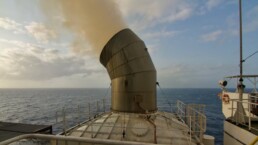
Scrubbers are exhaust gas cleaning systems installed in a ship’s exhaust line to remove SOx and, to some extent, Particulate Matter from engine emissions, thereby allowing the vessel to use higher-sulphur fuel while still meeting the air-emission limits set by MARPOL.
Exhaust gas cleaning systems are permitted as an equivalent means of compliance, provided that they achieve an emissions outcome equivalent to the 0.10% m/m SOx limit applicable within the Med ECA.
1. Permitted scrubber types
For the purposes of MARPOL Annex VI, this includes different scrubber: Open-loop scrubbers, as well as closed-loop and hybrid scrubbers.
a) Open-loop scrubbers
The Med ECA designation itself does not prohibit open-loop scrubber discharge, and there is no basin-wide prohibition. Accordingly, such systems may be used on the high seas, outside the territorial waters of neighbouring States, provided that the discharge complies with the IMO washwater criteria.
There is no single Med ECA rule governing the discharge of open‑loop scrubber washwater. The applicable requirements vary between the jurisdictions of States bordering the Med ECA and may also differ from one port to another within the same State.
b) Closed-loop scrubbers and hybrid scrubbers
Likewise, closed-loop and hybrid scrubbers are not prohibited by the Med ECA. However, as with the open-loop scrubbers, their use may be subject to national or port-level restrictions, particularly in coastal waters and ports.
2. Scrubber washwater
Whilst MARPOL permits the use of scrubbers to achieve the required sulphur limit, it does not confer an unrestricted right to discharge scrubber washwater in all areas.
Regulation 4.4 of MARPOL expressly permits environmental protection considerations, thereby providing the legal basis on which ports and coastal States have prohibited open‑loop discharge.
The International Maritime Organization (IMO) regulates scrubber washwater criteria in the 2021 Guidelines for Exhaust Gas Cleaning Systems, adopted by the IMO MEPC Resolution MEPC.340(77). The relevant provisions are in section 10 (“Washwater”), which sets out the washwater discharge criteria and monitoring parameters.
Impact on shipping
The Med ECA regime has implications both for port States and for the shipowners and operators of vessels calling at ports within the Med ECA or transiting the Mediterranean.
A. Port States
Many Mediterranean ports have had to expand their fuel supply capabilities for low-sulphur fuels in order to meet demand from ships trading within the Med ECA. In addition, port States have had to implement rules governing scrubber washwater discharge and ensure the availability of appropriate disposal arrangements.
Port State Control (PSC) authorities at Mediterranean ports have also had to implement compliance checks during inspections to ensure that the Med ECA limits are met.
B. Shipowners and operators
For ships passing through the Med ECA or operating within it, operating costs have increased due to the higher price of low-sulphur fuels.
As an alternative to using low-sulphur fuel, ships may be fitted with scrubbers.
However, although scrubbers allow vessel operators to continue using high-sulphur fuel within the Mediterranean Sea ECA, their use involves additional vessel-specific costs, including chemicals and waste-disposal expenses. In addition, open-loop scrubber systems may not be a viable option for calls at certain Mediterranean ports where their use is prohibited.
From an operational perspective, compliance within the Med ECA may be supported by measures such as slow steaming to reduce fuel consumption, together with careful voyage planning to minimise time spent within the area, where operationally feasible.
However, operating within the Med ECA has nevertheless become more expensive, not least because of the need to use low-sulphur fuel oil when transiting the basin, as well as the higher costs associated with fuel and scrubber installation.
In addition to these direct costs, owners and operators must also address fuel management procedures, increased PSC inspections, crew training and voyage-planning adjustments.
Strict compliance with applicable air-pollution requirements within the Med ECA is therefore essential. Any non-compliance with applicable Med ECA regulations, regional or local, may give rise to significant fines, and in some cases, result in detention of the vessel until adequate security has been provided.
Recommendations from Skuld
The International Chamber of Shipping (ICS) maintains an updated list of scrubber discharge prohibitions by jurisdiction which we recommend that members consult for current scrubber regulations by country and port. We also strongly advise members to check with local agents for any local requirements well in advance of any port call within the Med ECA.
If you have any questions, please do not hesitate to reach out to your local Skuld contact.
Source: Skuld



Related News.
Navigating the Multi-Orbit Era: In Conversation with Intellian’s Jon Harrison at SMM 2026
At SMM 2026 in Hamburg, the rapid evolution of maritime satellite communications took centre stage. Across the exhibition halls, discussions among…
Cyprus ports need joint energy and investment strategy, shipping agents chief says
Cyprus needs a coordinated strategy for shipping, energy and environmental protection to support port investment and modernisation, Cyprus shipping…

MASO Public Affairs introduces MASO Regulatory Intelligence
A new subscription service helping businesses understand what is changing and what it means for them MASO Public Affairs introduces MASO Regulatory…
Anglo-Eastern helps turn CMBTECH’s ammonia ambition into an operational reality
From early feasibility study and risk-based design to newbuilding supervision, crew readiness and technical management, Anglo-Eastern drew on its…
Escalation of attacks threatens to derail recovery in Middle East oil exports
World oil demand is forecast to fall by 2.5 mb/d y-o-y in 4Q26 and 2.6 mb/d on average in 2026. As the Iran war manifests itself through restricted…
New study finds shipping pays twice its share to EU ETS earmarked revenues should triple to help build market for sustainable fuels and technologies
Shipping is responsible for around 10% of EU ETS emissions but pays almost 20% of the ETS bill. Unlike other sectors, it has never received free…

MSARC strengthens maritime mass rescue readiness through training and national live exercise off Dakar, Senegal
Joint MSARC–FHAS programme combines three days of SAR training with a national multi-agency live exercise The Maritime Search and Rescue Council ,…
Sogese report deliveries are still being delayed as container freight rates fluctuate
FOR IMPORTERS Spot rates into the Mediterranean are back at January levels, Far East to Europe reliability sits at pandemic lows, and nearly…
Glencore begins trading on Australian Securities Exchange
Glencore has begun trading on the Australian Securities Exchange under the ASX code GLC. Gary Nagle, Glencore’s CEO, said it was an exciting day for…
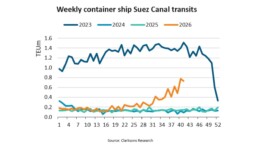
BIMCO Shipping Number of the Week
Suez Canal container ship transits exceed 50% of pre-disruption levels "During the first two weeks of October, weekly container ship capacity…
Subscribe to our newsletter!
if you dont want to swim alone in the ocean of news, sign up for the newsletter, and you will receive daily all the important news of world shipping!
