Maritime Safety Committee (MSC 111): Key outcomes on autonomous ships, GHG safety and situation in the Strait of Hormuz
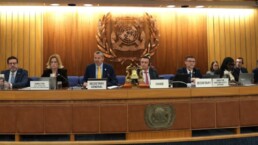

The International Maritime Organization’s Maritime Safety Committee met for its 111th session from 13 to 22 May 2026 in London, United Kingdom. The meeting was chaired by Mr. Theofilos Mozas of Greece. Key outcomes are outlined below, with full meeting summary to follow.
First global code for autonomous ships
IMO adopted a new International Code of Safety for Maritime Autonomous Surface Ships (MASS Code) to support the safe integration of AI-enabled and remotely operated commercial ships into global shipping.
The MASS Code sets out a comprehensive, goal-based framework to ensure that remotely controlled or autonomous ships are designed and operated to a level of safety, security and environmental protection that is expected of a conventional ship. They will also be required to comply with the International Convention for the Safety of Life at Sea (SOLAS) and other applicable mandatory IMO instruments.
The Code applies to cargo ships* and will take effect from 1 July 2026. As it is a non-mandatory instrument, Member States are given the opportunity to test its use while paving the way for making it mandatory under the SOLAS Convention.
Welcoming the milestone at the conclusion of the 111th session of the Maritime Safety Committee (MSC) in London, held 13 to 22 May, IMO Secretary-General Mr. Arsenio Dominguez said:
“This landmark achievement positions IMO at the forefront of regulating emerging technologies, demonstrating the Organization’s ability to anticipate and shape the future of shipping. It represents a major step forward, enabling innovation while ensuring that safety, accountability and the human element remain at the core of maritime operations.”
New approach required
A ship is considered autonomous if such shipboard technology is designed and verified to control actions without human intervention. While the number of fully crewless or remote-operated ships are currently limited, a growing number are being successfully trialled internationally.
The MASS Code introduces new requirements for the design, approval and operation of these ships, including in key areas such as navigation, connectivity, remote operations, fire safety, and search and rescue. It places strong emphasis on risk assessment, robust system design, cybersecurity and the integration of Remote Operations Centres (ROCs).
Importantly, it underscores the importance of human oversight, with the master retaining overall responsibility for the ship at all times – even if not on board the ship.
Roadmap towards binding rules
The new MASS Code supplements existing IMO instruments, taken due account of the international law, including the United Nations Convention on the Law of the Sea (UNCLOS). It is the culmination of nearly a decade of multilateral discussions, legal work and on-the-water trials, to enable new and conventional technologies to operate safely together.
The next steps for the Code include:
- December 2026 – MSC 112 to re-establish MASS Working Group for the Development of a framework for an Experience-Building Phase (EBP) of the non-mandatory MASS Code;
- 2028 – Development of the mandatory MASS Code, based on the non-mandatory Code and results from the EBP and review conducted by the relevant sub-committees. Consideration of amendments to SOLAS (new chapter) for the Code’s adoption;
- By 1 July 2030 – Expected adoption of the IMO’s first mandatory MASS Code, for entry into force on 1 January 2032.
In addition to the new MASS Code, the Maritime Safety Committee took the following key decisions:
Situation in the Strait of Hormuz
The Committee adopted a resolution requesting the support of IMO Member States for the Secretary-General’s ongoing efforts to facilitate the safe evacuation of ships and seafarers trapped in the Persian Gulf.
The Committee urged Member States and organizations to assist trapped seafarers by providing essential supplies, establishing helplines and remote support, and keeping families informed. Crew changes were also encouraged.
The Committee requested the Secretary-General to closely monitor the situation and provide regular updates to Member States and relevant IMO bodies.
Guidelines for ships using alternative fuels
The Committee continued work on the safety regulatory framework for ships using new technologies and alternative fuels. It approved new Interim guidelines for use of ammonia cargo as fuel, to support the safe design, construction and operation of ships carrying and using ammonia as fuel.
The Committee approved two new sets of interim guidelines for training seafarers on ships using alternative fuels and technologies, reflecting the need to develop new skills while addressing the specific risks of each fuel type. These include:
- Interim guidelines on training for seafarers on ships using methyl/ethyl alcohol as fuel; and
- Interim guidelines on training for seafarers on ships using ammonia as fuel.
The Committee also clarified how the “one ship, one code” principle applies to gas carriers using alternative fuels, including whether the IGF Code or IGC Code should apply, improving consistency and clarity in the regulatory framework.
Progress towards free ship tracking data for coastal States
The Committee approved amendments to the SOLAS Convention that would change how the Long-Range Identification and Tracking (LRIT) system works, with the aim of making global ship tracking data easier to access, and improve safety, security and environmental protection at sea. The amendments will be considered for adoption by MSC 112 in December.
The amendments will allow coastal States to receive standard ship position reports free of charge, removing a major barrier to using the system. This is expected to help countries better monitor maritime activity, support search and rescue operations, and respond to issues such as illegal shipping and marine pollution.
LRIT is a worldwide system that allows governments to track ships by receiving regular updates on their position and identity.
Improving security of ship communications through VDES
The Committee adopted a resolution to introduce the VHF data exchange system (VDES) into the IMO regulatory framework, as an alternative to the current AIS tracking system current required of ships. The new regulations are expected to enter into force on 1 January 2028.
VDES is a more advanced version of AIS that allows ships and coastal authorities to send and receive more data, more quickly and more securely. VDES is designed to make ship tracking more secure by adding authentication, helping to reduce the risk of spoofing.
The Committee also adopted revised Performance standards for shipborne VDES and approved Guidelines for the onboard operational use of shipborne VDES.



Related News.

Navigating the Multi-Orbit Era: In Conversation with Intellian’s Jon Harrison at SMM 2026
At SMM 2026 in Hamburg, the rapid evolution of maritime satellite communications took centre stage. Across the exhibition halls, discussions among…

Cyprus ports need joint energy and investment strategy, shipping agents chief says
Cyprus needs a coordinated strategy for shipping, energy and environmental protection to support port investment and modernisation, Cyprus shipping…

MASO Public Affairs introduces MASO Regulatory Intelligence
A new subscription service helping businesses understand what is changing and what it means for them MASO Public Affairs introduces MASO Regulatory…

Anglo-Eastern helps turn CMBTECH’s ammonia ambition into an operational reality
From early feasibility study and risk-based design to newbuilding supervision, crew readiness and technical management, Anglo-Eastern drew on its…

Escalation of attacks threatens to derail recovery in Middle East oil exports
World oil demand is forecast to fall by 2.5 mb/d y-o-y in 4Q26 and 2.6 mb/d on average in 2026. As the Iran war manifests itself through restricted…

New study finds shipping pays twice its share to EU ETS earmarked revenues should triple to help build market for sustainable fuels and technologies
Shipping is responsible for around 10% of EU ETS emissions but pays almost 20% of the ETS bill. Unlike other sectors, it has never received free…

MSARC strengthens maritime mass rescue readiness through training and national live exercise off Dakar, Senegal
Joint MSARC–FHAS programme combines three days of SAR training with a national multi-agency live exercise The Maritime Search and Rescue Council ,…

Sogese report deliveries are still being delayed as container freight rates fluctuate
FOR IMPORTERS Spot rates into the Mediterranean are back at January levels, Far East to Europe reliability sits at pandemic lows, and nearly…

Glencore begins trading on Australian Securities Exchange
Glencore has begun trading on the Australian Securities Exchange under the ASX code GLC. Gary Nagle, Glencore’s CEO, said it was an exciting day for…

BIMCO Shipping Number of the Week
Suez Canal container ship transits exceed 50% of pre-disruption levels "During the first two weeks of October, weekly container ship capacity…
Subscribe to our newsletter!
if you dont want to swim alone in the ocean of news, sign up for the newsletter, and you will receive daily all the important news of world shipping!
