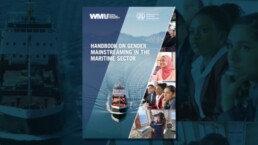

IMO and WMU release new practical guide for shipping industry to promote measurable actions on gender equality
The International Maritime Organization and World Maritime University have released a new Handbook on Gender Mainstreaming in the Maritime Sector, calling for action to address persistent gender inequality across the global maritime industry.
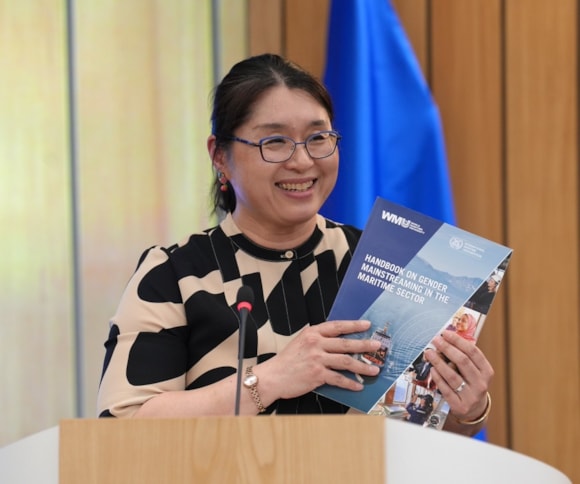
The handbook, authored by WMU Professor Momoko Kitada, was launched on the International Day for Women in Maritime on 18 May. Professor Kitada is also the recipient of the 2026 IMO Gender Equality Award.
The publication is the first of its kind, aimed at closing the gender gap in the maritime sector, where women account for just 1% of the world’s seafaring workforce and hold only 19% of ministerial roles responsible for maritime affairs.
A practical tool
The handbook provides practical guidance for maritime administrations, shipping companies, ports, shipyards and maritime education institutions on how to integrate gender considerations into policies, recruitment, training, workplace safety and leadership development.
It includes tools tailored to maritime organizations for gender analysis, the development of gender equality action plans, and monitoring and evaluation.
Presenting the handbook, Professor Kitada emphasized that gender mainstreaming is an effective strategy, process and methodology which works for everyone’s benefit:
“Gender mainstreaming requires leadership to implement. No matter our role or level in an organization, we can exercise gender mainstreaming in both large and small capacities.”
Moving beyond rhetoric
In the foreword, IMO Secretary-General Arsenio Dominguez said the industry must move “beyond rhetoric and toward measurable action,” adding that a more diverse maritime workforce is more competent, safer and more sustainable.
He stated: “Gender mainstreaming is the strategic tool we must employ to bridge this gap. It is not a secondary objective or a ‘women’s issue’; it is a globally recognized methodology used to ensure that every policy, every regulation, and every operational practice is scrutinized through a gender lens.”
WMU President Maximo Q. Mejia, Jr. said in the preface that the handbook was designed to serve as “a roadmap to definitive change,” helping organizations implement practical measures to create more equitable workplaces.
He noted that WMU itself had reached gender parity in its Malmö MSc intake for 2025 after decades of targeted efforts to increase opportunities for women in maritime education.
Source:IMO



Related News.
Navigating the Multi-Orbit Era: In Conversation with Intellian’s Jon Harrison at SMM 2026
At SMM 2026 in Hamburg, the rapid evolution of maritime satellite communications took centre stage. Across the exhibition halls, discussions among…
Cyprus ports need joint energy and investment strategy, shipping agents chief says
Cyprus needs a coordinated strategy for shipping, energy and environmental protection to support port investment and modernisation, Cyprus shipping…

MASO Public Affairs introduces MASO Regulatory Intelligence
A new subscription service helping businesses understand what is changing and what it means for them MASO Public Affairs introduces MASO Regulatory…
Anglo-Eastern helps turn CMBTECH’s ammonia ambition into an operational reality
From early feasibility study and risk-based design to newbuilding supervision, crew readiness and technical management, Anglo-Eastern drew on its…
Escalation of attacks threatens to derail recovery in Middle East oil exports
World oil demand is forecast to fall by 2.5 mb/d y-o-y in 4Q26 and 2.6 mb/d on average in 2026. As the Iran war manifests itself through restricted…
New study finds shipping pays twice its share to EU ETS earmarked revenues should triple to help build market for sustainable fuels and technologies
Shipping is responsible for around 10% of EU ETS emissions but pays almost 20% of the ETS bill. Unlike other sectors, it has never received free…
MSARC strengthens maritime mass rescue readiness through training and national live exercise off Dakar, Senegal
Joint MSARC–FHAS programme combines three days of SAR training with a national multi-agency live exercise The Maritime Search and Rescue Council ,…
Sogese report deliveries are still being delayed as container freight rates fluctuate
FOR IMPORTERS Spot rates into the Mediterranean are back at January levels, Far East to Europe reliability sits at pandemic lows, and nearly…
Glencore begins trading on Australian Securities Exchange
Glencore has begun trading on the Australian Securities Exchange under the ASX code GLC. Gary Nagle, Glencore’s CEO, said it was an exciting day for…
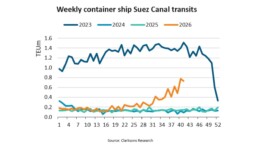
BIMCO Shipping Number of the Week
Suez Canal container ship transits exceed 50% of pre-disruption levels "During the first two weeks of October, weekly container ship capacity…
Subscribe to our newsletter!
if you dont want to swim alone in the ocean of news, sign up for the newsletter, and you will receive daily all the important news of world shipping!
