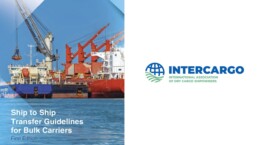

Ship to ship transfers are an established part of dry bulk operations, and they are growing. As new trading areas and cargo flows emerge, STS operations are expanding into regions where port infrastructure or draft limitations make direct berth access impossible. However, the sector has been doing this without a dedicated standard.
In tanker shipping, STS activity is underpinned by established industry guidance. Dry bulk has had no equivalent framework, despite the added complexity arising from different cargoes, equipment and operating conditions.
INTERCARGO has now published the “Ship to Ship Transfer Guidelines for Bulk Carriers”, setting out the first dedicated standard for these activities in the dry bulk sector.
STS transfers allow cargo operations in locations where ports cannot accommodate the vessel size, required draft or cargo volumes, particularly in regions where infrastructure is limited. However, such operations also introduce additional challenges, including increased operational interfaces, greater personnel involvement and less margin for error when operating conditions change.
The new guidelines are built around the practical realities of conducting STS operations at sea. They address planning, risk assessment, manoeuvring, fendering, cargo handling and emergency response procedures, with practical checklists and operational responsibilities. Together, they bring a consistent framework to operations that until now have had none.

John Xylas, Chair of INTERCARGO said: “Ship to ship transfers in dry bulk are already happening across the industry, and they are increasing. However, a published standard for dry bulk shipping wasn’t available for consistent application and safe operations.
“As STS becomes more widely used, we expect to see greater alignment across operators, charterers, insurers and regulators, so that a more consistent approach becomes the norm for dry bulk operations.”
The guidelines were presented last week at INTERCARGO’s Executive and Technical Committees, semi-annual meetings in Singapore, where shipowners, operators and technical specialists from the sector convened to progress the Association’s agenda on safety, security, environmental stewardship, sustainability, decarbonisation, operational standards including DryBMS, vetting issues, regional port state control requirements, and the human element in dry bulk shipping.
The STS publication was developed through the collective operational experience and technical input of shipowners, operators, marine and technical specialists throughout the sector, reflecting both operational experience and the realities crews face on the water.

The intention is straightforward: to introduce more clarity, consistency and standardisation to how STS transfers are carried out in dry bulk shipping and reduce the operational inconsistency that exists today. As STS activity continues across both traditional and emerging trades, the next step will be wider alignment across the maritime industry. Adoption by operators, charterers, insurers and regulators will shape how quickly these practices are applied in reality, and how quickly a more consistent approach becomes established across dry bulk STS operations worldwide.



Related News.

Navigating the Multi-Orbit Era: In Conversation with Intellian’s Jon Harrison at SMM 2026
At SMM 2026 in Hamburg, the rapid evolution of maritime satellite communications took centre stage. Across the exhibition halls, discussions among…

Cyprus ports need joint energy and investment strategy, shipping agents chief says
Cyprus needs a coordinated strategy for shipping, energy and environmental protection to support port investment and modernisation, Cyprus shipping…

MASO Public Affairs introduces MASO Regulatory Intelligence
A new subscription service helping businesses understand what is changing and what it means for them MASO Public Affairs introduces MASO Regulatory…

Anglo-Eastern helps turn CMBTECH’s ammonia ambition into an operational reality
From early feasibility study and risk-based design to newbuilding supervision, crew readiness and technical management, Anglo-Eastern drew on its…

Escalation of attacks threatens to derail recovery in Middle East oil exports
World oil demand is forecast to fall by 2.5 mb/d y-o-y in 4Q26 and 2.6 mb/d on average in 2026. As the Iran war manifests itself through restricted…
New study finds shipping pays twice its share to EU ETS earmarked revenues should triple to help build market for sustainable fuels and technologies
Shipping is responsible for around 10% of EU ETS emissions but pays almost 20% of the ETS bill. Unlike other sectors, it has never received free…

MSARC strengthens maritime mass rescue readiness through training and national live exercise off Dakar, Senegal
Joint MSARC–FHAS programme combines three days of SAR training with a national multi-agency live exercise The Maritime Search and Rescue Council ,…

Sogese report deliveries are still being delayed as container freight rates fluctuate
FOR IMPORTERS Spot rates into the Mediterranean are back at January levels, Far East to Europe reliability sits at pandemic lows, and nearly…

Glencore begins trading on Australian Securities Exchange
Glencore has begun trading on the Australian Securities Exchange under the ASX code GLC. Gary Nagle, Glencore’s CEO, said it was an exciting day for…
BIMCO Shipping Number of the Week
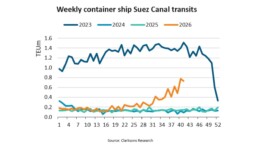
Suez Canal container ship transits exceed 50% of pre-disruption levels "During the first two weeks of October, weekly container ship capacity…
Subscribe to our newsletter!
if you dont want to swim alone in the ocean of news, sign up for the newsletter, and you will receive daily all the important news of world shipping!
