Don’t use the MASS code as an excuse to do nothing


This week in London, the IMO is expected to adopt the MASS Code – the regulatory framework for autonomous and remotely operated ships. It is, by any measure, a significant step forward. But it’s worth being clear about what adoption actually means. The Code is non-mandatory. Shipowners can follow it or not. Flag states can implement it or not. There’s no enforcement mechanism, no deadline, no consequence for inaction. The mandatory version won’t enter into force until 2032 – six years from now, during which the technology will have lapped the regulation multiple times.
WHAT A VOLUNTARY CODE SIGNALS TO THE MARKET
When a regulatory body publishes a voluntary code, the message to shipowners is straightforward: this is where things are heading, but you don’t have to act yet. For conservative operators weighing investment decisions, that’s often enough to defer action. What has historically moved industries is mandatory standards with universal application. AIS transponders, ECDIS, load line rules – in each case, adoption remained limited until the mandate arrived, even when the technology was already proven.
History suggests that voluntary frameworks in safety-critical industries reflect the pace of the slowest movers rather than the most capable ones. And the slowest movers are not the ones absorbing the risk. Human error is implicated in 75–80% of maritime incidents. Fatigue, distraction and the limits of human watchkeeping in demanding conditions are not edge cases; they’re a persistent feature of how ships are operated today. That’s not an abstract risk. It’s the predictable result of an industry where doing nothing carries no formal consequence.
But there’s a more fundamental problem with waiting. Voluntary frameworks don’t just slow adoption – they entrench the wrong baseline. When human-only watchkeeping remains the unquestioned default, the burden of proof sits entirely with AI-powered decision support. Every incident involving an AI-equipped vessel gets scrutinised. Every near-miss on a conventionally operated ship gets absorbed as normal. That asymmetry distorts how the industry reads its own safety record.
EXPERIENCE BUILDING DOESN’T NEED TO START FROM SCRATCH
The 2026–2028 experience-building phase (EBP) is designed to generate real-world evidence that will inform the mandatory MASS Code. What’s less clear is why it needs to start from scratch when substantial operational evidence already exists.
Earlier this year, for example, Lloyd’s Register (LR) conducted a live vessel trial of Orca AI’s navigation platform – the first time a major class society has independently assessed an AI-based navigation system in real operating conditions. Over five days, covering 828 nautical miles through the Mediterranean including the busy Strait of Messina, the system was tested against the full range of conditions autonomous navigation will need to handle. Across 739 relevant targets – including small, unlit and low-Radar-signature vessels that traditional Radar failed to identify – it achieved 94% precision and 98.6% recall, with zero downtime throughout.
Moreover, a joint study by Orca AI and P&I club NorthStandard, covering 139 vessels across more than 10.8 million nautical miles, recorded a 52% reduction in high-severity close encounters within 12 months of deployment. Improvements held across vessel ages and operating regions, including the most congested shipping corridors.
This is precisely the kind of evidence the EBP is intended to produce: independent, rigorous, conducted in real conditions by parties with high credibility. The case for engaging with data of this kind now, rather than treating the EBP as the starting point, is straightforward. It already exists.
THE BURDEN OF PROOF HAS SHIFTED
That evidence points to something the industry hasn’t yet fully absorbed: the threshold for AI-assisted navigation has already been crossed. Not in a lab, and not in a simulation – but in independent trials, at scale, and verified by leading shipping bodies.
When that threshold is crossed, the question the industry should be asking is no longer “why adopt AI assistance?” It’s “why not?” Aviation reached this point with collision-avoidance systems decades ago. TCAS didn’t stay optional once the safety case was established – it became the baseline, and operating without it required justification. Maritime is at an equivalent inflection point, even if the regulatory framework hasn’t caught up.
Making AI-assisted navigation the operational default doesn’t mean removing crews or resolving every question the MASS Code raises. It means treating the unassisted bridge as the condition that needs to explain itself – on safety grounds, on insurance grounds, on operational grounds. The data to support that shift is already there. What’s missing is the willingness to read it as a reason to move, with no exceptions, rather than a reason to feel comfortable waiting.
WHAT COMES NEXT
The MASS Code is a foundation. The mandatory version in 2032 will matter more. But the companies and operators who move seriously in the intervening years will not be waiting for the mandate – they’ll be building operational expertise, generating the safety data the EBP is designed to produce and setting the performance benchmarks the mandatory code will eventually codify.
More importantly, they’ll have helped determine what the mandatory code actually says. The operators generating safety data now, in real conditions at scale, are the ones who’ll set the performance benchmarks regulators will eventually codify. That’s not a minor thing – it’s the difference between writing the rules and being handed them.



Related News.

Navigating the Multi-Orbit Era: In Conversation with Intellian’s Jon Harrison at SMM 2026
At SMM 2026 in Hamburg, the rapid evolution of maritime satellite communications took centre stage. Across the exhibition halls, discussions among…
Cyprus ports need joint energy and investment strategy, shipping agents chief says
Cyprus needs a coordinated strategy for shipping, energy and environmental protection to support port investment and modernisation, Cyprus shipping…

MASO Public Affairs introduces MASO Regulatory Intelligence
A new subscription service helping businesses understand what is changing and what it means for them MASO Public Affairs introduces MASO Regulatory…
Anglo-Eastern helps turn CMBTECH’s ammonia ambition into an operational reality
From early feasibility study and risk-based design to newbuilding supervision, crew readiness and technical management, Anglo-Eastern drew on its…

Escalation of attacks threatens to derail recovery in Middle East oil exports
World oil demand is forecast to fall by 2.5 mb/d y-o-y in 4Q26 and 2.6 mb/d on average in 2026. As the Iran war manifests itself through restricted…
New study finds shipping pays twice its share to EU ETS earmarked revenues should triple to help build market for sustainable fuels and technologies
Shipping is responsible for around 10% of EU ETS emissions but pays almost 20% of the ETS bill. Unlike other sectors, it has never received free…

MSARC strengthens maritime mass rescue readiness through training and national live exercise off Dakar, Senegal
Joint MSARC–FHAS programme combines three days of SAR training with a national multi-agency live exercise The Maritime Search and Rescue Council ,…
Sogese report deliveries are still being delayed as container freight rates fluctuate
FOR IMPORTERS Spot rates into the Mediterranean are back at January levels, Far East to Europe reliability sits at pandemic lows, and nearly…

Glencore begins trading on Australian Securities Exchange
Glencore has begun trading on the Australian Securities Exchange under the ASX code GLC. Gary Nagle, Glencore’s CEO, said it was an exciting day for…
BIMCO Shipping Number of the Week
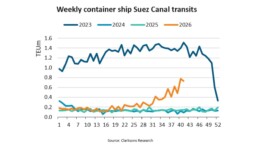
Suez Canal container ship transits exceed 50% of pre-disruption levels "During the first two weeks of October, weekly container ship capacity…
Subscribe to our newsletter!
if you dont want to swim alone in the ocean of news, sign up for the newsletter, and you will receive daily all the important news of world shipping!
