Sustainable Shipping initiative study industry must now scale digital, sign and workforce action to build on progress


New report charts the progress made under the Hong Kong Convention and identifies the digital innovation, end-of-life design thinking and workforce continuity required to safely scale ship recycling for rising dema
The Sustainable Shipping Initiative has released a new study, Alang in Transition: From Compliance to Capability, that builds on the substantial progress made in ship recycling safety within the region under the Hong Kong Convention (HKC) and signals the next phase of action needed to safely scale the industry. With 115 of 128 operational plots in the Alang-Sosiya cluster in Gujarat now HKC compliant, and recovery rates approaching 98% of vessel mass, the study finds the foundations are in place for the sector to go further by combining digital solutions and processes, whole-lifecycle accountability starting at vessel design, and investing further in the continuity of accumulated workforce knowledge at recycling facilities.
The research, supported by Lloyd’s Register, is grounded in a case study of Priya Blue Group’s HKC-compliant facility in Alang-Sosiya, examining day-to-day operations and what they reveal about the progress, scale and future direction of safe dismantling as vessel retirement volumes rise sharply over the coming decade.
Ellie Besley-Gould, Chief Executive, Sustainable Shipping Initiative, said: “The progress made in HKC-compliant facilities is real and provides a strong foundation to build on. To meet the scale and complexity of vessel retirements coming in the next decade, the next phase of safety improvement will depend on three things working together: harnessing digital innovation at yard level, embedding end-of-life thinking into ship design and maintenance, and investing in the workforce knowledge that turns procedures into safe daily practice. An industry roadmap to 2050 would give the sector the framework it needs, with clear milestones for safety, digitisation and sustainable dismantling. The decisions taken now will shape the conditions facing recycling workers for decades to come.”

The study highlighted the following focuses:
- Digitising yard processes should be a near-term priority. It is one of the highest-leverage opportunities for the Alang cluster. For example, implementing digital twin capabilities at yard level to use real-time virtual representations that can identify congestion, predict lift conflicts and optimise sequencing of cutting and lifting. Combined with RFID worker tracking and AI-assisted gas detection, these tools would extend supervisory capacity as throughput rises.
- Lifecycle accountability begins at the design stage. Many hazards encountered during dismantling originate from decisions made during design or maintenance. This includes structural configurations, hazardous material integration, and fragmented documentation across ownership transitions. The study recommends embedding dismantling considerations into vessel design and developing a vessel end-of-life passport. This is a continuously updated digital record that builds on the Inventory of Hazardous Materials and travels with the vessel through its operational life.
- Workforce continuity influences safety culture. The Mukadam supervisory system at Alang, where supervisors progress from helper to supervisor over the years, was identified as the single most important safety asset observed at the facility. As digitisation scales, human aspects become more critical. The report cautions that increasing throughput by hiring new daily-wage workers does not scale safety capability. It calls for the provision of continuous employment contracts, ILO-compliant accommodation, supporting community facilities, and clear career pathways to be seen as direct safety investments.
- Vessels arriving at shipyards between now and the 2050s will bring greater variability and complexity into ship recycling. The systems, efficiencies and workforce knowledge required to dismantle them safely must be built now. Developing an industry roadmap to 2050 will help to achieve this by aligning investment, regulation and innovation across the ship recycling sector. This should include clear milestones for safety performance, digitisation and the transition to more sustainable dismantling practices.
-

Image: Left to Right Ellie Besley-Gould, Chief Executive, Sustainable Shipping Initiative and Maria Marilyn Joseph, Ship Recycling Lead, Sustainable Shipping initiative and author of the report Satish Singh, Chief Operating Officer, Priya Blue Group, added: “At Priya Blue Group, we have always taken a forward-looking view of our responsibilities, and have worked to set the benchmark for the Indian ship recycling industry. This report shows the world what Indian ship recyclers are doing today, and what we are capable of delivering tomorrow, sustainably and responsibly. It captures our operations with transparency and accuracy, and the author has done a commendable job of documenting the innovations, the supervisory systems and the everyday practices that define our facility, and safety standards.”
Maria Marilyn Joseph, Ship Recycling Lead, Sustainable Shipping initiative and author of the report, concluded: “Spending time inside the facility made it clear that the Mukadam supervisory system, where supervisors have 40 years of accumulated operational judgement and can translate written procedures into safe practice in real time, is one of the most important safety assets. Also, the locally engineered adaptations we documented, from modified winch systems to workshop-fabricated components, exist because equipment designed specifically for ship recycling environments hardly yet exists. Both factors across human knowledge and engineering innovation are assets the wider industry can learn from, and that the next decade of growth must protect.”
Alang was selected for its deep industrial ecosystem, built up over 40 years. This includes its workforce knowledge base, a network of secondary markets, a downstream cluster of more than 80 re-rolling mills in Sihor, and a culture of local engineering innovation that has adapted industrial equipment for the specific conditions of ship dismantling. The Gujarat Maritime Board has committed to expanding capacity from 4.5 million to 9 million LDT by 2035.



Related News.

Navigating the Multi-Orbit Era: In Conversation with Intellian’s Jon Harrison at SMM 2026
At SMM 2026 in Hamburg, the rapid evolution of maritime satellite communications took centre stage. Across the exhibition halls, discussions among…

Cyprus ports need joint energy and investment strategy, shipping agents chief says
Cyprus needs a coordinated strategy for shipping, energy and environmental protection to support port investment and modernisation, Cyprus shipping…

MASO Public Affairs introduces MASO Regulatory Intelligence
A new subscription service helping businesses understand what is changing and what it means for them MASO Public Affairs introduces MASO Regulatory…

Anglo-Eastern helps turn CMBTECH’s ammonia ambition into an operational reality
From early feasibility study and risk-based design to newbuilding supervision, crew readiness and technical management, Anglo-Eastern drew on its…

Escalation of attacks threatens to derail recovery in Middle East oil exports
World oil demand is forecast to fall by 2.5 mb/d y-o-y in 4Q26 and 2.6 mb/d on average in 2026. As the Iran war manifests itself through restricted…

New study finds shipping pays twice its share to EU ETS earmarked revenues should triple to help build market for sustainable fuels and technologies
Shipping is responsible for around 10% of EU ETS emissions but pays almost 20% of the ETS bill. Unlike other sectors, it has never received free…

MSARC strengthens maritime mass rescue readiness through training and national live exercise off Dakar, Senegal
Joint MSARC–FHAS programme combines three days of SAR training with a national multi-agency live exercise The Maritime Search and Rescue Council ,…

Sogese report deliveries are still being delayed as container freight rates fluctuate
FOR IMPORTERS Spot rates into the Mediterranean are back at January levels, Far East to Europe reliability sits at pandemic lows, and nearly…

Glencore begins trading on Australian Securities Exchange
Glencore has begun trading on the Australian Securities Exchange under the ASX code GLC. Gary Nagle, Glencore’s CEO, said it was an exciting day for…
BIMCO Shipping Number of the Week
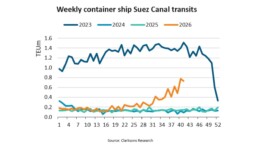
Suez Canal container ship transits exceed 50% of pre-disruption levels "During the first two weeks of October, weekly container ship capacity…
Subscribe to our newsletter!
if you dont want to swim alone in the ocean of news, sign up for the newsletter, and you will receive daily all the important news of world shipping!
