Study humans are still the “Integration Layer” in freight operations despite AI expansion

- Majority (52%) re-enter the same shipment data across multiple systems
- 49% switch between 5+ systems to complete a single workflow
- The highest levels of friction in logistics sit at the foundation, namely data and workflows, where manual intervention remains most prevalent
Despite years of investment in digital platforms and AI, freight operations still depend heavily on humans manually connecting disconnected systems, according to a new industry report released by Deep Current, a Germany-based AI company building the pre-operational data flow infrastructure layer for logistics.
“Many logistics organisations continue to operate in environments where workflows are fragmented and require significant ‘human integration layer’ in between more than 5+ systems on average for a typical workflow. Even in 2026, many tech platforms and AI models still depend on this human intervention to deliver results.” Shared Tamim Fannoush, Founder & CEO, Deep Current AS.
The report, Levers of Digital Sophistication, examines where logistics AI initiatives continue to break down operationally, despite growing pressure across the industry to scale automation, improve resilience and reduce execution delays.
The study indicates that a large share of the industry still struggles in early stages of operational digitalisation and decision intelligence, where data does not flow seamlessly and automation is not fully embedded into first entry points of data feeding.
Where exactly does the logistics operations break
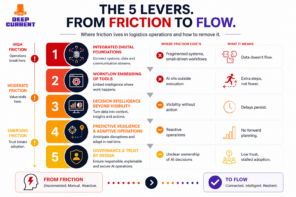
With more than 24 months of project implementation samples studied, varying across mid and large sized logistics sector implementation, we mapped the hot spots of friction that hinders AI integration. The highest friction remains in data connectivity and workflow integration, where systems are still disconnected and AI operates outside execution.
| Lever | Friction Level | Where Friction Exists | What It Means |
| Integrated Digital Foundations | 🔴 High | Fragmented systems, email-driven workflows | Data doesn’t flow |
| Workflow Embedding | 🔴 High | AI sits outside execution | Extra steps, not fewer |
| Decision Intelligence | 🟠 Moderate | Visibility without action | Delays persist |
| Predictive Resilience | 🟠 Moderate | Reactive operations | No forward planning |
| Governance & Human-AI | 🟡 Emerging | Unclear ownership of AI decisions | Low trust, stalled adoption |
The report found:
- 61% of logistics teams still depend on emails and spreadsheets for operational communication
- 57% report shipment delays caused by document errors
- Only 29% have implemented digital tools across core operational workflows
- 47% cite legacy system integration as the biggest barrier to adoption
Additional operational analysis conducted by Deep Current also found that more than half of logistics operators still re-enter the same shipment data across multiple systems, while nearly half switch between five or more platforms to complete a single workflow.
According to the report, the problem is no longer visibility.
Most logistics organisations can now detect disruptions, delays and shipment exceptions in real time. The larger breakdown is happening at the execution layer, where operational teams still manually interpret, validate and move information across fragmented systems.
This gap between digital ambition and operational reality is where most transformation efforts stall.
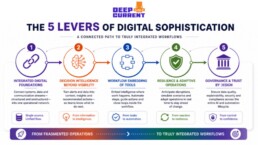
The report identifies five operational levers shaping digital sophistication in logistics:
- Integrated digital foundations
- Decision intelligence beyond visibility
- Workflow embedding of AI tools
- Predictive resilience and scenario capability
- Governance, skills and human-AI partnership
Together, they outline how organisations move from fragmented execution to truly integrated, AI-driven workflows. Each lever builds on the last, shifting operations from manual interpretation to structured data, from isolated tools to embedded intelligence, and from reactive processes to scalable, resilient systems.
Deep Current argues that many AI initiatives continue to struggle because intelligence is layered on top of workflows rather than embedded directly inside them.
“As long as AI sits outside operational execution, teams still end up doing the integration work manually,” said Fannoush. “Copy-paste workflows, repeated validation and fragmented communication continue to absorb enormous operational capacity across freight.”
The company positions this challenge as a “pre-operational intelligence” problem, where operational breakdowns often originate before execution even begins, at the point where information is created, shared and interpreted across systems.
Deep Current develops AI systems for logistics operations focused on structuring unstructured operational inputs, validating information across sources and enabling clean data flow across workflows. Its product suite includes tools for demand intake, document validation, data extraction and workflow intelligence.



Related News.

Navigating the Multi-Orbit Era: In Conversation with Intellian’s Jon Harrison at SMM 2026
At SMM 2026 in Hamburg, the rapid evolution of maritime satellite communications took centre stage. Across the exhibition halls, discussions among…

Cyprus ports need joint energy and investment strategy, shipping agents chief says
Cyprus needs a coordinated strategy for shipping, energy and environmental protection to support port investment and modernisation, Cyprus shipping…

MASO Public Affairs introduces MASO Regulatory Intelligence
A new subscription service helping businesses understand what is changing and what it means for them MASO Public Affairs introduces MASO Regulatory…
Anglo-Eastern helps turn CMBTECH’s ammonia ambition into an operational reality
From early feasibility study and risk-based design to newbuilding supervision, crew readiness and technical management, Anglo-Eastern drew on its…

Escalation of attacks threatens to derail recovery in Middle East oil exports
World oil demand is forecast to fall by 2.5 mb/d y-o-y in 4Q26 and 2.6 mb/d on average in 2026. As the Iran war manifests itself through restricted…

New study finds shipping pays twice its share to EU ETS earmarked revenues should triple to help build market for sustainable fuels and technologies
Shipping is responsible for around 10% of EU ETS emissions but pays almost 20% of the ETS bill. Unlike other sectors, it has never received free…

MSARC strengthens maritime mass rescue readiness through training and national live exercise off Dakar, Senegal
Joint MSARC–FHAS programme combines three days of SAR training with a national multi-agency live exercise The Maritime Search and Rescue Council ,…

Sogese report deliveries are still being delayed as container freight rates fluctuate
FOR IMPORTERS Spot rates into the Mediterranean are back at January levels, Far East to Europe reliability sits at pandemic lows, and nearly…

Glencore begins trading on Australian Securities Exchange
Glencore has begun trading on the Australian Securities Exchange under the ASX code GLC. Gary Nagle, Glencore’s CEO, said it was an exciting day for…
BIMCO Shipping Number of the Week
Suez Canal container ship transits exceed 50% of pre-disruption levels "During the first two weeks of October, weekly container ship capacity…
Subscribe to our newsletter!
if you dont want to swim alone in the ocean of news, sign up for the newsletter, and you will receive daily all the important news of world shipping!
