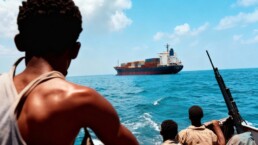

It’s been a nightmare two months for global shipping, with the Strait of Hormuz largely shut to commercial traffic and the threat of fresh attacks on vessels in the Red Sea.
Now, a third crisis is brewing — a resurgence in Somali piracy.
Even before the latest escalations between the United States, Israel and Iran, around half the vessels bound for Europe from Asia and the Gulf were bypassing the Red Sea and Suez Canal due to earlier strikes by the Iran-backed Houthis.
Faced with the threat of attacks around the Bab el-Mandeb Strait, the narrow chokepoint between the Red Sea and the Gulf of Aden, major shipping firms opted instead for the long detour around southern Africa.
This diversion adds two to three weeks and thousands of nautical miles to the journey, taking ships right past Somalia’s coastline — the same waters where Somali pirates staged a multiyear campaign of hijackings that peaked in 2011. Sporadic incidents have been reported ever since.
Piracy makes a troubling return
That stretch of sea is now seeing piracy return with a vengeance, with three ships hijacked off Somalia and nearby Yemen in the past three weeks alone. As of May 8, 2026, the Honour 25 and Eureka oil tankers and the cargo ship Sward all remain under pirate control.
Experts believe that organized crime groups in Somalia are taking advantage of the Iran war to launch hijackings, as international naval patrols, first deployed in 2008 to counter the pirates, have been stretched thin by current events around Hormuz and the Red Sea.
Tim Walker, senior researcher for transnational threats and organized crime at South Africa’s Institute for Security Studies, says the pirates now perceive fewer deterrents along Somalia’s 3,300-kilometer (2,050-mile) stretch of coastline, which is the longest in all of continental Africa.
“Some groups, organized by … piracy kingpins, are now looking to seize vessels and hold them for ransom, along with the crew on board — sometimes demanding a high ransom for their safe return,” Walker told DW.
The European Union’s Operation Atalanta, the naval mission tasked with protecting shipping off Somalia, does maintain a steady presence in the western Indian Ocean, operating alongside the multinational Combined Task Force 151. But it is not an escort force, and is responsible for patrolling vast areas.
Well-funded pirates using dhows
According to Lloyd’s List Intelligence, a maritime data company, there are at least two active pirate groups, primarily based in Puntland, a semi-autonomous region in northeastern Somalia. They appear to be well-resourced.
The pirates have seized large traditional vessels known as dhows — used for fishing and local trade — which are repurposed as mother ships. These allow pirates to extend their range and remain at sea for weeks before using them as launching pads to target commercial shipping.
Some of the latest hijackings involved large dhows, which need navigation kits, weapons and boarding equipment,” Troels Burchall Henningsen, assistant professor at Denmark’s Institute for Strategy and War Studies, told DW. “It’s a large operation which requires investment.”
“There are a lot more ships in the area and some aren’t adopting the best security measures,” Walker said, describing how one tanker, sailing to Mogadishu, was hijacked close to the Somali coast, where it was most vulnerable.
Piracy could raise shipping costs further
With Middle East conflicts already driving up shipping insurance premiums, adding around a million dollars in fuel costs per voyage and sending freight rates soaring, shipping industry leaders warn that any major resurgence in piracy could push costs even higher and further disrupt global trade.
At the height of the previous piracy crisis in 2011, the economic damage from hijackings was estimated at around $7 billion (€5.98 billion) a year, according to the Sasakawa Peace Foundation, a Japanese think tank.
This included the cost of military operations, rerouting, traveling faster — which uses more fuel — additional security equipment and onboard guards.
Only a tiny proportion of the overall cost, nearly $160 million, was paid out in ransoms, calculated the think tank.
Development funds to Somalia cut
While the Iran war created a useful distraction for the pirates, a shift in Washington’s policy toward East Africa may have also played a role in the resurgence of piracy.
For years, the US funded development projects in Somalia — especially in coastal communities — to reduce poverty and stop young men from joining pirate groups.
Under the current Trump administration, however, nearly all non-security development aid has been suspended. Washington has instead focused on direct counter-terrorism operations against the Islamist militant group al-Shabab.
When you reduce those resources, the intelligence network and maritime patrols don’t have the same capability to work from,” Burchall Henningsen lamented.
Maritime organizations have, meanwhile, advised shipping firms to avoid Somali territorial waters, including ports. The deployment of armed guards onboard is also highly effective against pirate attacks, they say.
“There has never been a successful hijacking of a ship [off Somalia] with armed guards on board.” Burchall Henningsen added.
Source: Deutsche Welle



Related News.

Hong Kong Global Maritime Trade Summit to return for third edition
The International Chamber of Shipping, in collaboration with the Transport and Logistics Bureau of the Government of Hong Kong and the Hong Kong…

Appetite for US crude oil exports climbs despite high freight
South Korea tops US crude destinations at 568,600 b/d VLCC rates to Asia double, closing arbitrage window European refining margins…
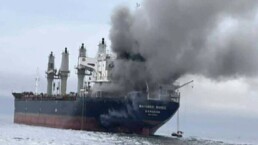
Shipping stocks Rally as Hormuz Traffic plunges 75%
Ship traffic through the Strait of Hormuz — a critical chokepoint handling about 20% of global crude oil and liquefied natural gas shipments — has…
Diana Shipping announces Time Charter Contract for m/v G P Zafirakis with Classic Maritime
Diana Shipping, a global shipping company specializing in the ownership and bareboat charter-in of dry bulk vessels, announced that, through a…
New IMO ESP Code framework for Remote Inspection Techniques
The International Maritime Organisation, through Resolution MSC.584(111) , has adopted amendments to the International Code on the Enhanced…
ABS opens Offshore & Marine Support Center in Bergen
ABS has expanded its capabilities in the Norwegian maritime market with the opening of a cutting-edge support center in Bergen, bringing advanced…
MOL holds giant step memorial ceremony and beach cleanup at Kashima Coast
Memorial and Reflection 20 Years After the Accident: Learning from the Past to Foster an Even Stronger Safety Culture Mitsui O.S.K. Lines, announced…

KEZAD-based Arabian Gulf Steel Industries achieves lowest verified Carbon Footprint for Rebar
CARES UK verified Environmental Product Declaration confirms 139 kg CO₂e per tonne for rebar produced at AGSI’s KEZAD Abu Dhabi facility Arabian…

Indian Register of Shipping announces launch of first fleet support ship INS Surya
Indian Register of Shipping continues to strengthen its role in supporting the Indian Navy and India’s naval shipbuilding capabilities through the…

VLCCs Climbing the Record Charts
LR2 The TC1 75kt MEG/Japan index decreased by only a single point this week to WS928. The corresponding Baltic round-trip TCE fell by $2,000 to…
Subscribe to our newsletter!
if you dont want to swim alone in the ocean of news, sign up for the newsletter, and you will receive daily all the important news of world shipping!
