Sustainable Shipping Initiative launches first data map for Crew Welfare, Wellbeing and Safety, Exposing Critical Gaps for Progressive
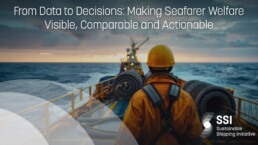

Integrated mapping of crew welfare, wellbeing and safety data in shipping aims to help organisations better understand and act on the human elements of maritime risk and shows significant gaps which are slowing seafarer welfare improvements.
The Sustainable Shipping Initiative (SSI) has released the first integrated, industry-wide mapping of crew welfare, wellbeing and safety data in shipping, funded by the Lloyd’s Register Foundation. Published as a stand-alone resource for the sector, the library is a foundational reference point for owners, operators, insurers, charterers, financiers and seafarer organisations seeking to understand and act on the human elements of maritime risk.
The mapping has revealed that although data exists and is used, application is fragmented, siloed, and could be rapidly improved to support decision-making and seafarer welfare. Although legal definitions of welfare and safety are well established, the mapping shows they are not being applied consistently and that there are no shared industry-wide indicators against which to assess progress. It also highlighted that there is no transparent way to account for good welfare practice, and that information is not being shared consistently across the sector.
Commenting on the research, Ellie Besley-Gould, Chief Executive Officer, Sustainable Shipping Initiative, said: “For the first time, the maritime industry has a single, integrated view of essential welfare, wellbeing and safety data, and what it tells us is sobering. The information we need to manage human risk well exists, but it is fragmented, inconsistent and rarely connected to the decisions that matter. This has real-world implications for seafarers as well as operational and commercial best practices.”
The SSI has identified five critical evidence gaps;
- Fatigue is routinely miscoded as human error in incident reports, systematically underrepresenting the actual driver of losses and meaning that risk is being priced on incomplete information, or not priced at all.
- There is no common KPI baseline as definitions and indicators are not aligned across organisations, so welfare performance cannot be compared or benchmarked at the portfolio level.
- Early-warning capability is weak, with reactive tools missing leading indicators, even though the raw data needed to build them already exists in separate systems across claims, inspections and crew surveys
- There is no mechanism for transparently accounting for the presence of good welfare across the industry meaning data is not joined up.
- Good practice could be spread more widely as only a small number of insurers, P&I clubs, owners, managers and charterers integrate people-risk signals into operational and chartering decisions and without broader information-sharing, the benefit remains confined to early movers.
These gaps map directly onto everyday commercial decisions. Exposure shows up in incident rates and the claims, off-hire time and operational disruption that follow, in crew instability that erodes performance, and in poor onboard conditions that drive disputes, Port State Control detentions and reputational damage. Translated into financial terms, those consequences manifest as reduced cashflow, higher earnings volatility, increased default and restructuring risk, asset impairment and counterparty risk.
The findings derive from a full audit of welfare, wellbeing, and safety data and research that is currently in use. It was combined with input from industry stakeholders, including contributions from owners, operators, insurers, charterers, finance, legal, recruitment, NGOs and seafarers. The outcomes were peer-reviewed by industry participants before publication.
SSI Seafarer Welfare Lead Kristina Kunigenas said “Data only matters when it leads to better decisions. By translating evidence into action – and by working together across industry – we can respond more effectively to seafarers’ needs and ensure welfare initiatives are targeted and meaningful for the people behind the numbers.”
SSI Trustee, Olivia Swift, said “A shared knowledge of where to find information about seafarers’ safety and wellbeing is essential to significantly improve it. It is the missing foundation needed to join up existing work, of knowing what works when it comes to improving seafarer safety and wellbeing, of tracking collective progress.”
Francesca Fairbairn, IHRB member rep, said “There’s so much data out there, but aligning it all in a way that will allow the industry to effectively track and improve seafarers’ rights is the next essential step.”
Yves Vandenborn from North Standard said “To drive real progress for seafarers, we must speak a common language. Currently, the industry’s understanding of welfare and safety is hindered by fragmented data and inconsistent metrics. By establishing uniform definitions and clear KPIs, we can move from isolated insights to a truly integrated landscape.
Furthermore, the transparent sharing of suitably anonymised data is essential; it allows us to identify collective risks and hidden root causes, like stress and fatigue, without compromising individual confidentiality. Only through this shared clarity can we track our progress and ensure a safer, more sustainable future for the entire maritime workforce.”
Menand Karsan, General Manager, Marine at Rio Tinto said, “Improving safety and crew welfare starts with a clear, shared understanding of the data the industry can rely on. This mapping represents a meaningful step towards greater transparency, consistency and alignment, helping support more informed dialogue, better decision-making and targeted action.”
The mapping is available here, and the next phase will require active participation across the value chain to define shared indicators, validate vessel-level signals for wellbeing, and translate evidence into the frameworks that shape underwriting, chartering and finance decisions.
Ellie Besley-Gould concluded: “Closing these gaps is a collective task. The SSI is calling on the industry to join our members in collaborating on closing gaps, co-creating the frameworks the sector currently lacks, and establishing a standardised approach to managing people-related risks at sea before the commercial and human costs of inaction escalate further.”



Related News.

Hong Kong Global Maritime Trade Summit to return for third edition
The International Chamber of Shipping, in collaboration with the Transport and Logistics Bureau of the Government of Hong Kong and the Hong Kong…

Appetite for US crude oil exports climbs despite high freight
South Korea tops US crude destinations at 568,600 b/d VLCC rates to Asia double, closing arbitrage window European refining margins…

Shipping stocks Rally as Hormuz Traffic plunges 75%
Ship traffic through the Strait of Hormuz — a critical chokepoint handling about 20% of global crude oil and liquefied natural gas shipments — has…

Diana Shipping announces Time Charter Contract for m/v G P Zafirakis with Classic Maritime
Diana Shipping, a global shipping company specializing in the ownership and bareboat charter-in of dry bulk vessels, announced that, through a…

New IMO ESP Code framework for Remote Inspection Techniques
The International Maritime Organisation, through Resolution MSC.584(111) , has adopted amendments to the International Code on the Enhanced…

ABS opens Offshore & Marine Support Center in Bergen
ABS has expanded its capabilities in the Norwegian maritime market with the opening of a cutting-edge support center in Bergen, bringing advanced…
MOL holds giant step memorial ceremony and beach cleanup at Kashima Coast
Memorial and Reflection 20 Years After the Accident: Learning from the Past to Foster an Even Stronger Safety Culture Mitsui O.S.K. Lines, announced…

KEZAD-based Arabian Gulf Steel Industries achieves lowest verified Carbon Footprint for Rebar
CARES UK verified Environmental Product Declaration confirms 139 kg CO₂e per tonne for rebar produced at AGSI’s KEZAD Abu Dhabi facility Arabian…

Indian Register of Shipping announces launch of first fleet support ship INS Surya
Indian Register of Shipping continues to strengthen its role in supporting the Indian Navy and India’s naval shipbuilding capabilities through the…

VLCCs Climbing the Record Charts
LR2 The TC1 75kt MEG/Japan index decreased by only a single point this week to WS928. The corresponding Baltic round-trip TCE fell by $2,000 to…
Subscribe to our newsletter!
if you dont want to swim alone in the ocean of news, sign up for the newsletter, and you will receive daily all the important news of world shipping!
