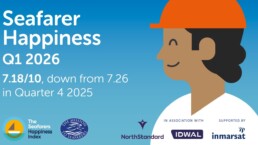

The Q1 2026 Seafarers Happiness Index (SHI) from The Mission to Seafarers has revealed a quarter of two halves. What began as an initial period of stabilisation was abruptly overturned by the outbreak of conflict in the Persian Gulf, leaving many seafarers with critically low necessities and in fear for their safety.
The quarterly survey was tracking upward at 7.35/10 early in the quarter, before dropping to 7.01/10 in the weeks following the start of the conflict. This 4.6% decline represented an unusually rapid rate of deterioration. Even seafarers operating outside the immediate conflict zone reported heightened stress and fear, describing the pervasive sense of uncertainty as a “new pandemic.”
The SHI is a quarterly survey conducted by The Mission to Seafarers, in partnership with Idwal and NorthStandard, and supported by Inmarsat, providing vital insight into the lives and experiences of those working at sea.
The report paints a stark picture of conditions for seafarers stranded in the conflict zone. Respondents described watching drones and missiles fly at low altitudes and hearing fighter jets pass close to their vessels. Stranded crews reported critical shortages of basic necessities, with some forced to boil seawater for drinking and ration food to a single daily meal. Many felt trapped in what the report characterises as a form of “de facto detention”: fearful that requesting relief or repatriation could see them blacklisted by shipping companies and unable to secure future employment.
Connectivity, usually a source of comfort, has become a further pressure point. Increased GNSS jamming made navigation dangerous and in the words of respondents, “terrifying” for captains, while internet blocking and communication blackouts in conflict zones severed seafarers from their families at moments of vital emotional need.
Outside of the Persian Gulf, the data reveals a deepening structural crisis. Workload management recorded the sharpest decline of any category, falling to 6.36/10. Seafarers report that rest hour records are frequently falsified to demonstrate regulatory compliance while actual working hours routinely reach 12 to 14 hours a day, seven days a week, with reduced crew numbers compounding the burden.
Despite the growing risks, wages have remained largely static for a decade, even as company profits and inflation have risen. Wage scores edged up slightly to 6.98/10, but senior officers, particularly Captains, report the lowest happiness scores of any rank, shouldering the greatest responsibility with the least support. Of particular concern for the industry’s long-term outlook: seafarers aged 25 to 35 represent the largest group of respondents and the least satisfied, pointing to a looming recruitment and retention crisis.
Ben Bailey, Director of Programme, The Mission to Seafarers, said: “The Q1 data tells two very different stories. The early signs were encouraging, wellbeing was improving and there were reasons for cautious optimism. But the outbreak of conflict in the Persian Gulf changed everything, and the speed of that deterioration should alarm us all. Behind these numbers are real people, stranded, frightened and cut off from their families. At the same time, the structural pressures we have been tracking for years have not gone away. The industry cannot afford to treat these as separate problems.”
Thom Herbert, Regional Lead, Asia and Crew Welfare Advocat at Idwal, commented: “This quarter’s Seafarers’ Happiness Index is a stark reminder of how quickly global events are felt by those at sea. What we see in the data mirrors what we hear across the industry: seafarers are carrying the human cost of geopolitical instability, alongside long‑standing pressures around workload, fatigue and time away from home.
“Seafarers operate on the front line of world trade, and through our work and conversations across the sector, including with surveyors and operators active in high‑risk regions, we see just how exposed they are to sudden shifts in global risk. This report reinforces the need for the industry to treat seafarer welfare not as an abstract priority, but as a critical responsibility.”
Yves Vandenborn, Head of Loss Prevention Asia-Pacific, NorthStandard, added: “This quarter’s Seafarers Happiness Index indicates a small drop that tells a much bigger story. It reflects how closely life at sea is tied to events ashore, especially during times of conflict whereby being caught in geopolitical tensions could mean physical danger, disruption to food and water, as well as delays in signing on/off – which quickly translates into risk, isolation and uncertainty. As an industry, we need to recognise this and do more to support those who keep global trade moving, especially when the world becomes less stable.”



Related News.

Navigating the Multi-Orbit Era: In Conversation with Intellian’s Jon Harrison at SMM 2026
At SMM 2026 in Hamburg, the rapid evolution of maritime satellite communications took centre stage. Across the exhibition halls, discussions among…

Cyprus ports need joint energy and investment strategy, shipping agents chief says
Cyprus needs a coordinated strategy for shipping, energy and environmental protection to support port investment and modernisation, Cyprus shipping…

MASO Public Affairs introduces MASO Regulatory Intelligence
A new subscription service helping businesses understand what is changing and what it means for them MASO Public Affairs introduces MASO Regulatory…

Anglo-Eastern helps turn CMBTECH’s ammonia ambition into an operational reality
From early feasibility study and risk-based design to newbuilding supervision, crew readiness and technical management, Anglo-Eastern drew on its…

Escalation of attacks threatens to derail recovery in Middle East oil exports
World oil demand is forecast to fall by 2.5 mb/d y-o-y in 4Q26 and 2.6 mb/d on average in 2026. As the Iran war manifests itself through restricted…

New study finds shipping pays twice its share to EU ETS earmarked revenues should triple to help build market for sustainable fuels and technologies
Shipping is responsible for around 10% of EU ETS emissions but pays almost 20% of the ETS bill. Unlike other sectors, it has never received free…

MSARC strengthens maritime mass rescue readiness through training and national live exercise off Dakar, Senegal
Joint MSARC–FHAS programme combines three days of SAR training with a national multi-agency live exercise The Maritime Search and Rescue Council ,…

Sogese report deliveries are still being delayed as container freight rates fluctuate
FOR IMPORTERS Spot rates into the Mediterranean are back at January levels, Far East to Europe reliability sits at pandemic lows, and nearly…

Glencore begins trading on Australian Securities Exchange
Glencore has begun trading on the Australian Securities Exchange under the ASX code GLC. Gary Nagle, Glencore’s CEO, said it was an exciting day for…

BIMCO Shipping Number of the Week
Suez Canal container ship transits exceed 50% of pre-disruption levels "During the first two weeks of October, weekly container ship capacity…
Subscribe to our newsletter!
if you dont want to swim alone in the ocean of news, sign up for the newsletter, and you will receive daily all the important news of world shipping!
