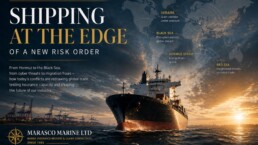

Geopolitics, energy, food security and insurance capacity are converging and redefining how global shipping must think, operate and protect itself.
The global shipping industry is no longer navigating isolated crises. It is operating within a persistent, interconnected risk environment, where geopolitical tensions, energy flows, food security, and insurance capacity are increasingly interdependent.
The conflicts spanning the Middle East, the ongoing Russia–Ukraine war, and the growing instability across key maritime corridors are not temporary disruptions. They are shaping a new structural risk framework — one that will define the industry for the next decade. The question is no longer whether disruption will occur. It is whether operators, insurers, and investors are structurally prepared to absorb and respond to it.
Hormuz and the Fragility of Energy Flows
The Strait of Hormuz remains the most critical energy chokepoint globally. Any sustained disruption — whether through direct conflict, escalation, or strategic pressure — would have immediate and systemic consequences:
– Up to 20% of global oil supply at risk.
– Sharp upward pressure on oil and LNG prices.
– Rapid escalation in bunker costs across all shipping segments.
This is not a theoretical scenario. Even perceived risk translates into:
- Increased War Risk Additional Premiums (APs)
- Tighter voyage underwriting conditions
- Operational hesitation across marginal trades
Shipping, in such conditions, becomes a transmission mechanism of geopolitical stress into global pricing.
The Black Sea: Food Security Under Pressure
The disruption of Ukrainian exports has already altered global grain dynamics.
Ukraine and Russia are central to the supply of:
- Wheat
- Barley
- sunflower oil
- fertilizers
Constraints in the Black Sea corridor lead to:
- Volatility in global food prices
- Re-routing of cargoes at higher cost
- Increased insurance scrutiny and pricing (scrutinizing sanctions forms prior risk approval).
For many importing regions, particularly in North Africa, the Middle East and parts of Asia, this is not simply a logistics issue — it is a stability variable.
Second-Order Effects: Fertilizers and Agricultural Output
Energy and agriculture are tightly linked.
Natural gas remains a key input for fertilizer production. As energy prices rise:
- Fertilizer costs increase
- Agricultural yields decline
- Food prices escalate further
Shipping sits at the center of this chain — moving both inputs and outputs, while absorbing cost inflation across the cycle.
From Physical to Hybrid Risk: The Expanding Threat Landscape
The current environment is not defined solely by traditional war risks.
A broader spectrum of threats is emerging:
- Cyber attacks targeting vessels, navigation systems, and port infrastructure
- Asymmetric threats from non-state actors
- Disruption of critical maritime corridors (Red Sea, Gulf region)
These risks challenge traditional underwriting models.
Marine insurance is transitioning from a reactive indemnity framework to a more dynamic risk assessment and mitigation function.
Insurance Capacity: Discipline Over Expansion
For the Lloyd’s market and the wider specialty insurance sector, the current environment presents a dual reality:
- rising risk frequency and severity
- increased demand for coverage in high-risk areas
However, capacity is unlikely to expand indiscriminately. Instead, we are already observing:
- selective underwriting
- emphasis on data-driven risk assessment
- stricter terms and pricing discipline
The issue is not whether capacity will grow or contract — it is how intelligently it will be deployed. Capital will follow clarity of risk, not volume of demand.

Europe: Economic Pressure and Structural Adjustment
Europe’s position within this evolving landscape is complex. It faces simultaneous pressures:
- energy cost volatility
- industrial competitiveness challenges
- demographic and migration shifts
- Migration flows — whether driven by conflict or policy — introduce:
- labour market adjustments
- fiscal pressures
- long-term structural changes
These developments will influence:
- consumption patterns
- infrastructure demands
- political stability
Shipping demand is ultimately tied to these underlying economic realities.
Shipping Economics: Cost, Frequency, and Trade Patterns
The cumulative effect of these pressures is already visible:
- higher transportation costs
- potential reduction in trade frequency on marginal routes
- shifts in global sourcing and trade flows
Operators will increasingly need to make decisions based not only on freight rates, but on:
- risk-adjusted economics
- insurance availability
- geopolitical exposure
Crisis as a Filter — Not Just a Threat
There is a recurring principle in times of disruption:
- Periods of instability do not affect all participants equally.
- They act as a filter.
They reward those who:
- understand risk ahead of the curve
- structure protection appropriately
- maintain financial and operational discipline
Historically, this has been evident within Greek shipping. Periods of volatility have often coincided with strategic expansion and repositioning, not contraction.
Marasco Marine Ltd: A Risk-First Approach
At Marasco Marine Ltd, our approach has always been grounded in one principle:
- Risk must be understood before it is transferred.
The coming years will require:
- tailored insurance structures aligned with actual claims exposure
- proactive identification of coverage gaps
- integration of claims experience into underwriting strategy
Insurance, in this context, is not a compliance requirement. It is a financial instrument that must perform under stress.
The true value of a policy is not measured at placement — but at the moment of a claim.
A Narrower, More Demanding Environment
The shipping industry is entering a phase where:
- geopolitical risk is persistent
- insurance capacity is selective
- economic pressures are interconnected
This environment does not eliminate opportunity. It refines it. The path forward is narrower — but clearer for those who are prepared.
The defining factor will not be scale.
It will be clarity, discipline, and the ability to act ahead of events.
By Anastasios Andreas Maraslis – Founder/President of *Marasco Marine Ltd.



Related News.
Hong Kong Global Maritime Trade Summit to return for third edition
The International Chamber of Shipping, in collaboration with the Transport and Logistics Bureau of the Government of Hong Kong and the Hong Kong…

Appetite for US crude oil exports climbs despite high freight
South Korea tops US crude destinations at 568,600 b/d VLCC rates to Asia double, closing arbitrage window European refining margins…
Shipping stocks Rally as Hormuz Traffic plunges 75%
Ship traffic through the Strait of Hormuz — a critical chokepoint handling about 20% of global crude oil and liquefied natural gas shipments — has…
Diana Shipping announces Time Charter Contract for m/v G P Zafirakis with Classic Maritime
Diana Shipping, a global shipping company specializing in the ownership and bareboat charter-in of dry bulk vessels, announced that, through a…
New IMO ESP Code framework for Remote Inspection Techniques
The International Maritime Organisation, through Resolution MSC.584(111) , has adopted amendments to the International Code on the Enhanced…

ABS opens Offshore & Marine Support Center in Bergen
ABS has expanded its capabilities in the Norwegian maritime market with the opening of a cutting-edge support center in Bergen, bringing advanced…
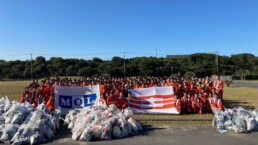
MOL holds giant step memorial ceremony and beach cleanup at Kashima Coast
Memorial and Reflection 20 Years After the Accident: Learning from the Past to Foster an Even Stronger Safety Culture Mitsui O.S.K. Lines, announced…

KEZAD-based Arabian Gulf Steel Industries achieves lowest verified Carbon Footprint for Rebar
CARES UK verified Environmental Product Declaration confirms 139 kg CO₂e per tonne for rebar produced at AGSI’s KEZAD Abu Dhabi facility Arabian…
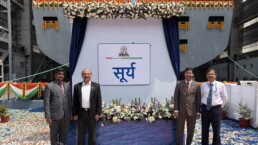
Indian Register of Shipping announces launch of first fleet support ship INS Surya
Indian Register of Shipping continues to strengthen its role in supporting the Indian Navy and India’s naval shipbuilding capabilities through the…

VLCCs Climbing the Record Charts
LR2 The TC1 75kt MEG/Japan index decreased by only a single point this week to WS928. The corresponding Baltic round-trip TCE fell by $2,000 to…
Subscribe to our newsletter!
if you dont want to swim alone in the ocean of news, sign up for the newsletter, and you will receive daily all the important news of world shipping!
