IMO Urged To Ramp Up Efforts on Curbing Shipping’s Black Carbon Impacts on Arctic

Adoption of Northeast Atlantic Emission Control Area Welcomed
As this week’s meeting of the International Maritime Organization’s (IMO) Marine Environment Protection Committee (MEPC 84, April 27-May 1) closes, the Clean Arctic Alliance called on Arctic and climate-vulnerable states to lead on ramping up efforts to regulate black carbon emissions from international shipping by defining the geographical extent for the IMO’s polar fuel measure – to help understand the measure’s impact.
The Alliance welcomed adoption of the North East Atlantic Emission Control Area, along with some progress made on underwater noise and marine pollution from scrubbers.
“To curb black carbon emissions in the Arctic, IMO member states must spend the coming months deliberating over the appropriate geographic scope for such a polar fuel concept, in order to ensure effectiveness of the proposed measure – countries need to know where on shipping charts that the rules will apply”, said Dr Sian Prior, Lead Advisor to the Clean Arctic Alliance.
“Despite the current geopolitical and energy turmoil, Arctic governments must take the lead on polar fuels in order to drive the reduction of black carbon emissions in the Arctic. They must work closely with other IMO members on defining the geographic application of a new measure between now and the conclusion of November’s MEPC 85, so they can submit a new or amended proposal to an IMO meeting in early 2027 – PPR 14”, said Prior.
Black Carbon and Polar Fuels Measure
A paper submitted to MEPC 84 by eNGOs, International efforts to reduce emissions of Black Carbon, provides IMO member states with evidence that can underpin action to curb the impact on the Arctic of emissions of black carbon from international shipping.
The paper, which MEPC 84 referred to a future IMO meeting, PPR 14, comments on the latest polar fuel concept discussions, and highlights ongoing research and a number of recent initiatives focused on reducing black carbon emissions from a variety of sources due to the impact on climate, on the environment and communities and on the Arctic.
The Arctic is warming four times faster than elsewhere on Earth; in March, Arctic winter sea ice tied for its lowest measured level. Black carbon is a short-lived climate pollutant, produced by the incomplete burning of fossil fuels, and accelerates melting if deposited onto snow and ice and has a disproportionate impact when released in and near to the Arctic (more information below).
The European State of the Climate 2025 report by the European Centre for Medium-Range Weather Forecasts published earlier this week shows that in 2025 as well as a significant reduction in snow and ice cover across Europe (including some parts of the Arctic) the Greenland ice sheet lost around 139 gigatonnes of ice and that glaciers in Europe saw a net mass loss, with the most negative mass balances observed in Iceland. The report confirms the Arctic as the fastest-warming region on Earth.
“Despite the current geopolitical and energy turmoil, Arctic governments must take the lead on polar fuels in order to drive the reduction of black carbon emissions in the Arctic. They must work closely with other IMO members on defining the geographic application of a new measure between now and the conclusion of November’s MEPC 85, so they can submit a new or amended proposal to an IMO meeting in early 2027 – PPR 14”, said Prior.
- MEPC 84/10/3: International efforts to reduce emissions of Black Carbon
- Further reading: Now Arctic Governments Must Take Multilateralist Approach to Achieve Arctic Fuel Measure
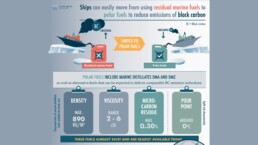
- Infographic: Polar Fuels Can Reduce the Impact of Black Carbon on the Arctic
Emission Control Areas
Agreed in April 2025, the IMO’s North-East Atlantic Emission Control Area(ECA) should have been adopted during a special meeting (MEPC/ES.2) of the IMO in October 2025, but was finally adopted this week during MEPC 84, and will come into force in September 2027.
“We welcome the adoption of the North East Atlantic Ocean Emission Control Area, the world’s largest ECA for sulphur and nitrogen oxide ”, said Carolina Silva, Shipping Policy Officer at ZERO, a Clean Arctic Alliance member. “Implementation of the North-East Atlantic ECA will significantly and cost-effectively reduce ships’ emissions, improve air quality, and contribute to improving public health and environmental protection in the north-east Atlantic region including the Arctic waters around Greenland and Iceland”,
“Despite one reservation from Russia whose waters are not even within the ECA, this is a massive win for coastal and Indigenous communities and for the marine environment from Portugal to Greenland, but also an opportunity to look ahead and fill in the gaps”, says Silva. “The Atlantic ECA will connect existing ECAs in the North and the Baltic Seas, and the recently adopted Canadian Arctic waters and Norwegian EEZ, to the Mediterranean SECA in the south. It’s very clear that moving forward, the Portuguese islands of Madeira and the Azores, as well as the Spanish Canary Islands, should be included both to guarantee an economic level playing field, but most importantly to protect the coastal communities from the harmful effects of air pollution from ships.”
By restricting the use of the most polluting shipping fuels, the North East Atlantic Emission Control area will see SOx emissions cut by up to 82% and particulate matter by 64%, which will avoid thousands of premature deaths by 2050, and have a co-benefit of reducing the black carbon emissions which have a detrimental impact on Arctic snow and ice.
“The positive impacts from adoption of this emission control area will be further bolstered by action on black carbon by the IMO”, said Silva. “Black carbon is one of the longest, unresolved issues running at the IMO, and must be dealt with without delay.”
- Emission Control Area Press Release: World’s largest Emission Control Area adopted by International Maritime Organization
- Infographic: Why Emission Control Areas Are the Best Tool for Tackling Air Pollution from Ships at Sea
Underwater Noise
“Efforts to continue the prioritization of underwater radiated noise reduction was on display this week as evidenced by numerous interventions made by member states supporting the two-year extension of the Experience Building Phase through 2028 as well as formal comments made by the MEPC Chair acknowledging the importance and necessary planning required for an IMO-commissioned study on global URN emissions to be identified by MEPC 85”, said CT Harry, Senior Ocean Policy Analyst at Environmental Investigation Agency, a member of the Clean Arctic Alliance.
“A majority of member countries also gave indication that progressing a URN policy roadmap is key for ensuring momentum on international cooperation and technical exchange of knowledge on the co-benefits of energy efficiency and URN reduction within the shipping industry”, said Harry.
Infographic: Underwater Noise From Ships
Scrubbers
The proposed concept for a new environmental standard using fuel-based compliance as a benchmark was welcomed by a number of member states during MEPC 83 as a constructive basis for addressing pollution from scrubbers. The paper was forwarded to PPR 14 for further consideration – the next step is to further develop the concept ahead of PPR 14.
“The existing rules create an uneven playing field by allowing scrubber‑equipped ships to pollute more than ships using cleaner, lower sulfur fuels. Our proposal aims to eliminate that inconsistency”, said Sam Davin, Head of Delegation to MEPC 84 for WWF, a Clean Arctic Alliance member.
At MEPC 84, eNGOs WWF and Pacific Environment – both Clean Arctic Alliance members – sought views on a technology-neutral, goal-based approach to discharges using a fuel-based compliance approach – using scrubbers would only be permitted if the environmental performance of scrubbers was equivalent to the use of cleaner fuels i.e. resulted in no pollutant discharge into the ocean and reduced air pollution in line with emissions from cleaner fuels).
“The lack of IMO regulation of scrubbers discharges is leading to an increasing patchwork of regulation which leads to fragmentation, confusion and environmental destruction”, said Davin. “The IMO must put in place global regulation surrounding scrubber use or scrubber wastewater discharges.”

Black Carbon Emissions in the Arctic
A new report by Energy and Environment Research Associates (EERA), commissioned by the Clean Arctic Alliance, Black Carbon Emissions from Ships in the Arctic 2019 – 2024, provides a comprehensive analysis of tank-to-wake Black Carbon (BC) emissions from Arctic shipping using three geographic definitions: a latitudinal band north of 60oN (excluding the Baltic Sea and Gulf of Alaska), the Polar Code Arctic waters, as well as a broader ecological boundary defined by the Arctic Monitoring and Assessment Programme (AMAP). It estimates BC emissions for the years 2019, 2022 and 2024.
The report examines the seasonal patterns of Arctic shipping routes, profiling ship characteristics, fuel consumption by EEZ and ship type as well as energy use. Historical estimates included in the report show how Arctic shipping activity and associated emissions have changed over time, while forecasts reveal how growth in emissions could affect the Arctic, and inform decisions on fuel choices.
Based on the report, it is clear that distillates are the dominant fuel choice in the Arctic. However, residual fuel use remains present and is increasing as ship traffic grows and receding sea ice opens new waterways. Arctic routes, including the Northern Sea Route (NSR) and North-West Passage (NWP), are seeing increasing traffic that passes through the Polar Code region, as such these activities will be captured when the Arctic HFO ban goes into effect. Full enforcement of the ban is not scheduled until 2029, and because its scope is limited to the Polar Code area, a considerable volume of traffic that affects the ecologically-defined Arctic region may still continue to utilize HFO. Norway’s Exclusive Economic Zone (EEZ) has the highest BC emissions within the 60°N and AMAP Arctic areas, but sees minimal reductions (≤ 2.1%) under the ban due to the Polar Code boundary’s limited reach.
Switching from HFO to lower-sulphur residual fuels (VLSFO, ULSFO) or distillate fuels/blends (MGO, MDO) reduces BC emissions, however switching to low sulphur residual fuels instead of distillates does not produce the same level of reductions. Even with full implementation of the HFO ban within the Polar Code region, the BC reductions remain limited due to already widespread use of distillate. Even under an optimistic assumption that all ships shift entirely to distillates, rather than low-sulphur residual fuels once the ban takes effect, this analysis finds a 2.4 to 5.0% decrease in total BC emissions, depending on geographical scope. Greater reductions in Arctic BC emissions could be achieved through stronger regulatory measures. While ship activity is increasing in the Polar Code region, the highest concentration of traffic falls within broader Arctic geographical scopes, along coastal areas with dense port activity, especially concentrated along Norway. Ship traffic is however growing throughout the Arctic region and associated Black Carbon emissions have grown by 47% in the five years from 2019 to 2024.
The geographic scope of the Arctic fuel measure proposed for inclusion in MARPOL Annex VI is yet to be decided. The scope is proposed to include waters north of 60oN latitude , which would also encompass all Polar Code Arctic waters. The Arctic Council’s AMAP or AHDR boundaries are possible alternatives, but it is important to recognise that restricting a measure to the same geographic scope as the Arctic HFO prohibition in MARPOL Annex Iwould not result in any beneficial outcome in terms of air pollution. The Clean Arctic Alliance has prepared more information on potential geographic scopes which is available in PPR 13/6/3.
In the Atlantic part of the Arctic, over 366,000MT of residual fuel use in 2024 was beyond the Polar Code Arctic waters. The largest share of residual fuel burn in the Atlantic Arctic was in the Norwegian Sea EEZ (over 70%), with 9.6% in Russia’s EEZ, 9% in Iceland’s EEZ, 6.5% in Greenland’s EEZ and 1% in the UK’s EEZ. It is also worth noting that the largest percentage of Arctic shipping is flagged to Norway with some 25% being international ships in its NIS registry. Most EU MRV shipping operating in the Arctic is expected to approach the Arctic via the North Sea meaning either a 60oN latitude geographic scope or an AMAP boundary geographic scope would include these ships.
The proposal in PPR 13/6 also resolves concerns around potentially catastrophic Arctic fuel spill cleanup due to low pour point of blended fuels, voiced by Norway and Iceland at previous sessions of PPR and MEPC.
About Black Carbon
Black carbon is a short-lived climate pollutant, produced by the incomplete burning of fossil fuels, with an impact more than sixteen hundred times that of CO2 over a 20 year period. It makes up around one-fifth of international shipping’s climate impact. Not only does it contribute to warming while in the atmosphere, black carbon accelerates melting if deposited onto snow and ice – hence it has a disproportionate impact when released in and near to the Arctic.
The melting snow and ice exposes darker areas of land and water and these dark patches then absorb further heat from the sun and the reflective capacity of the planet’s polar ice caps is severely reduced. More heat in the polar systems – results in increased melting. This is the loss of the albedo effect.
Declines in sea ice extent and volume are leading to a burgeoning social and environmental crisis in the Arctic, while cascading changes are impacting global climate and ocean circulation. Scientists have high confidence that processesare nearing points beyond which rapid and irreversible changes on the scale of multiple human generations are possible. Scientists say it is now too late to save summer Arctic sea ice, and research has shown that “preparations need to be made for the increased extreme weather across the northern hemisphere that is likely to occur as a result.”
Black carbon also has a negative impact on human health including premature death and harmful effects on the cardiovascular system (heart, blood and blood vessels), and recent research has found black carbon particles in the body tissues of foetuses, following inhalation by pregnant mothers.
The need to reduce emissions of black carbon because of both the climate andhealth impacts has been long recognised. On land, considerable effort has been made to ban dirtier fuels in power stations, to install diesel particulate filters on land-based transport, and to improve the burning of dry wood – all to reduce emissions of black carbon and improve air quality. However, at sea the same efforts have not yet been made.



Related News.

Columbia Group calls for greater focus on retaining women at sea as second She Beyond Conference takes place
Columbia Group has called on the maritime industry to create a future where women can thrive, progress and lead at sea, as it celebrated the second…
Neptune Group Welcomes “NIKOS TRAVLOS”
The new vessel proudly bears the name of Neptune's founder, who laid the foundation for the creation and enduring evolution of the Group. Her…

Wildcat Defense enters into exclusive agreement to acquire Fraser Shipyards
American family firm takes the next step in its strategy to rebuild U.S. shipbuilding and repair capacity, following its offer for Austal USA.…
Kawasaki signs strategic partnership MOU with Romania’s Transgaz for Onshore Hydrogen Gas Transport
Establishing a model for large-scale hydrogen supply and transport via pipelines Kawasaki Heavy Industries, announced at the Romania–Japan…

UK P&I Club and TT Club secure regulatory approval for Thomas Miller acquisition
The UK P&I Club and TT Club announce the successful completion of their joint acquisition of the Thomas Miller Holdings group, marking a major…

Valenciaport presents its Sandbox at PEIC’26 as a tool to bridge the gap between innovation and implementation
The opening session featured a discussion between Valenciaport President Mar Chao and Valenciaport Foundation Director Antonio Torregrosa. The…

Major investments strengthen Gothenburg RoRo Terminal
Expanded terminal areas, new rail connections and modernised quays are among the investments that have strengthened Gothenburg RoRo Terminal in…

ABP appoints key roles in the Humber
Associated British Ports has made two key appointments at its container terminals strengthening its unitised operations at the ports of Immingham…
Xinhua Silk Road 2026 North Bund Forum unveils 20 shipping-related achievements
The 2026 North Bund Forum opened in Shanghai on October 20 with 20 key shipping-related achievements spanning international cooperation, green…
Ports encouraged to prepare now for advanced nuclear in maritime and clean energy
New joint Lloyd’s Register and British Ports Association paper sets out a practical readiness pathway for ports considering nuclear-powered vessels,…
Subscribe to our newsletter!
if you dont want to swim alone in the ocean of news, sign up for the newsletter, and you will receive daily all the important news of world shipping!
