Asia Pacific ports advance cross-sector hydrogen and e-fuel readiness
Accelleron, a global technology leader in turbocharging, fuel injection, and digital solutions in the marine and energy industries, highlights how Asia Pacific ports are building early foundations for green hydrogen-based e-fuel markets through coordinated cross-sector action. This momentum is being driven not only by decarbonization, but also by a focus on long-term energy security across the region.
The ships are ready, the fuels are missing. While vessel technology has advanced rapidly and dual-fuel ships capable of running on methanol and ammonia are setting sail, fuel production remains very slow, due to fragmented demand, high upfront costs, and the scale of infrastructure required.
“Where e-fuel projects succeed, energy and multiple hard-to-abate industries move together. Combining demand creates contracts large enough to start building, shares risk so projects become insurable, and allows developers to build infrastructure once instead of duplicating it,” says President of the Medium- and Low-Speed Division at Accelleron, Christoph Rofka. “Ports can anchor that process by planning and developing bunkering infrastructure to supply inland power generation and industrial demand first, preparing the way for future maritime uptake.”
Accelleron’s report Asia Pacific as the proving ground for overcoming shipping’s carbon-neutral fuel deadlocks shows early green hydrogen and e-fuel projects advancing across major ports, including Singapore, Yokohama, Busan, and Shanghai. These pilots are being driven by national hydrogen and e-fuel strategies linked to industrial decarbonization and energy security objectives, rather than shipping demand alone.
The research shows the outline of an early e-fuel market emerging in Asia Pacific, with ports taking on complementary roles based on their resource bases, industrial structures, and geographies. A supply-demand dynamic architecture for hydrogen and e-fuels is forming, with ports leveraging their strengths to serve as either producers, connectors, receivers, or export sources.
In addition, high-volume trade corridors like the Australia-Singapore-China iron ore route, are emerging as practical pathways for early fuel deployment, aligning industrial demand (iron ore conversion with hydrogen), maritime traffic, and port readiness. The research also highlights the Singapore-Rotterdam route as a developing link between Asia Pacific’s emerging e-fuel system and European demand centers.
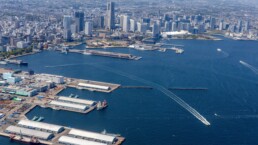
The Port of Yokohama illustrates how national policy, local government coordination, and industry collaboration are realizing this public-private cross-sector approach in practice. As one of Japan’s designated Carbon Neutral Ports under the program led by the Ministry of Land, Infrastructure, Transport and Tourism, Yokohama is aligning port development with nearby industrial demand and the national energy strategy.
The Port of Yokohama’s roadmap comprises 145 public‑private partnership projects covering fuel-handling systems, hydrogen, ammonia, and methanol supply chains, as well as a robust program of port-area decarbonization, including shore power, electrified equipment, and financing mechanisms. It is also coordinating closely with neighboring Kawasaki City to align regional fuel supply planning and industrial energy demand.
“To achieve decarbonization in international shipping and logistics, and in heavy industries such as power generation, steelmaking, and chemicals, Japan’s Ministry of Land, Infrastructure, Transport and Tourism has launched the Carbon Neutral Port initiative, which aims to broadly decarbonize port areas, where all of these converge,” says Director for Carbon Neutral Port Promotion, Port and Harbor Bureau, City of Yokohama, Hitoshi Nakamura.
“Public support is critical to enabling early development, especially when we are working across multiple sectors. Through the Yokohama Port CNP Sustainable Finance Framework, we have made it easier for companies to access green loans and other financing, and in a short time have launched 145 projects spanning port decarbonization, fuel-related infrastructure, and supply chains. We see that this structured, public-private, cross-sector approach is effective in accelerating infrastructure and market development, and we are seeing very promising progress toward the goals of the CNP initiative.”
Download the full report: Accelerating to Net Zero: Asia Pacific as the proving ground for overcoming shipping’s carbon neutral fuel deadlocks?



Related News.

Navigating the Multi-Orbit Era: In Conversation with Intellian’s Jon Harrison at SMM 2026
At SMM 2026 in Hamburg, the rapid evolution of maritime satellite communications took centre stage. Across the exhibition halls, discussions among…
Cyprus ports need joint energy and investment strategy, shipping agents chief says
Cyprus needs a coordinated strategy for shipping, energy and environmental protection to support port investment and modernisation, Cyprus shipping…

MASO Public Affairs introduces MASO Regulatory Intelligence
A new subscription service helping businesses understand what is changing and what it means for them MASO Public Affairs introduces MASO Regulatory…
Anglo-Eastern helps turn CMBTECH’s ammonia ambition into an operational reality
From early feasibility study and risk-based design to newbuilding supervision, crew readiness and technical management, Anglo-Eastern drew on its…

Escalation of attacks threatens to derail recovery in Middle East oil exports
World oil demand is forecast to fall by 2.5 mb/d y-o-y in 4Q26 and 2.6 mb/d on average in 2026. As the Iran war manifests itself through restricted…
New study finds shipping pays twice its share to EU ETS earmarked revenues should triple to help build market for sustainable fuels and technologies
Shipping is responsible for around 10% of EU ETS emissions but pays almost 20% of the ETS bill. Unlike other sectors, it has never received free…
MSARC strengthens maritime mass rescue readiness through training and national live exercise off Dakar, Senegal
Joint MSARC–FHAS programme combines three days of SAR training with a national multi-agency live exercise The Maritime Search and Rescue Council ,…
Sogese report deliveries are still being delayed as container freight rates fluctuate
FOR IMPORTERS Spot rates into the Mediterranean are back at January levels, Far East to Europe reliability sits at pandemic lows, and nearly…
Glencore begins trading on Australian Securities Exchange
Glencore has begun trading on the Australian Securities Exchange under the ASX code GLC. Gary Nagle, Glencore’s CEO, said it was an exciting day for…
BIMCO Shipping Number of the Week
Suez Canal container ship transits exceed 50% of pre-disruption levels "During the first two weeks of October, weekly container ship capacity…
Subscribe to our newsletter!
if you dont want to swim alone in the ocean of news, sign up for the newsletter, and you will receive daily all the important news of world shipping!
