Key amendments to China’s new Maritime Code


The 2025 Chinese Maritime Code (the “Code”), effective from 1 May 2026, introduces several important changes that will impact shipowners, charterers, and cargo interests engaged in international trade involving Chinese ports. We have prepared a summary of the main amendments and their practical implications:
1. Limitation periods
- Interruption of limitation
The limitation period for claims can now be interrupted not only by commencing legal proceedings or arbitration, but also by a simple demand for performance (such as a letter of claim), upon which the limitation period will run afresh. This makes it easier for claimants to preserve their rights. - Recourse claims
For recourse claims arising from cargo disputes, if more than 90 days remain in the original one-year limitation period after settlement, that period continues to apply. If fewer than 90 days remain, a new 90-day period is granted. - General average claims
General average claims are now subject to a six-year long-stop limitation period, running from the end of the common maritime adventure, regardless of when adjustment is completed.
2. Real rights of ships
- Transfer of mortgaged ships
Mortgaged ships can now be transferred without the mortgagee’s consent, unless otherwise agreed. The mortgage remains attached to the ship after transfer.
3. Contracts for the carriage of goods by sea
- Mandatory application of cargo liability provisions
For international contracts for the carriage of goods by sea where loading or discharge is at a Chinese port, the Code’s cargo liability provisions apply mandatorily. Parties cannot contract out of these minimum standards, even by choosing a different governing law. - Expanded definition of actual carrier
The definition of “actual carrier” is expanded to a person entrusted by the carrier, or by way of sub-entrustment, who actually performs all or part of the carrier’s cargo-handling obligations. This makes terminal operators and others potentially liable for cargo loss or damage, but also allows them to benefit from package or unit limitations. - Compensation for cargo loss or damage
Compensation is now based on the market price at the place and time of delivery, with CIF value as a fallback where the market price cannot be determined. - Responsibility for storage costs
Responsibility for storage costs at the discharge port generally shifts to the shipper, unless the consignee has exercised contractual rights but fails to take delivery. - Carrier’s right of lien
The carrier’s right of lien is clarified. Carriers can now exercise a lien over cargo, even where such cargo is not owned by the debtor, subject to certain limitations and provided that the underlying claims (such as unpaid freight, general average contributions, or demurrage) arise out of that carriage.
4. Limitation of liability
- Adoption of higher limits in relation to liability
The Code adopts the higher liability limits set out in the 1996 Protocol to the LLMC 1976, significantly increasing the amounts shipowners and other parties may be required to pay for qualifying claims. - Parties entitled to limit liability
The Code makes clear that ship managers and voyage charterers including slot charterers are entitled to limitation of liability otherwise available to shipowners.
5. Oil pollution liability and compensation
- Clear scope of compensation
The Code now expressly covers compensation for property damage (other than to the polluting ship itself), loss of income due to oil pollution, and the costs of preventive measures taken to minimise pollution damage. - Strict liability and limitation
Where a vessel leaks oil following collision, the Code suggests that compensation liability shall be borne by the leaking vessel, which may then seek recourse against the other vessel involved in the collision.
Practical implications
These changes modernise China’s maritime legal framework, strengthen protections for cargo interests, and clarify the rights and obligations of shipowners, charterers, and terminal operators. The new rules are particularly relevant for international trade involving Chinese ports, and all parties—including those contracting under voyage charterparties—should review their contracts and operational practices to ensure compliance ahead of the May 2026 implementation date.
It is also pertinent to note that, while this summary was being prepared, the PRC Supreme People’s Court issued guidance on the application of the Code during the transition period. The general principle is that the Code will apply to matters continuing beyond, or arising after, 1 May 2026. However, the position may vary depending on the nature of the case, and it is therefore advisable to seek legal advice when the issue arises.
We would like to thank Mr. John Wang of Wang Jing & Co for his assistance in preparing this summary. For more information, please refer to the attached articles prepared by Wang Jing & Co.
Source: Skuld



Related News.

Navigating the Multi-Orbit Era: In Conversation with Intellian’s Jon Harrison at SMM 2026
At SMM 2026 in Hamburg, the rapid evolution of maritime satellite communications took centre stage. Across the exhibition halls, discussions among…
Cyprus ports need joint energy and investment strategy, shipping agents chief says
Cyprus needs a coordinated strategy for shipping, energy and environmental protection to support port investment and modernisation, Cyprus shipping…

MASO Public Affairs introduces MASO Regulatory Intelligence
A new subscription service helping businesses understand what is changing and what it means for them MASO Public Affairs introduces MASO Regulatory…
Anglo-Eastern helps turn CMBTECH’s ammonia ambition into an operational reality
From early feasibility study and risk-based design to newbuilding supervision, crew readiness and technical management, Anglo-Eastern drew on its…

Escalation of attacks threatens to derail recovery in Middle East oil exports
World oil demand is forecast to fall by 2.5 mb/d y-o-y in 4Q26 and 2.6 mb/d on average in 2026. As the Iran war manifests itself through restricted…
New study finds shipping pays twice its share to EU ETS earmarked revenues should triple to help build market for sustainable fuels and technologies
Shipping is responsible for around 10% of EU ETS emissions but pays almost 20% of the ETS bill. Unlike other sectors, it has never received free…

MSARC strengthens maritime mass rescue readiness through training and national live exercise off Dakar, Senegal
Joint MSARC–FHAS programme combines three days of SAR training with a national multi-agency live exercise The Maritime Search and Rescue Council ,…
Sogese report deliveries are still being delayed as container freight rates fluctuate
FOR IMPORTERS Spot rates into the Mediterranean are back at January levels, Far East to Europe reliability sits at pandemic lows, and nearly…

Glencore begins trading on Australian Securities Exchange
Glencore has begun trading on the Australian Securities Exchange under the ASX code GLC. Gary Nagle, Glencore’s CEO, said it was an exciting day for…
BIMCO Shipping Number of the Week
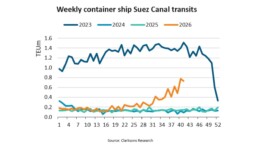
Suez Canal container ship transits exceed 50% of pre-disruption levels "During the first two weeks of October, weekly container ship capacity…
Subscribe to our newsletter!
if you dont want to swim alone in the ocean of news, sign up for the newsletter, and you will receive daily all the important news of world shipping!
