More Output, Less Meaning: How AI is Changing Day-to-Day Work

MOO Survey Finds 84% of Employers Prioritizing Speed Over Quality, Yet Employees Still Crave Human Connection and Creative Thinking
MOO, the leading design company specializing in premium branded merchandise and print services, today unveiled new research capturing the workplace in the age of AI. The survey of 1,000 U.S. office workers reveals a workforce that has rapidly embraced AI, with over half reporting it has made them more efficient, but prompting concerns of whether quality is suffering and expectations between leadership and employees are widening. Amid these pressures, human connection remains irreplaceable as coworkers continue to be central to employee wellbeing, and traditional analog tools are helping people find a sense of balance.
“AI should make work better, not just faster,” said Ray’n Terry, Chief People Officer at MOO. “If all it does is create more work for employees, we’ve missed the point. The real value is giving people the space for more rest, for more creativity, and for the human connections that make work worth doing in the first place.”
Efficiency Gains
AI is making us faster at our jobs, but that speed may not be translating into better work, and even worse, it may just be creating more work. When quality control is slipping even as output climbs, the risk is that AI becomes a generator of volume rather than value.
- Speed over quality: The findings show that over 4 in 5 (84%) respondents agree that their employer prioritizes speed over quality more than they did a year ago.
- Faster doesn’t mean better: While AI is speeding up internal processes, workers said quality control and attention to detail (41%), thoughtful decision-making and strategic planning (39%), and creativity and original problem solving (37%) are all slowing down.
- Efficiency as top priority: 40% of workers surveyed were most likely to say that AI has most impacted the way work feels by making it more efficient.
The Confidence Gap
One reason that the quality of work may be suffering: employees are under pressure to adopt AI, driving usage at an accelerating pace, but faster than genuine understanding. Rather than admitting uncertainty, many are masking real confusion behind a facade of AI fluency.
- The demand to keep up: As leadership looks to implement AI practices to keep up with being innovative, 94% of employees who use AI at work feel pressure to appear “AI‑savvy.”
- Faking it: In the same vein, half (52%) admit they sometimes pretend to understand AI tools or outputs when they actually don’t.
- Blurring human and machine credit: Just over 4 in 5 (81%) respondents say feeling valued and appreciated at work is easier than it was a few years ago, but that recognition might be misplaced. 78% of AI users report receiving recognition for work that was largely generated by AI.
Employer Expectations
In a tightening labor market, employers’ expectations are rising while employees are increasingly spending valuable time refining AI content to make it usable. The result is a workforce under more pressure, with less room for work that actually moves the needle.
- Widening strain: Among AI users, 88% report that the time they spend bridging the gap between leadership expectations and what’s actually feasible for their team and colleagues has increased. Leadership may be overestimating what can be achieved, with employees left to bridge the disconnect between ambition and practicality.
- Lost in translation: Over half (55%) of workers say they regularly rework or rephrase complex information (e.g., AI-generated content or leadership directives) for their teams.
- Humanizing AI outputs: While AI is making us efficient, not everything that’s generated is usable – 58% of workers say they frequently spend time editing, humanizing, or “fixing” AI outputs from colleagues or leadership before they go to clients/teams.
Elevating The Human Side
As the need to perform in the workplace rises, employees are focused on sharpening the soft skills that set them apart. The human abilities that make a great leader are more important than ever, and AI can free up time for the creative strategy and big-picture thinking that matter most.
- Recognition for human strengths: Employees want to be valued for what AI can’t do: 30% aim to be recognized for problem-solving skills, and 29% for strategic thinking. The challenge is about making the thinking count.
- Shifting toward higher-level work: As AI handles some of the manual processes of day-to-day work, 92% of respondents report that their work has shifted toward higher-level activities (e.g., strategic, creative, decision-making).
People Still Need People
Despite our broadening relationship with AI, employees are prioritizing human connection more than ever, becoming more intentional about how they show up for each other.
- Setting the stage: Workers surveyed about AI’s impact said it has made work feel more mechanical (27%), more isolated (25%), and more overwhelming (24%).
- Coworkers matter most: When it comes to feeling supported at work, coworkers matter most: 32% of employees say their coworkers are the biggest factor in whether they feel supported, ahead of their manager (28%) and HR (21%).
- Peer support strengthens: Half of respondents (47%) still have informal, non‑work conversations multiple times a day, even across distributed or hybrid setups, and 83% say it’s easier to get practical support from peers (career advice, conflict resolution, skill development) than it was two or three years ago.
Offline Advantage
As digital demands intensify, many employees are responding by deliberately stepping back from their screens. This shift toward “offline” methods is a strategy for focus, creativity, and well‑being in a world of constant digital input.
- Offline methods on the rise: Four in five employees (80%) say their use of analog tools has increased in the past 2-3 years.
- Why workers are going analog: The top reasons include better memory (48%), improved focus (39%), and greater privacy (38%).
- Preference for physical tools: 45% say they often prefer offline methods even when digital ones are available.
As organizations navigate an increasingly AI-driven world, MOO’s findings reveal a workforce actively seeking balance. By combining the efficiency of digital innovation with the creativity and authenticity that come from real human connection, organizations can unlock the best of both worlds. The future of work may be digital, but meaning still lives in how we connect, create, and make our mark offline.
Source: BUSINESS WIRE



Related News.

Navigating the Multi-Orbit Era: In Conversation with Intellian’s Jon Harrison at SMM 2026
At SMM 2026 in Hamburg, the rapid evolution of maritime satellite communications took centre stage. Across the exhibition halls, discussions among…

Cyprus ports need joint energy and investment strategy, shipping agents chief says
Cyprus needs a coordinated strategy for shipping, energy and environmental protection to support port investment and modernisation, Cyprus shipping…

MASO Public Affairs introduces MASO Regulatory Intelligence
A new subscription service helping businesses understand what is changing and what it means for them MASO Public Affairs introduces MASO Regulatory…

Anglo-Eastern helps turn CMBTECH’s ammonia ambition into an operational reality
From early feasibility study and risk-based design to newbuilding supervision, crew readiness and technical management, Anglo-Eastern drew on its…
Escalation of attacks threatens to derail recovery in Middle East oil exports
World oil demand is forecast to fall by 2.5 mb/d y-o-y in 4Q26 and 2.6 mb/d on average in 2026. As the Iran war manifests itself through restricted…
New study finds shipping pays twice its share to EU ETS earmarked revenues should triple to help build market for sustainable fuels and technologies
Shipping is responsible for around 10% of EU ETS emissions but pays almost 20% of the ETS bill. Unlike other sectors, it has never received free…

MSARC strengthens maritime mass rescue readiness through training and national live exercise off Dakar, Senegal
Joint MSARC–FHAS programme combines three days of SAR training with a national multi-agency live exercise The Maritime Search and Rescue Council ,…
Sogese report deliveries are still being delayed as container freight rates fluctuate
FOR IMPORTERS Spot rates into the Mediterranean are back at January levels, Far East to Europe reliability sits at pandemic lows, and nearly…
Glencore begins trading on Australian Securities Exchange
Glencore has begun trading on the Australian Securities Exchange under the ASX code GLC. Gary Nagle, Glencore’s CEO, said it was an exciting day for…
BIMCO Shipping Number of the Week
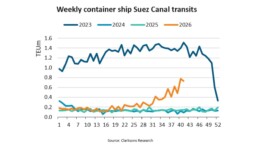
Suez Canal container ship transits exceed 50% of pre-disruption levels "During the first two weeks of October, weekly container ship capacity…
Subscribe to our newsletter!
if you dont want to swim alone in the ocean of news, sign up for the newsletter, and you will receive daily all the important news of world shipping!
