Skuld speed and performance claims underperformance without good weather – navigating benchmark conditions

Introduction
Charterers often face a well-known challenge on time-charter trips: due to restrictive benchmark conditions, no qualifying good-weather days may be available, yet the vessel significantly underperforms. In owners’ markets, benchmark definitions become more restrictive, even with a trend to exclude extrapolation. Therefore, charterers are sometimes unable to obtain sufficient data to test the performance warranty under the good-weather method.
As Middle East conflicts push bunker price volatility up to 100%, it is time to review the options.
The Divinegate – when evidence falls short
In practice, it has been very common for many years to also use alternative methods to establish underperformance. The most common is the Rounds-per-Minute-Method, usually called the RPM method.
The method was court-tested in 2022 in The Divinegate. In this case, a supramax was fixed for a TCT from Rotterdam to New Orleans, and charterers used the RPM method in support of their underperformance claim.
The RPM method is based on the “propeller pitch”. This is the distance in meters that a propeller moves longitudinally during one single revolution. The figure is then adjusted by a deduction for water resistance. This allowance is called “slip” and is measured in percentage. A laden vessel with a clean hull will have a slip of between 5% and 10% in good weather conditions. Higher slip figures indicate decreased performance.
However, the court rejected the RPM method as not a reliable method to identify loss of time.
LMAA Arbitrators: focus on slip values
Following The Divinegate alternative methods based on RPM were significantly upgraded with science. They have yet to be tested in court.
Recent London Arbitrations, however, indicate positive news for charterers: a trend amongst arbitrators has emerged to conclude underperformance from elevated slip values.
Slip values can be easily accessed as they are recorded in an extra column in the noon reports. Analysts can also calculate slip in conjunction with the engine’s RPMs. The “apparent slip“ is essentially the difference between the theoretical distance the propeller should drive the ship (based on pitch and RPM) and the actual distance observed.
In LMAA 23/21, constantly high slip figures of 25% to 35% were interpreted by the tribunal as an incontrovertible indicator of hull fouling. The tribunal agreed that these figures were circumstantial evidence, leaving no doubt that the vessel’s hull was fouled. The owners did not need to adduce any further evidence, and the tribunal concluded the loss of time to be an off-hire event. This was a very favourable result for charterers in particular, as their WRC report was not in compliance with the benchmark conditions. Charterers were entitled to a hire reduction for the time lost and extra fuel consumed.
Correspondingly, in LMAA 15/23, charterers presented a WRC report that disregarded the benchmark conditions. Their algorithm did not address swell and was found to be inconsistent with DSS 3 and was held to be non-compliant. Owners’ WRC did not identify any good weather at all during the voyage. The tribunal reviewed the data on slip, noting that wind and sea conditions were fair, with insignificant swell, and found the vessel’s speed through the water to be no more than 11.2 knots vs the warranted 13.5 knots. On this basis, the tribunal concluded the “constant“ slip factor to be about 22 %. Although the condition of the underwater hull and propeller was uncertain, the tribunal was satisfied that they were fouled.
Likewise, in LMAA 04/25, charterers WRC failed in meeting the strict requirements for good weather under the warranty. However, the tribunal took the slip record in the noon reports as evidence for significant hull fouling “likely to impair performance”. An analysis of the slip and RPM convinced the tribunal “that the vessel was suffering from a hull impediment, most likely hull fouling, precluding it from achieving the minimum warranted speed“. The master must have made a conscious decision not to exceed the set speeds to avoid an exponential increase in consumption arising from the hull fouling, pointing towards a breach of cl. 8 of the NYPE.
Most recently in LMAA 05/26 the tribunal again concluded that the slip factor (from data supplied by the vessel) was around 25 %, “which clearly denoted underperformance”.
Conclusion
The awards had three things in common:
- borderline good weather beyond benchmark
- slip above 20%
- clearly underperforming vessels
The tribunals appear to have been aiming to prevent underperforming vessels from relying on overly restrictive “good weather” definitions. This represents a useful development from a charterers’ perspective.
When analysing performance data, this trend should be kept in mind. Reference to slip values may help streamline the assessment and reduce protracted debates over what constitutes appropriate benchmark weather conditions.



Related News.

Navigating the Multi-Orbit Era: In Conversation with Intellian’s Jon Harrison at SMM 2026
At SMM 2026 in Hamburg, the rapid evolution of maritime satellite communications took centre stage. Across the exhibition halls, discussions among…
Cyprus ports need joint energy and investment strategy, shipping agents chief says
Cyprus needs a coordinated strategy for shipping, energy and environmental protection to support port investment and modernisation, Cyprus shipping…

MASO Public Affairs introduces MASO Regulatory Intelligence
A new subscription service helping businesses understand what is changing and what it means for them MASO Public Affairs introduces MASO Regulatory…
Anglo-Eastern helps turn CMBTECH’s ammonia ambition into an operational reality
From early feasibility study and risk-based design to newbuilding supervision, crew readiness and technical management, Anglo-Eastern drew on its…

Escalation of attacks threatens to derail recovery in Middle East oil exports
World oil demand is forecast to fall by 2.5 mb/d y-o-y in 4Q26 and 2.6 mb/d on average in 2026. As the Iran war manifests itself through restricted…

New study finds shipping pays twice its share to EU ETS earmarked revenues should triple to help build market for sustainable fuels and technologies
Shipping is responsible for around 10% of EU ETS emissions but pays almost 20% of the ETS bill. Unlike other sectors, it has never received free…

MSARC strengthens maritime mass rescue readiness through training and national live exercise off Dakar, Senegal
Joint MSARC–FHAS programme combines three days of SAR training with a national multi-agency live exercise The Maritime Search and Rescue Council ,…

Sogese report deliveries are still being delayed as container freight rates fluctuate
FOR IMPORTERS Spot rates into the Mediterranean are back at January levels, Far East to Europe reliability sits at pandemic lows, and nearly…

Glencore begins trading on Australian Securities Exchange
Glencore has begun trading on the Australian Securities Exchange under the ASX code GLC. Gary Nagle, Glencore’s CEO, said it was an exciting day for…
BIMCO Shipping Number of the Week
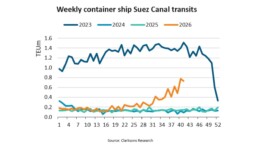
Suez Canal container ship transits exceed 50% of pre-disruption levels "During the first two weeks of October, weekly container ship capacity…
Subscribe to our newsletter!
if you dont want to swim alone in the ocean of news, sign up for the newsletter, and you will receive daily all the important news of world shipping!
