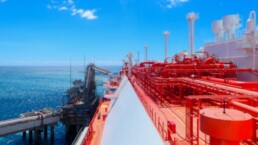

Belgium, Germany, the Kingdom of Netherlands and Sweden deposit ratifications to 2010 HNS Convention.
Four States deposited their instruments of ratification of the International Convention on Liability and Compensation for Damage in Connection with the Carriage of Hazardous and Noxious Substances by Sea, 2010, bringing the treaty’s entry into force a step closer.
The 2010 HNS Convention aims to ensure adequate, prompt, and effective compensation for those affected by incidents involving hazardous and noxious substances (HNS) carried on seagoing ships. This is particularly relevant given the increasing amounts of chemicals and alternative fuels being transported in bulk by sea.
There are now 12 Contracting States* to the 2010 Protocol to the HNS Convention, meeting the number of States criteria for entry into force. The treaty requires at least 12 States to express their consent to be bound by it, including four States each with not less than 2 million units of gross tonnage. Five of the eight States which had previously ratified the treaty had more than 2 million units of gross tonnage each.
The Protocol additionally requires States to submit to the IMO Secretary-General at the deposit of the instrument of ratification and annually thereafter, on or before 31 May (until the Protocol enters into force for that State), data on the total quantities of HNS contributing cargo liable for contributions received in that State during the preceding calendar year.
The 2010 HNS Protocol will enter into force 18 months after the contracting Parties have received during the preceding calendar year a total quantity of at least 40 million tonnes of cargo contributing to the HNS general account. The total quantity received by Belgium, Germany, the Kingdom of Netherlands and Sweden in 2025 is almost 28 million tonnes of HNS contributing cargo.
This means that the HNS contributing cargo data received by existing 8 contracting States in 2025 (they received a total of more than 22 million HNS contributing cargo in 2024) will be assessed after 31 May 2026, in order to confirm the entry into force date 18 months later, i.e. 30 November 2027 the earliest.
The representatives of Belgium (His Excellency Mr. Jeroen Cooreman, Ambassador of Belgium to the UK and Permanent Representative to the IMO), Germany (Her Excellency Ms. Susanne Baumann Ambassador Extraordinary and Plenipotentiary of the Federal Republic of Germany to the United Kingdom and Permanent Representative to the IMO), the Kingdom of the Netherlands (Her Excellency Ms. Annemijn van den Broek, Deputy Head of mission of the Kingdom of the Netherlands to the United Kingdom) and Sweden (His Excellency Mr. Stefan Gullgren, Ambassador of Sweden to the United Kingdom) deposited their instruments of ratification on the sidelines of the IMO Legal Committee, which is meeting for its 113th session (13-17 April).
The deposits were welcomed by IMO Secretary-General Arsenio Dominguez and Director of the International Oil Pollution Compensation Funds (IOPC) Gaute Sivertsen.
2010 HNS Convention regime
When in force, the 2010 HNS Convention will provide a regime of liability and compensation for damage caused by HNS cargoes transported by sea, including oil and chemicals, and covers not only pollution damage, but also the risks of fire and explosion, including loss of life or personal injury as well as loss of or damage to property.
The 2010 HNS Convention establishes the principle that the ‘polluter pays’ by ensuring that the shipping and HNS industries provide compensation for those who have suffered loss or damage resulting from an HNS incident. An HNS Fund will be established, to pay compensation once shipowner’s liability is exhausted. This Fund will be financed through contributions paid post incident by receivers of HNS cargoes
The 2010 HNS Convention complements existing regimes already in force for the transport of oil as cargo, bunker oil used for the operation and propulsion of ships, the removal of hazardous wrecks and claims for death of or personal injury to passengers, or for damage to their luggage, on ships.
Total compensation available under the HNS Convention will be capped at 250 million Special Drawing Rights (SDR) of the International Monetary Fund (approximately USD $360 million at current exchange rates) per event. Shipowners are held strictly liable up to a maximum limit of liability established by the Convention for the cost of an HNS incident. Registered owners of ships carrying HNS cargoes have to maintain insurance that is State certified. The HNS Fund will pay compensation once shipowner’s liability is exhausted and is financed through contributions paid post incident by receivers of HNS cargoes.
The HNS Fund will be administered by States and contributions will be based on the actual need for compensation.
HNS covered by the Convention include: oils; other liquid substances defined as noxious or dangerous; liquefied gases; liquid substances with a flashpoint not exceeding 60˚C; dangerous, hazardous and harmful materials and substances carried in packaged form or in containers; and solid bulk materials defined as possessing chemical hazards.
It is estimated that some 65.000 ships will require the HNS certificates of insurance or other financial security.



Related News.

Navigating the Multi-Orbit Era: In Conversation with Intellian’s Jon Harrison at SMM 2026
At SMM 2026 in Hamburg, the rapid evolution of maritime satellite communications took centre stage. Across the exhibition halls, discussions among…

Cyprus ports need joint energy and investment strategy, shipping agents chief says
Cyprus needs a coordinated strategy for shipping, energy and environmental protection to support port investment and modernisation, Cyprus shipping…

MASO Public Affairs introduces MASO Regulatory Intelligence
A new subscription service helping businesses understand what is changing and what it means for them MASO Public Affairs introduces MASO Regulatory…

Anglo-Eastern helps turn CMBTECH’s ammonia ambition into an operational reality
From early feasibility study and risk-based design to newbuilding supervision, crew readiness and technical management, Anglo-Eastern drew on its…

Escalation of attacks threatens to derail recovery in Middle East oil exports
World oil demand is forecast to fall by 2.5 mb/d y-o-y in 4Q26 and 2.6 mb/d on average in 2026. As the Iran war manifests itself through restricted…

New study finds shipping pays twice its share to EU ETS earmarked revenues should triple to help build market for sustainable fuels and technologies
Shipping is responsible for around 10% of EU ETS emissions but pays almost 20% of the ETS bill. Unlike other sectors, it has never received free…

MSARC strengthens maritime mass rescue readiness through training and national live exercise off Dakar, Senegal
Joint MSARC–FHAS programme combines three days of SAR training with a national multi-agency live exercise The Maritime Search and Rescue Council ,…

Sogese report deliveries are still being delayed as container freight rates fluctuate
FOR IMPORTERS Spot rates into the Mediterranean are back at January levels, Far East to Europe reliability sits at pandemic lows, and nearly…

Glencore begins trading on Australian Securities Exchange
Glencore has begun trading on the Australian Securities Exchange under the ASX code GLC. Gary Nagle, Glencore’s CEO, said it was an exciting day for…

BIMCO Shipping Number of the Week
Suez Canal container ship transits exceed 50% of pre-disruption levels "During the first two weeks of October, weekly container ship capacity…
Subscribe to our newsletter!
if you dont want to swim alone in the ocean of news, sign up for the newsletter, and you will receive daily all the important news of world shipping!
