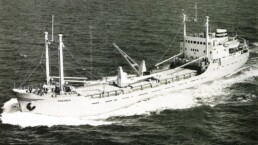

By the mid-1950s, Torvald Klaveness had established a foothold in both refrigerated and bulk trades. The company had moved from management to ownership, and from individual ships to more structured industrial engagements.
The next decade would build on that foundation by rethinking how cargo could be transported.
From experience to new methods
Industrial cargoes such as fertilizer, alumina, and cement were traditionally transported in sacks. Moving these cargoes in bulk was not yet a widely established practice. It required new thinking, technical development, and close cooperation with those producing and receiving the cargo.
An early test case was fertilizer from Glomfjord, Norway – and what began as trial shipments soon developed into a structured trade.
The vessel M/S Mosjøen, delivered in 1958, was built specifically for this purpose and became one of the first specialized dry bulk ships of its kind. That same vessel created new opportunities when seeking return cargo, securing Klaveness a contract to transport alumina from Rotterdam to northern Norway.
These developments reflected a broader approach to linking trades, adapting vessels, and addressing transport challenges by working at the intersection of ship, cargo, and port.
Proving bulk at scale
In partnership with Dalen Portland cement factory, Klaveness applied the same thinking to cement. The ambition was to do for cement what had already been achieved for fertilizer: move it in bulk rather than in bags.
At the time, this had not been attempted in practice. There were concerns that cement would absorb moisture, solidify, or shift during transport. These concerns were tested in practice and in 1961, the first bulk shipment of cement was carried from Brevik in Norway to the United States. What had been considered uncertain became a workable solution.
Designing for the trade
As these trades expanded, the complexity increased. Ports were often not equipped to handle bulk cargo, and each route required practical solutions. Klaveness became involved not only in transporting cargo, but in solving how it could be handled across vessels, ports, and infrastructure.
As operations evolved, so did the vessels. New vessels were designed with features that made them suitable for cargoes such as cement and alumina in bulk. Cargo handling systems, cranes, and unloading solutions were adapted to reduce reliance on port infrastructure and improve efficiency.
Pooling and partnership
With this increasing complexity came the need for coordination and in 1963, Klaveness became a central participant in the establishment of one of the first-ever pool concepts, I/S Bulkhandling. The pool brought together vessels of similar sizes and allowed them to operate as a coordinated unit. This made it possible to secure larger and more stable cargo programs, while also improving flexibility in deployment.
Bulkhandling became more than a commercial structure. It provided a framework for planning voyages, managing contracts, and developing new trades across a shared fleet. Its success was closely linked to the development of bulk cement exports, which provided essential return cargo in transatlantic trades.
Partnerships extended beyond shipowners, and Klaveness worked closely with industrial customers, shipyards, and technical partners to develop solutions tailored to specific cargo flows.
This second decade of the Torvald Klaveness company was defined by coordinated systems built around cargoes and collaboration. The cargo moved differently, the vessels were designed differently, and the company operated differently.
In the following decade, these ideas would evolve further as new vessel concepts reshaped how Klaveness competed in global shipping.



Related News.

Navigating the Multi-Orbit Era: In Conversation with Intellian’s Jon Harrison at SMM 2026
At SMM 2026 in Hamburg, the rapid evolution of maritime satellite communications took centre stage. Across the exhibition halls, discussions among…

Cyprus ports need joint energy and investment strategy, shipping agents chief says
Cyprus needs a coordinated strategy for shipping, energy and environmental protection to support port investment and modernisation, Cyprus shipping…

MASO Public Affairs introduces MASO Regulatory Intelligence
A new subscription service helping businesses understand what is changing and what it means for them MASO Public Affairs introduces MASO Regulatory…

Anglo-Eastern helps turn CMBTECH’s ammonia ambition into an operational reality
From early feasibility study and risk-based design to newbuilding supervision, crew readiness and technical management, Anglo-Eastern drew on its…

Escalation of attacks threatens to derail recovery in Middle East oil exports
World oil demand is forecast to fall by 2.5 mb/d y-o-y in 4Q26 and 2.6 mb/d on average in 2026. As the Iran war manifests itself through restricted…

New study finds shipping pays twice its share to EU ETS earmarked revenues should triple to help build market for sustainable fuels and technologies
Shipping is responsible for around 10% of EU ETS emissions but pays almost 20% of the ETS bill. Unlike other sectors, it has never received free…

MSARC strengthens maritime mass rescue readiness through training and national live exercise off Dakar, Senegal
Joint MSARC–FHAS programme combines three days of SAR training with a national multi-agency live exercise The Maritime Search and Rescue Council ,…

Sogese report deliveries are still being delayed as container freight rates fluctuate
FOR IMPORTERS Spot rates into the Mediterranean are back at January levels, Far East to Europe reliability sits at pandemic lows, and nearly…

Glencore begins trading on Australian Securities Exchange
Glencore has begun trading on the Australian Securities Exchange under the ASX code GLC. Gary Nagle, Glencore’s CEO, said it was an exciting day for…

BIMCO Shipping Number of the Week
Suez Canal container ship transits exceed 50% of pre-disruption levels "During the first two weeks of October, weekly container ship capacity…
Subscribe to our newsletter!
if you dont want to swim alone in the ocean of news, sign up for the newsletter, and you will receive daily all the important news of world shipping!
