Econavis optimises wind assisted propulsion with new Flettner Rotor Technology
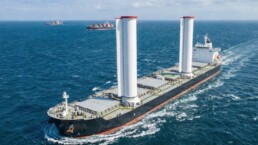

EcosNavis Solutions is developing a next generation wind-assisted propulsion system designed to enhance the performance and commercial viability of Flettner-type rotor sails for deep-sea shipping.
The company’s Eco Rotor Sail introduces a patented tail-appendage device designed to increase thrust, reduce power demand, and widen the range of wind angles in which rotor sails can operate efficiently.
Flettner rotors – rotating cylindrical sails first introduced in the 1920s – are enjoying a come back as shipowners seek credible ways to cut fuel consumption and greenhouse gas emissions. But a major deterrent to much wider take-up is performance reliability when the wind direction changes. Anton Flettner’s underlying principle has changed little in more than a century.
The EcoNavis design, however, essentially broadens the rotor’s effective “wind window” by reshaping the wind flow in the rotor’s wake to deliver higher thrust with lower torque demand.
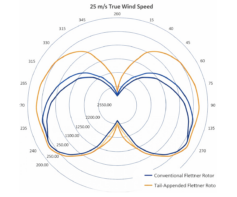
According to the Glasgow-based innovator, initial simulations indicate an increase in thrust of up to ten per cent alongside a five per cent reduction in torque.
The Eco Rotor Sail retains the conventional rotating cylinder but introduces a fixed aerodynamic appendage downstream to stabilise the airflow behind the rotor, reducing losses and allowing the system to continue generating thrust as wind conditions change.
“Flettner rotors already offer one of the highest lift-to-drag ratios among wind-assisted devices, with a relatively modest footprint, but the main drawback has been the narrow band of wind angles – typically beam and stern-quarter winds,” said EcoNavis CEO and founder Dr Batuhan Aktas. “The Eco Rotor Sail expands the range of wind angles over which the rotor can operate efficiently.”
Aktas said compared to existing rotors, the new design strengthens the case for the technology on larger commercial tonnage. “It offers more energy savings and lower operating costs,” he said.
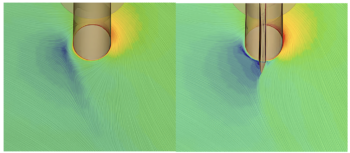
“By recovering energy that would otherwise be lost and optimising the flow behind the rotor, we can provide a Fletner rotor design with a greater operational range. This means shipowners can have greater flexibility in route planning and more consistent performance over a typical trading year, without fundamental changes to vessel operations.
“If you can maintain performance across a wider range of conditions, you change how the technology is used. It becomes something operators can plan around, rather than something that depends on favourable weather,” Aktas said.
Eco Rotor Sail development is backed by a £100,000 research grant from Scottish Enterprise to take the £265,000 project through to validation and demonstration stages. The next phase will move into physical testing.
EcoNavis plans to build a scale model for wind tunnel trials at Politecnico di Milano, Italy, to validate performance and correlate results with simulation data.
Subject to successful validation, a full-scale prototype could be built this year for shipboard trials as part of an integrated power system.



Related News.

Navigating the Multi-Orbit Era: In Conversation with Intellian’s Jon Harrison at SMM 2026
At SMM 2026 in Hamburg, the rapid evolution of maritime satellite communications took centre stage. Across the exhibition halls, discussions among…
Cyprus ports need joint energy and investment strategy, shipping agents chief says
Cyprus needs a coordinated strategy for shipping, energy and environmental protection to support port investment and modernisation, Cyprus shipping…

MASO Public Affairs introduces MASO Regulatory Intelligence
A new subscription service helping businesses understand what is changing and what it means for them MASO Public Affairs introduces MASO Regulatory…
Anglo-Eastern helps turn CMBTECH’s ammonia ambition into an operational reality
From early feasibility study and risk-based design to newbuilding supervision, crew readiness and technical management, Anglo-Eastern drew on its…

Escalation of attacks threatens to derail recovery in Middle East oil exports
World oil demand is forecast to fall by 2.5 mb/d y-o-y in 4Q26 and 2.6 mb/d on average in 2026. As the Iran war manifests itself through restricted…
New study finds shipping pays twice its share to EU ETS earmarked revenues should triple to help build market for sustainable fuels and technologies
Shipping is responsible for around 10% of EU ETS emissions but pays almost 20% of the ETS bill. Unlike other sectors, it has never received free…

MSARC strengthens maritime mass rescue readiness through training and national live exercise off Dakar, Senegal
Joint MSARC–FHAS programme combines three days of SAR training with a national multi-agency live exercise The Maritime Search and Rescue Council ,…

Sogese report deliveries are still being delayed as container freight rates fluctuate
FOR IMPORTERS Spot rates into the Mediterranean are back at January levels, Far East to Europe reliability sits at pandemic lows, and nearly…

Glencore begins trading on Australian Securities Exchange
Glencore has begun trading on the Australian Securities Exchange under the ASX code GLC. Gary Nagle, Glencore’s CEO, said it was an exciting day for…
BIMCO Shipping Number of the Week
Suez Canal container ship transits exceed 50% of pre-disruption levels "During the first two weeks of October, weekly container ship capacity…
Subscribe to our newsletter!
if you dont want to swim alone in the ocean of news, sign up for the newsletter, and you will receive daily all the important news of world shipping!
