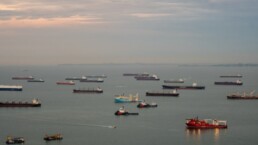

KOBC warns port bottlenecks and vessel backlogs persist even after transit resumes
On April 2, the Korea Ocean Business Corporation (KOBC) stated in a special report titled ‘The Time Lag Between the Resumption of Transit in Hormuz and Market Normalization,’ “the physical resumption of transit through the Strait of Hormuz does not immediately mean a smooth market recovery.”
According to the report, the laden ratio of Very Large Crude Carriers (VLCCs) within the Persian Gulf has surged from 49% before the war to 95%, indicating a severe internal accumulation. The ballast ratio of VLCCs in the Gulf of Oman, east of Hormuz, has also jumped from a pre-war average of 68% to 86%. This means that vessels waiting due to blocked entry and those that have moved preemptively in anticipation of the strait’s reopening are concentrated inside the strait and at its eastern entrance.
The report assessed that if the closure period of the Strait of Hormuz is less than 40 days, the normalization of the shipping market would proceed relatively smoothly. This judgment is based on the consideration that the standard round-trip duration for a VLCC on the Persian Gulf-Northeast Asia route is 38 to 45 days. If the closure does not exceed 40 days, the demand for cargo reloading would not be significant, leading to only a one-time bottleneck upon the lifting of the blockade.
However, the situation changes if the closure period exceeds 40 days. A problem arises when the vessels that depart en masse (the ‘first wave’) immediately after the strait reopens return to the Persian Gulf after unloading at their destinations. Competition to pass through the strait and load cargo before rivals will lead to collective transit, causing a ‘second wave’ of congestion at Northeast Asian ports and resulting in recurring bottlenecks.
It was also pointed out that the movements in the insurance market could be a factor delaying normalization. Currently, the Strait of Hormuz is designated as a high-risk area, and war risk insurance premiums have soared. While some risk-taking shipowners might lead an initial ‘departure rush’ to secure high freight rates immediately after a war, it was analyzed that conservative shipowners or vessels with constraints under financial contracts will likely maintain a wait-and-see approach until insurance normalization is confirmed, forming a ‘dual-rate market’.
The report divided the shipping market normalization process into three stages. The first 1-8 weeks are the ‘departure rush’ stage, driven by concentrated sailings; the next 2-6 months are the ‘wave absorption’ stage, where recurring bottlenecks ease; and the period from 6 to 24 months or more is the ‘structural normalization’ stage, involving the lifting of the high-risk area designation and fleet redeployment. In particular, it was projected that complete normalization is not possible through diplomatic declarations alone; substantial recovery, such as a decrease in insurance premiums, will only be possible after a sufficient amount of incident-free transit data has been accumulated.
The report emphasized, “The key short-term risk for energy-importing countries is not supply availability but terminal handling capacity,” and “A contingency plan is needed for congestion exceeding normal levels for 4-8 weeks.” It added, “Rather than the timing of the end of the war or the resumption of transit itself, the subsequent second-wave bottleneck and the delayed normalization period must be managed as a separate risk phase.”
Source: BusinessKorea



Related News.

WISTA Cyprus brings the next generation closer to the sea
As part of its activities for World Maritime Day 2026, WISTA Cyprus brought its members and their families together for “Here Only Monachus”, a…

Europe remains top destination for US LNG in September amid winter storage rebuild
HIGHLIGHTS Europe receives 53% of September cargoes Netherlands, Egypt top September destinations EU storage trails prior years……
NORDEN raises full-year guidance
On the back of strong operational performance, NORDEN upgrades the 2026 full-year net profit On the back of strong operational performance, NORDEN…
South Korea, China clash over LNG carrier market
Fierce competition is unfolding between South Korea and China in the market for large liquefied natural gas )carriers, which represent high…
Iran insists it controls Hormuz as rial hits record low and exports dry up
Iran's military insisted it retained full control of Hormuz and the foreign minister said the strait could reopen within seven days if Tehran's…
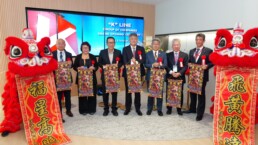
“K” LINE holds opening ceremony for new consolidated office in Singapore
Bringing Together the Knowledge, Human Resources, and Functions of Three Group Companies to Strengthen Its Business Foundation in Southeast Asia On…
Intermodal Report Week 40 2026
Pls find below the Intermodal Report - Week 40 2026 Intermodal Report Week 40 2026

Allied Weekly Market Review Week 40
Pls find below the Allied - Weekly Market Review - Week 40 ALLIED - Weekly Market Report- Week 40

FIS-RDC, EnPower, Trafigura and Gridworks join forces to deliver landmark power interconnector to supply the DRC’s Copperbelt
A 700MW cross-border transmission line will bring affordable power to the DRC's Copperbelt, unlock new mining and industrial capacity, open export…

Ocean Network Express expands partnership with Project Maji to Nigeria
Ocean Network Express announced the expansion of its partnership with Project Maji, a pan-African safe water social enterprise, in Nigeria.…
Subscribe to our newsletter!
if you dont want to swim alone in the ocean of news, sign up for the newsletter, and you will receive daily all the important news of world shipping!
