BAR Technology warns fuel strategy has shifted from decarbonisation to commercial survival


Fuel strategy in global shipping is increasingly being shaped by immediate commercial realities rather than long-term decarbonisation targets, according to BAR Technology, as volatility in energy markets pushes operators to rethink how they power their fleets.
A combination of infrastructure disruption, geopolitical risk and persistent uncertainty around key maritime corridors is exposing the fragility of single-fuel strategies. At the same time, constraints around the availability of alternative fuels are limiting the industry’s ability to follow a linear transition pathway.
The result, BAR Technology argues, is a decisive shift towards fuel flexibility as a core commercial requirement rather than a sustainability preference.
“Let’s be clear – the current situation is exposing the commercial risk of relying too heavily on fossil fuels. The direction of travel is towards a more stable and ultimately more profitable model, where not all of your energy is bought on the market” said John Cooper, CEO of BAR Technology.
Dual-fuel vessels, once positioned primarily as a bridge to lower emissions, are increasingly being treated as a hedge against volatility. Fleet deployment decisions are being shaped as much by fuel availability as by demand, while shifting trade flows continue to alter cost dynamics across key routes.
Alongside this, there is renewed attention on the role of wind-assisted propulsion within the fuel mix. While not a standalone solution, wind offers a distinct advantage in a volatile market: it is not exposed to fuel pricing and, with advances in weather routing and voyage planning, can be forecast and integrated into operations with increasing precision.
“Wind won’t replace fuel, but it changes the risk profile,” Cooper added. “If part of your energy input isn’t bought on the market, you’re less exposed. That starts to matter when volatility becomes the norm, not the exception.”
According to BAR Technology, this marks a structural change rather than a temporary adjustment. Energy markets are becoming less predictable, and operators are responding by building resilience into how they power and deploy their fleets.
“Everyone talks about transition as if it’s a straight line,” Cooper said. “It isn’t. It’s uneven, and it’s being shaped by real-world constraints. The companies that build flexibility into their operations will be the ones that come through this strongest.”
While decarbonisation remains a long-term objective, the immediate priority is managing uncertainty. In that environment, optionality, across fuels, routes and technologies, is increasingly defining commercial performance.
BAR Technology continues to support clients with insight into fuel strategy, fleet deployment and trade flow dynamics as the industry adapts to a more complex operating landscape.



Related News.

Navigating the Multi-Orbit Era: In Conversation with Intellian’s Jon Harrison at SMM 2026
At SMM 2026 in Hamburg, the rapid evolution of maritime satellite communications took centre stage. Across the exhibition halls, discussions among…
Cyprus ports need joint energy and investment strategy, shipping agents chief says
Cyprus needs a coordinated strategy for shipping, energy and environmental protection to support port investment and modernisation, Cyprus shipping…

MASO Public Affairs introduces MASO Regulatory Intelligence
A new subscription service helping businesses understand what is changing and what it means for them MASO Public Affairs introduces MASO Regulatory…
Anglo-Eastern helps turn CMBTECH’s ammonia ambition into an operational reality
From early feasibility study and risk-based design to newbuilding supervision, crew readiness and technical management, Anglo-Eastern drew on its…
Escalation of attacks threatens to derail recovery in Middle East oil exports
World oil demand is forecast to fall by 2.5 mb/d y-o-y in 4Q26 and 2.6 mb/d on average in 2026. As the Iran war manifests itself through restricted…
New study finds shipping pays twice its share to EU ETS earmarked revenues should triple to help build market for sustainable fuels and technologies
Shipping is responsible for around 10% of EU ETS emissions but pays almost 20% of the ETS bill. Unlike other sectors, it has never received free…

MSARC strengthens maritime mass rescue readiness through training and national live exercise off Dakar, Senegal
Joint MSARC–FHAS programme combines three days of SAR training with a national multi-agency live exercise The Maritime Search and Rescue Council ,…
Sogese report deliveries are still being delayed as container freight rates fluctuate
FOR IMPORTERS Spot rates into the Mediterranean are back at January levels, Far East to Europe reliability sits at pandemic lows, and nearly…
Glencore begins trading on Australian Securities Exchange
Glencore has begun trading on the Australian Securities Exchange under the ASX code GLC. Gary Nagle, Glencore’s CEO, said it was an exciting day for…
BIMCO Shipping Number of the Week
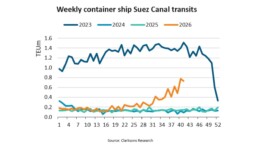
Suez Canal container ship transits exceed 50% of pre-disruption levels "During the first two weeks of October, weekly container ship capacity…
Subscribe to our newsletter!
if you dont want to swim alone in the ocean of news, sign up for the newsletter, and you will receive daily all the important news of world shipping!
