Clean Arctic Alliance welcomes coming into force of emission control areas for shipping
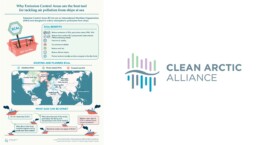

Reacting to the coming into force of the Canadian Arctic and Norwegian Sea emission control areas (ECAs) on March 1, Dr Sian Prior, Lead Advisor to the Clean Arctic Alliance said:
“The Clean Arctic Alliance welcomes the entry into force of the two new emission control areas in the Canadian Arctic and Norwegian Sea, and looks forward to the International Maritime Organization’s expected adoption of the North Atlantic ECA in May which will include the waters of Greenland and Iceland.”
ECAs are the IMO’s tool for tackling air pollution from ships. Both the Norwegian Sea and the Canadian Arctic ECAs have been designed to reduce sulphur oxide (SOx) and particulate matter (PM) emissions and nitrogen oxides (NOx) emissions to improve air quality, cut premature deaths, reduce acid rain and protect environmentally sensitive ecosystems.
Although the new ECAs are now in force, the SOx regulation addressing the sulphur content of fuel oil allows a 12-month delay before shipping has to follow the new regulations. As a result, ships passing through the new ECAs will not have to comply with the requirement to use fuels with a 0.1% sulphur content until March 2027.
“The Clean Arctic Alliance urges the international shipping industry to immediately begin transitioning to cleaner low sulphur fuels when operating in the new ECAs”, says Prior.
ECAs have already been in place for some years in North American waters, and the North Sea and Baltic Sea, where shipping already has to use ultra low sulphur fuels to meet the requirements which reduce the impact of SOx pollution on human health and on ecosystems. The international shipping industry already has extensive experience of switching between traditional residual fuels to cleaner ECA-compliant fuels when moving into ECA designated waters, thus the availability of suitable fuels should not prove a problem.
While a co-benefit of ECA designation is a reduction in emissions of black carbon – a component of particulate matter, the IMO still needs to address the reduction of black carbon emissions, which have significant impact on the Arctic. TECAs still allow the use of ultra low sulphur fuels (ULSFO), marine diesel oils (MDO), and installation of exhaust gas cleaning systems to remove SOx, in combination with heavy fuel oils (HFO). Moving away from these options to instead use marine gas oil (MGO) or new alternative fuels in the Arctic will further reduce black carbon emissions.
“Emissions of black carbon from shipping have a disproportionate impact in the Arctic, which is already warming four times faster than the rest of the planet, by contributing to the melt of sea and land-ice leading to global consequences”, said Prior.
“Black carbon emissions also increase the risk of respiratory and cardio-vascular illnesses in local communities. This past winter saw the lowest Arctic sea ice extent in the 47-year satellite record – melting of the Arctic sea ice results in loss of ice habitat, important for wildlife and Indigenous communities in the Arctic, while the melting of land-ice – glaciers – contributes to rising global sea-levels.” (See NSIDC graph which compares with previous winters.)
“In addition to ECAs, it is essential that the IMO regulate ship emissions of black carbon impacting the Arctic. Since black carbon pollution is transported in the atmosphere, a regulation must apply throughout the whole Arctic and not just those waters where sea or glacier ice can be expected”, said Prior.
“Black carbon is one of the longest, unresolved issues running at the IMO, and must be dealt with without delay”, added Prior. “A strong agreement on polar fuels can set rules which will reduce black carbon emission levels from shipping in the Arctic region. We can not wait another year before taking the next steps”. See NGOs Criticise IMO’s Slow Progress on Cleaner Fuel Rules for Arctic Shipping (February 2026).
“The Clean Arctic Alliance is calling on IMO member states to submit a joint proposal to this November’s Marine Environment Protection Committee (MEPC 85), requesting that the IMO discuss and agree on the geographic scope of a measure that will curb black carbon emissions”, said Prior. “If they are to support action on black carbon, countries must know what waters it will apply to.”
The IMO’s Pollution Prevention and Response sub-committee ( PPR 14, early 2027) should finalise the draft measure (in light of the feedback and clarification of concerns at PPR 13) and recommend the measure to MEPC 86 in 2027 for approval and subsequent adoption.



Related News.

Navigating the Multi-Orbit Era: In Conversation with Intellian’s Jon Harrison at SMM 2026
At SMM 2026 in Hamburg, the rapid evolution of maritime satellite communications took centre stage. Across the exhibition halls, discussions among…
Cyprus ports need joint energy and investment strategy, shipping agents chief says
Cyprus needs a coordinated strategy for shipping, energy and environmental protection to support port investment and modernisation, Cyprus shipping…

MASO Public Affairs introduces MASO Regulatory Intelligence
A new subscription service helping businesses understand what is changing and what it means for them MASO Public Affairs introduces MASO Regulatory…
Anglo-Eastern helps turn CMBTECH’s ammonia ambition into an operational reality
From early feasibility study and risk-based design to newbuilding supervision, crew readiness and technical management, Anglo-Eastern drew on its…

Escalation of attacks threatens to derail recovery in Middle East oil exports
World oil demand is forecast to fall by 2.5 mb/d y-o-y in 4Q26 and 2.6 mb/d on average in 2026. As the Iran war manifests itself through restricted…
New study finds shipping pays twice its share to EU ETS earmarked revenues should triple to help build market for sustainable fuels and technologies
Shipping is responsible for around 10% of EU ETS emissions but pays almost 20% of the ETS bill. Unlike other sectors, it has never received free…

MSARC strengthens maritime mass rescue readiness through training and national live exercise off Dakar, Senegal
Joint MSARC–FHAS programme combines three days of SAR training with a national multi-agency live exercise The Maritime Search and Rescue Council ,…
Sogese report deliveries are still being delayed as container freight rates fluctuate
FOR IMPORTERS Spot rates into the Mediterranean are back at January levels, Far East to Europe reliability sits at pandemic lows, and nearly…
Glencore begins trading on Australian Securities Exchange
Glencore has begun trading on the Australian Securities Exchange under the ASX code GLC. Gary Nagle, Glencore’s CEO, said it was an exciting day for…
BIMCO Shipping Number of the Week
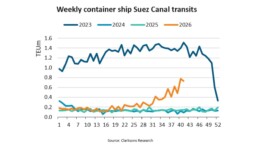
Suez Canal container ship transits exceed 50% of pre-disruption levels "During the first two weeks of October, weekly container ship capacity…
Subscribe to our newsletter!
if you dont want to swim alone in the ocean of news, sign up for the newsletter, and you will receive daily all the important news of world shipping!
