Ferry Switch to Bio-LNG Significantly reduces CO2 Emissions
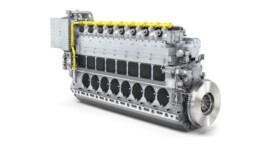

TT-Line, the German ferry operator, has revealed that – working closely with Everllence PrimeServ Germany – its Ro-Ro passenger vessels, the ‘Nils Holgersson‘ and the ‘Peter Pan’, successfully operated on bio-LNG during 2025, enjoying a significant emissions reduction. The 230-metre vessels were commissioned in 2022 and 2023 respectively and are powered by 2 × 8L51/60DF + 2 × 6L51/60DF engines each. They trade in the Baltic Sea between Germany, Sweden, Poland and Lithuania.
TT-Line and Everllence discussed the use of bio-LNG as a substitute for fossil-LNG fuel, strengthening the long-term technical cooperation between the two organisations. This collaboration also overlapped with continuous emission-measurements on board the Nils Holgersson that Everllence carried out for almost a year in support of operations optimisation.
This revealed:
no significant ageing effect on the engines related to methane emissions;
emission values from the test bed could be reproduced by measurements on board;
no negative influences on engine operating-parameters during bio-LNG operation.
Andreas Schaerli, COO TT-Line, said: “With the use of climate-neutral bio-LNG, which is obtained from waste materials, TT-Line is making a decisive contribution to climate protection on the Baltic Sea. Thanks to this technology, our Green Ships – the ‘Nils Holgersson’ and the ‘Peter Pan’ – enable a CO2-free journey throughout the entire fleet. Our customers can already fully compensate for their crossing by adding bio-LNG during the booking process. We are thus consistently focusing on innovative solutions to sustainably reduce emissions and shape the future of ferry transport in a climate-friendly way.”
The bio-LNG is sourced from agricultural waste in northern Europe where biogas is fed into the grid and then extracted, liquefied and loaded onto a bunker vessel, which transports the climate-neutral fuel to the respective TT-Line vessels. Replacing one tonne of fossil LNG with bio-LNG saves 2.75 tonnes of CO2 emissions, equivalent to a 100% reduction.
Dr. Michael Filous, Senior Vice President and Head of PrimeServ Germany, Everllence, said: “The key benefit associated with bio-LNG is the reduction in CO2 emissions. A major advantage for the customer is that while there are specifications that the fuel gas needs to fulfil – such as methane number – no additional engine works are necessary as long as the fuel gas meets the specifications. Indeed, this was the case for the Nils Holgersson.”
TT-Line further states that it is delighted with the positive experience gained from the uptake of renewable fuels during the collaboration. The resulting emission savings contribute to the reduction of TT-Line’s fleet emissions in the Baltic Sea through a process known as pooling. From an administrative perspective, this process is supported by certificates issued by the fuel supplier, which document the emission savings achieved by using biofuels compared to conventional fuels.
Source: Everllence



Related News.

Navigating the Multi-Orbit Era: In Conversation with Intellian’s Jon Harrison at SMM 2026
At SMM 2026 in Hamburg, the rapid evolution of maritime satellite communications took centre stage. Across the exhibition halls, discussions among…

Cyprus ports need joint energy and investment strategy, shipping agents chief says
Cyprus needs a coordinated strategy for shipping, energy and environmental protection to support port investment and modernisation, Cyprus shipping…

MASO Public Affairs introduces MASO Regulatory Intelligence
A new subscription service helping businesses understand what is changing and what it means for them MASO Public Affairs introduces MASO Regulatory…

Anglo-Eastern helps turn CMBTECH’s ammonia ambition into an operational reality
From early feasibility study and risk-based design to newbuilding supervision, crew readiness and technical management, Anglo-Eastern drew on its…

Escalation of attacks threatens to derail recovery in Middle East oil exports
World oil demand is forecast to fall by 2.5 mb/d y-o-y in 4Q26 and 2.6 mb/d on average in 2026. As the Iran war manifests itself through restricted…

New study finds shipping pays twice its share to EU ETS earmarked revenues should triple to help build market for sustainable fuels and technologies
Shipping is responsible for around 10% of EU ETS emissions but pays almost 20% of the ETS bill. Unlike other sectors, it has never received free…

MSARC strengthens maritime mass rescue readiness through training and national live exercise off Dakar, Senegal
Joint MSARC–FHAS programme combines three days of SAR training with a national multi-agency live exercise The Maritime Search and Rescue Council ,…

Sogese report deliveries are still being delayed as container freight rates fluctuate
FOR IMPORTERS Spot rates into the Mediterranean are back at January levels, Far East to Europe reliability sits at pandemic lows, and nearly…

Glencore begins trading on Australian Securities Exchange
Glencore has begun trading on the Australian Securities Exchange under the ASX code GLC. Gary Nagle, Glencore’s CEO, said it was an exciting day for…

BIMCO Shipping Number of the Week
Suez Canal container ship transits exceed 50% of pre-disruption levels "During the first two weeks of October, weekly container ship capacity…
Subscribe to our newsletter!
if you dont want to swim alone in the ocean of news, sign up for the newsletter, and you will receive daily all the important news of world shipping!
