ETF reaction to the Port Strategy and Maritime Industrial Strategy
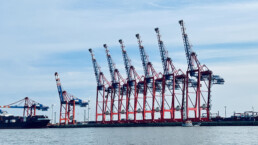

The European Transport Workers’ Federation (ETF) welcomes today’s European Commission proposals for an EU Port Strategy and an EU Industrial Maritime Strategy, insisting that workers must be placed at the heart of both initiatives. ETF stands ready to engage constructively with the European Commission, industry stakeholders and social partners to ensure that the final Strategy delivers a just, sustainable and socially responsible maritime future for Europe.
EU Port Strategy: competitiveness, security and quality jobs must go hand in hand
The EU Port Strategy rightly recognises the strategic role of ports in Europe’s economy, security, and green transition, as well as the importance of skills, safety, and workforce challenges.
However, ETF stresses that ports are not only infrastructure and logistics hubs — they are workplaces. To be effective, the Strategy must integrate social and labour considerations across all policy areas, including competition, concessions, security, investment, and governance. Europe’s ports will only be resilient, competitive, and secure if workers, social dialogue, and quality jobs are placed at the heart of port policy.
Berardina Tommasi, ETF Senior Policy Officer for Dockers said:
“We welcome the European Commission’s EU Port Strategy as a timely initiative at a moment of geopolitical uncertainty, supply-chain pressures, and climate transformation, when ports are central to the future of Europe. We particularly value the recognition of workers as key partners in crime prevention, the focus on health and safety, the emphasis on social dialogue, and the Commission’s intentions to assess competition dynamics, including vertical integration and mergers.
At the same time, we are concerned by the assumption that more competition through shorter port concessions is needed. European ports already face strong competition, and long-term concessions are essential to ensure stability, predictability, and investment.
Ports are not only infrastructure assets — they are major workplaces employing thousands of skilled workers who keep operations safe, resilient, and efficient every day. A truly strategic port policy balances competitiveness with quality jobs, strong labour standards, and meaningful social dialogue.”
Our key points:
We welcome the intention to assess the effects of vertical integration, mergers and shipping alliances.
We value the inclusion of port workers in the strategy, with references to health and safety, training, and social dialogue.
We disagree with the assumption that more competition through shorter port concessions is needed; European ports already face strong intra- and inter-port competition.
We welcome the scrutiny of FDI in European ports and the guiding principles for EU support to third-country ports, while calling for clearer social conditionality.
We support the “protect and train” approach to crime prevention and port security as opposed to targeting the port workers.
Skills partnerships should complement – and not substitute – broader social action.
We welcome the support for initiatives like ETF’s “Working Together. Much Safer” project.
EU Industrial Maritime Strategy: No Competitiveness Without Seafarers and Quality Jobs
We also welcome the European Commission’s effort to develop an EU Industrial Maritime Strategy, including the maritime transport sector and recognising its strategic importance for Europe’s security, resilience, economy, and energy independence.
The Strategy contains several positive elements that reflect long-standing ETF demands, including recognition of the maritime workforce recruitment and retention crisis, the strategic value of EU flags and the objective of enhancing the attractiveness of EU Member State flag. However, we insist that it must place workers at its core as Europe cannot secure supply chains, energy autonomy, fleet decarbonisation or secure maritime infrastructure without the people who operate the fleet. The EU can do more for a socially sustainable shipping without social dumping and equal treatment for all maritime professionals working between EU ports — regardless of nationality or flag. Work in European waters must mean European conditions.
Nikolaos Koletsis, ETF Senior Policy Officer for Maritime Transport said:
“We welcome the EU’s holistic approach linking shipbuilding and maritime transport, but the solutions must be more ambitious. Public investment should always come with strong social conditionality, while all crews operating regularly in European waters should benefit from EU standards. There is a proven link between working conditions and safety – safety at sea depends on people, and Europe’s resilience requires dual-use ferries that are built, flagged and crewed in Europe. International standards must also be reviewed to address excessive working hours that still affect seafarers.”
Our key points:
We insist on social conditionality: whenever public money is spent, it should be conditional upon upholding collective agreements and decent working conditions.
We insist on the fact that all crew working on board ships operating regularly in European waters can enjoy the EU’s terms and conditions (which is, unlike in other transport sectors, still not the case!)
Safety depends on the human element (working conditions, fatigue)
Military mobility: dual-use ferries must be built in Europe, EU-flagged and EU-crewed (otherwise, the ships cannot be requisitioned in case of a military conflict)
Need for a revision of the EU State Aid Guidelines for Maritime Transport, making EU seafarers’ employment, training and fair crewing mandatory conditions; encouraging the growth of EU national first registries, and with the effective implementation, stricter monitoring and enforcement of the obligations by the European Commission.
Need to support the review of some international standards of the MLC and STCW aimed at reducing excessive working time limits for seafarers (seafarers are legally allowed to work for up to 91 hours per week)
Source: ETF



Related News.

Navigating the Multi-Orbit Era: In Conversation with Intellian’s Jon Harrison at SMM 2026
At SMM 2026 in Hamburg, the rapid evolution of maritime satellite communications took centre stage. Across the exhibition halls, discussions among…
Cyprus ports need joint energy and investment strategy, shipping agents chief says
Cyprus needs a coordinated strategy for shipping, energy and environmental protection to support port investment and modernisation, Cyprus shipping…

MASO Public Affairs introduces MASO Regulatory Intelligence
A new subscription service helping businesses understand what is changing and what it means for them MASO Public Affairs introduces MASO Regulatory…
Anglo-Eastern helps turn CMBTECH’s ammonia ambition into an operational reality
From early feasibility study and risk-based design to newbuilding supervision, crew readiness and technical management, Anglo-Eastern drew on its…
Escalation of attacks threatens to derail recovery in Middle East oil exports
World oil demand is forecast to fall by 2.5 mb/d y-o-y in 4Q26 and 2.6 mb/d on average in 2026. As the Iran war manifests itself through restricted…
New study finds shipping pays twice its share to EU ETS earmarked revenues should triple to help build market for sustainable fuels and technologies
Shipping is responsible for around 10% of EU ETS emissions but pays almost 20% of the ETS bill. Unlike other sectors, it has never received free…
MSARC strengthens maritime mass rescue readiness through training and national live exercise off Dakar, Senegal
Joint MSARC–FHAS programme combines three days of SAR training with a national multi-agency live exercise The Maritime Search and Rescue Council ,…
Sogese report deliveries are still being delayed as container freight rates fluctuate
FOR IMPORTERS Spot rates into the Mediterranean are back at January levels, Far East to Europe reliability sits at pandemic lows, and nearly…
Glencore begins trading on Australian Securities Exchange
Glencore has begun trading on the Australian Securities Exchange under the ASX code GLC. Gary Nagle, Glencore’s CEO, said it was an exciting day for…
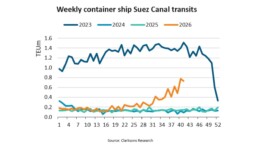
BIMCO Shipping Number of the Week
Suez Canal container ship transits exceed 50% of pre-disruption levels "During the first two weeks of October, weekly container ship capacity…
Subscribe to our newsletter!
if you dont want to swim alone in the ocean of news, sign up for the newsletter, and you will receive daily all the important news of world shipping!
