Yggdrasil defining the future of oil and gas

As offshore oil and gas developments become more complex, operators are rethinking how fields are designed, operated, and supported. For Aker BP, this shift is clearly visible in the Yggdrasil development, the largest ongoing project on the Norwegian Continental Shelf.
“What distinguishes Yggdrasil is not only its scale, but our operation strategy. The entire area will be remotely operated from shore, with minimal offshore activity, new technology and an extensive digital ecosystem enabling new ways of working. All facilities will be powered from shore, resulting in very low production emissions. First production is planned in 2027,” states Kristian Bay Næss, VP Asset Operation Yggdrasil.
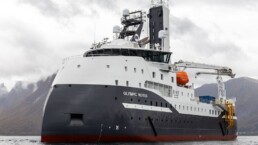
A central part of the Yggdrasil operating model is the use of unmanned platforms combined with Walk‑to‑Work (W2W) vessels. For Yggdrasil, Aker BP has selected the service vessel Olympic Notos to support offshore campaigns, underlining the growing importance of specialised vessels in enabling new offshore operating concepts.
The CSOV Olympic Notos was delivered from Ulstein Verft in 2024. She arrived at Ulstein Verft on 6 March 2026 to commence the retrofit work needed for her assignment at Yggdrasil.

An area designed for remote operations
“Yggdrasil comprises the Hugin, Fulla and Munin licence groups, with Aker BP as operator and Equinor and Orlen Upstream Norway as partners. Located between the Alvheim and Oseberg areas in the North Sea, the development holds estimated gross recoverable resources of around 700 million barrels of oil equivalents.

“The development includes a central processing platform (Hugin A) planned to be periodically unmanned, an unmanned production platform (Munin), a normally unmanned wellhead platform (Hugin B), extensive subsea infrastructure, more than 55 planned wells, and an Integrated Operations Centre onshore in Stavanger.

Why unmanned platforms?
Bay Næss continues:
“Aker BP’s investment in unmanned platforms such as Munin is driven by the need for safe, efficient production with low emissions and reduced costs. Munin is designed without living quarters, lifeboats and helidecks and will only be visited during planned offshore campaigns.
“Work is planned and prepared for onshore, while offshore crews focus entirely on executing work safely and efficiently. The platform’s design has been simplified, and materials and equipment have been selected with a focus on high reliability and low maintenance requirements, reducing both operational and investment costs. This approach has also elevated the role of vessels as operational hubs.
Olympic Notos: A key enabler for Yggdrasil
“Yggdrasil stretches 60 kilometres in length, and we have designed the area with only 42 cabins on Hugin A. Walk-to-work offers a flexible solution for maintenance campaigns where the vessel will be our accommodation,” explains Bay Næss, and elaborates:
“Olympic Notos will support planned campaigns on Munin and Hugin B, enabling personnel to live on board and walk to work via a motion-compensated gangway. With strong marine characteristics, broad operational capabilities, and modern, energy-efficient hybrid propulsion design, the vessel provides a safe, comfortable base for both work and leisure time for our personnel. This concept reduces the need for permanent offshore accommodation and helicopter support, while increasing operational flexibility and overall efficiency. The vessel will first support the hook-up phase of the Fenris platform in the Valhall area, before entering continuous operations in the Yggdrasil area later in the year.”
Walk‑to‑Work as part of the safety concept
“For unmanned installations, Walk‑to‑Work is not only a logistics solution, but an integral part of operations. During offshore campaigns on Munin, the gangway connects the vessel to the platform and functions as the primary escape route while personnel are on board. This requires robust platform design and specialised gangway solutions tailored for unmanned installations.”

Remote operations and a digital backbone
“At the core of Yggdrasil is the Integrated Operations Centre in Stavanger,” says Bay Næss. “From the onshore control room, we can start, run and safely shut down the entire process plant without any manual intervention offshore.
“Thousands of sensors in the plant provide continuous monitoring, with data collected and contextualised through advanced digital platforms. Live data and 3D models support condition-based and predictive maintenance, improved planning and, over time, increased automation. AI-supported maintenance and planning will be in use from day one, with a long-term ambition of achieving a high degree of autonomous operations.
A model for the future
” Through Yggdrasil, Aker BP is setting a new standard in operations. We are demonstrating how offshore fields can be designed and operated safely and efficiently remotely from shore with minimal activity and less people offshore, and Olympic Notos plays a central role,” concludes Bay Næss.



Related News.
Navigating the Multi-Orbit Era: In Conversation with Intellian’s Jon Harrison at SMM 2026
At SMM 2026 in Hamburg, the rapid evolution of maritime satellite communications took centre stage. Across the exhibition halls, discussions among…
Cyprus ports need joint energy and investment strategy, shipping agents chief says
Cyprus needs a coordinated strategy for shipping, energy and environmental protection to support port investment and modernisation, Cyprus shipping…

MASO Public Affairs introduces MASO Regulatory Intelligence
A new subscription service helping businesses understand what is changing and what it means for them MASO Public Affairs introduces MASO Regulatory…
Anglo-Eastern helps turn CMBTECH’s ammonia ambition into an operational reality
From early feasibility study and risk-based design to newbuilding supervision, crew readiness and technical management, Anglo-Eastern drew on its…
Escalation of attacks threatens to derail recovery in Middle East oil exports
World oil demand is forecast to fall by 2.5 mb/d y-o-y in 4Q26 and 2.6 mb/d on average in 2026. As the Iran war manifests itself through restricted…
New study finds shipping pays twice its share to EU ETS earmarked revenues should triple to help build market for sustainable fuels and technologies
Shipping is responsible for around 10% of EU ETS emissions but pays almost 20% of the ETS bill. Unlike other sectors, it has never received free…
MSARC strengthens maritime mass rescue readiness through training and national live exercise off Dakar, Senegal
Joint MSARC–FHAS programme combines three days of SAR training with a national multi-agency live exercise The Maritime Search and Rescue Council ,…
Sogese report deliveries are still being delayed as container freight rates fluctuate
FOR IMPORTERS Spot rates into the Mediterranean are back at January levels, Far East to Europe reliability sits at pandemic lows, and nearly…
Glencore begins trading on Australian Securities Exchange
Glencore has begun trading on the Australian Securities Exchange under the ASX code GLC. Gary Nagle, Glencore’s CEO, said it was an exciting day for…
BIMCO Shipping Number of the Week
Suez Canal container ship transits exceed 50% of pre-disruption levels "During the first two weeks of October, weekly container ship capacity…
Subscribe to our newsletter!
if you dont want to swim alone in the ocean of news, sign up for the newsletter, and you will receive daily all the important news of world shipping!
