Rising decision overload despite AI expansion, freight professionals


83% of Freight Leaders Say They Operate in Reactive Mode as Decision Load Rises Despite Digital Expansion, Study Finds
- 74% make more than 50 operational decisions daily
• 68% use five or more systems to manage shipment workflows
• 43% said their daily operational decision load has increased compared to five years ago
Eighty-three percent of freight and logistics leaders say they operate in reactive mode, as daily operational decision volumes continue to rise despite widespread digital and AI adoption, according to a new global industry study released by Deep Current, a technology company building custom-AI tools for the logistics industry.
Deep Current surveyed 600 freight decision-makers across Europe, North America, the Middle East, and Asia, including freight forwarders, NVOCCs, customs brokers, and third-party logistics providers.
The findings suggest that while freight companies have digitized workflows over the past decade, operational decision density remains high due to system fragmentation and manual validation processes.
High daily decision volume
The survey found that 74% of respondents make more than 50 operational decisions per day, while 50% make more than 100 decisions daily. 18% report exceeding 200 shipment-related decisions per day.
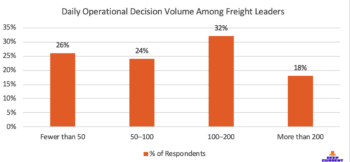
Operational decisions include routing approvals, rate selection, documentation validation, compliance checks, and exception handling.
At current levels, a typical operations leader may make more than 25,000 shipment-related decisions annually. In addition, a majority of respondents indicated that their daily decision load has increased compared to five years ago, despite greater access to digital tools.
43% said their daily operational decision load has increased compared to five years ago, even as digital tools and automation platforms have become more widely adopted across the sector.
Respondents attributed this increase to greater compliance complexity, higher customer expectations, multi-system workflows, and more frequent exception handling in volatile freight markets.
The findings suggest that while technology has expanded data access and visibility, the volume of human judgment required to validate and approve shipment workflows has not declined, and in many cases, has intensified.
Majority working in reactive mode
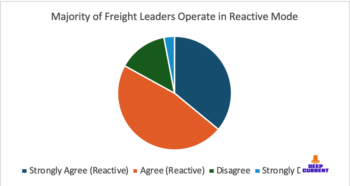
When asked about their working model, 83% agreed they operate more reactively than proactively, while 65% reported spending at least 70% of their time on repetitive operational decisions rather than strategic planning.
System fragmentation driving cognitive strain
The study identified system fragmentation as a key contributing factor:
- 68% use five or more systems daily to manage shipment workflows
- 72% cited manual documentation checks as a primary source of operational pressure
- 69% cited fragmented data across systems as a major challenge
The findings indicate that while digital systems are widely adopted, integration gaps may be contributing to increased decision complexity.
System fragmentation refers to the need for freight professionals to switch between multiple disconnected platforms including transportation management systems (TMS), ERP systems, documentation portals, spreadsheets, email threads, and messaging applications to complete a single shipment workflow. Each system typically holds partial information. As a result, operators must manually reconcile data across platforms, verify consistency, and cross-check documentation before making shipment decisions.
This constant switching creates context loss between systems, repetitive data validation, increased risk of inconsistencies, slower decision cycles and higher mental fatigue.
While digital adoption has expanded across the freight industry, integration gaps between systems mean that technology often increases data visibility without reducing decision effort. Instead of simplifying workflows, fragmented systems can multiply micro-decisions required to validate, confirm, and approve each shipment.
The findings suggest that without tighter system integration and intelligent decision support, digitization alone may not reduce cognitive strain and may, in some cases, amplify it.
Financial impact from manual errors
The survey also found:
- 59% reported financial impact in the past 12 months due to manual operational errors
- 61% acknowledged making decisions they later reconsidered due to time pressure or workload
Financial impacts were self-reported and included documentation mismatches, incorrect data entries, compliance delays, and rate discrepancies.
AI adoption remains limited in core decision workflows
Despite high operational pressure and digital investment, only 21% reported using AI-driven tools for documentation validation or decision support. The findings suggest that while automation tools are increasingly present in logistics operations, decision workflows remain largely human-driven.
Industry perspective
“Freight operations have become significantly more data-rich over the past decade, but the human decision burden has not declined,” said Tamim Fannoush, Founder and CEO of Deep Current. “If leaders are making more decisions than ever before, despite greater system adoption, it signals that digital transformation must evolve from task automation toward reducing decision density.”
“Operational excellence in freight will increasingly depend on simplifying judgment and reducing unnecessary cognitive strain. Technology should meaningfully lower decision load, not multiply it.”
Methodology
The survey was conducted between September 2025 and January 2026 and included 600 freight industry leaders across Europe, North America, the Middle East, and Asia. Respondents included operations directors, compliance managers, COOs, general managers, and business owners.
Data was collected through structured online questionnaires, online opinions through polls, qualitative data collection and customer feedbacks by Deep Current.



Related News.

Highly successful conclusion of the 2nd CSN Northern European Crewing Conference in Hamburg: Crewing 5.0 in Focus
We are delighted to report the highly successful conclusion of the 2nd CSN Northern European Crewing Conference, which took place on the 22nd of…

Dualog launches secure messaging for ship and shore
Dualog has launched Dualog Chat, a secure messaging service built for shipping. The first service in Workspace by Dualog, Chat gives crews and shore…

India and the Widening Tanker Freight Squeeze
This week’s Tanker Market Monitor tracks India’s return to Iraqi supply as Gulf oil movements recover amid persistent shipping risk. Yanbu is…

Star Bulk announces strategic partnership with Hermes World Maritime
Star Bulk Carriers Corp. (the "Company" or "Star Bulk") (Nasdaq & Euronext Athens: SBLK), today announced that it has entered into a strategic…

Thai Cave Rescue Diver Chris Jewell to Bring Lessons in Risk and Safety to IMCA Global Summit
The International Marine Contractors Association (IMCA) will launch its new strategy to 2030 as hundreds of offshore leaders and technical…

Port call optimisation pilot projects reveal significant emissions savings potential
Commercial ships spend between 4% and 6% of their operating year waiting outside ports. That idle time is one of the clearest inefficiencies in…

Port Houston celebrates Historic Project 11 Milestone
Houston Ship Channel expansion strengthens safety, efficiency, and regional prosperity Port Houston joined federal, state, and local elected…

Global VLCC Spot Earnings rise to $805,000/Day
Clarksons Research, the data and analytics arm of the Clarksons Group, continue to track and monitor shipping activity and markets impacted by the…

IMO adopts frameworks to assess marine geoengineering research activities
New guidance will help governments evaluate marine geoengineering research proposals to ensure they are safe for the environment. The…

BIMCO adopts addendum to support investments in retrofit projects
The shipping industry is working to improve fuel efficiency and ship performance to address decarbonisation requirements, new regulations and rising…
Subscribe to our newsletter!
if you dont want to swim alone in the ocean of news, sign up for the newsletter, and you will receive daily all the important news of world shipping!
