Germany’s gas reserves face crucial energy supply test
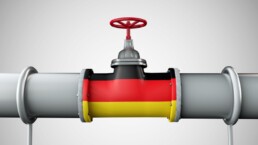

In early February, German media outlets reported on the strains affecting Germany’s gas reserves.
The news magazine Focus warned that the “cold snap devours our gas reserves.” At the same time, the TV broadcaster ntv said that “Germany’s gas reserves would theoretically last for about six more weeks,” and warned: “There is hardly any room for additional strain.”
The focus on gas reserves is a consequence of Russia’s invasion of Ukraine. In 2022, the German government decided that it no longer wanted to buy oil and gas from Russia. That led to the question of whether Germany could satisfy its energy needs without Russian gas. By the following year, it was evident that Germany could manage.
This was due, in part, to the diversification of import sources. Gas from Russia was replaced by imports from, among others, the United States and Norway. At the same time, import routes were adapted. Increasingly, liquefied natural gas (LNG) has been imported by sea. The terminals were planned, approved and put into operation in record time.
Sufficient gas reserves in Germany
The current winter in Germany is the harshest in years, prompting questions about supply security.
However, Susanne Ungrad, a press spokesperson for the Ministry for Economic Affairs and Energy (BMWE), told DW that “the gas supply is secured.” This, she said, was due to the “well-developed LNG infrastructure in Germany and Europe” and the “main supply via Norwegian pipeline gas.”
Fiete Wulff is equally sanguine about Germany’s reserves. The press spokesperson of the Federal Network Agency told DW that “at present, we see no threat to the gas supply.”
He added that “gas storage fill-levels are an important indicator, but not the only one.” A significant “share of our gas supply comes via pipelines and LNG shipments from neighboring countries.”
Even in the event of a harsher winter than the current one in Germany, supply would be secured, Wulff pointed out. More critical, he said, would be “disruptive events such as terrorist attacks or the failure of major import pipelines.”
Olaf Geyer, who heads the energy practice in Germany and Switzerland at the strategy consultancy Arthur D. Little, is also relaxed about the current situation.
When asked whether the reserves are sufficient, he was clear: “Yes. Under normal conditions. If extreme cold spells do not last longer than one or two weeks, then they are sufficient.”
That confidence is shared by Oskar Burmann of the industry association for gas and hydrogen, a lobbying group representing the gas sector.
“The legally mandated fill-level requirements for gas storage facilities have been met. In addition, thanks to the existing LNG infrastructure and new pipeline connections, the gas industry is fully capable of responding even at short notice to additional demand,” he said.
How do the storage facilities work?
Sebastian Heinermann, managing director of the “Initiative Energien Speichern” (INES), the association of German gas and hydrogen storage system operators, explained that imports are consistent throughout the year.
Consumption, by contrast, is flexible. In summer, demand is low.
“If we import 3.1 TWh [terawatt-hours] on a normal summer day but, for example, consume only 1.3, then a residual amount remains,” he said. This surplus is “partly exported, but to a large extent also flows into storage.”
Unlike import volumes, the filling and withdrawal of storage facilities are subject to seasonal fluctuations, Heinermann explained: “Storage facilities are filled in summer. In winter, they are primarily used to supply energy.”
However, pricing is a problem, Heinermann said.
“There is unanimous agreement within the industry that gas prices were exceptionally high last summer,” he said. “They were so high that gas cost more to buy in summer than it could be sold for in winter. This is referred to as a negative summer/winter spread.”
This, he added, was not a law of nature but a result of supply and demand. Gas suppliers could only expect limited government support in this regard.
According to the BMWE’s spokesperson, “storage filling must take place through market mechanisms,” adding that any state intervention “should only occur if it sustainably increases security of supply and does not relieve market participants of their responsibility.”
What’s in store for Germany next year?
When asked about the resilience of Germany’s storage system, Arthur D. Little analyst Geyer noted “that the energy system today is significantly more stable than it was three or four years ago.”
However, he also sees challenges ahead for Germany: “We will come out of winter with low storage levels, and then the question is: How will they be refilled?”
Attractive wholesale prices play a key role here, “so that this summer/winter spread is economically viable.”
Geyer emphasized that “there has to be a substantial gap” between the prices at which gas is bought in summer and sold in winter “for it to be attractive.”
He says more should be done to make gas supplies more secure, and is calling for “more flexibility in the system.”
This includes additional storage capacity and active demand-side management.
However, he also stressed that expanding alternative energy sources is essential. Electrifying heat generation, he said, would significantly strengthen the entire energy system.
This piece was originally published in German.



Related News.

Navigating the Multi-Orbit Era: In Conversation with Intellian’s Jon Harrison at SMM 2026
At SMM 2026 in Hamburg, the rapid evolution of maritime satellite communications took centre stage. Across the exhibition halls, discussions among…

Cyprus ports need joint energy and investment strategy, shipping agents chief says
Cyprus needs a coordinated strategy for shipping, energy and environmental protection to support port investment and modernisation, Cyprus shipping…

MASO Public Affairs introduces MASO Regulatory Intelligence
A new subscription service helping businesses understand what is changing and what it means for them MASO Public Affairs introduces MASO Regulatory…

Anglo-Eastern helps turn CMBTECH’s ammonia ambition into an operational reality
From early feasibility study and risk-based design to newbuilding supervision, crew readiness and technical management, Anglo-Eastern drew on its…

Escalation of attacks threatens to derail recovery in Middle East oil exports
World oil demand is forecast to fall by 2.5 mb/d y-o-y in 4Q26 and 2.6 mb/d on average in 2026. As the Iran war manifests itself through restricted…

New study finds shipping pays twice its share to EU ETS earmarked revenues should triple to help build market for sustainable fuels and technologies
Shipping is responsible for around 10% of EU ETS emissions but pays almost 20% of the ETS bill. Unlike other sectors, it has never received free…

MSARC strengthens maritime mass rescue readiness through training and national live exercise off Dakar, Senegal
Joint MSARC–FHAS programme combines three days of SAR training with a national multi-agency live exercise The Maritime Search and Rescue Council ,…

Sogese report deliveries are still being delayed as container freight rates fluctuate
FOR IMPORTERS Spot rates into the Mediterranean are back at January levels, Far East to Europe reliability sits at pandemic lows, and nearly…

Glencore begins trading on Australian Securities Exchange
Glencore has begun trading on the Australian Securities Exchange under the ASX code GLC. Gary Nagle, Glencore’s CEO, said it was an exciting day for…

BIMCO Shipping Number of the Week
Suez Canal container ship transits exceed 50% of pre-disruption levels "During the first two weeks of October, weekly container ship capacity…
Subscribe to our newsletter!
if you dont want to swim alone in the ocean of news, sign up for the newsletter, and you will receive daily all the important news of world shipping!
