Lloyd’s Register issues first guidance notes for onboard hydrogen generation as industry seeks regulatory clarity

The Guidance Notes provide clear technical direction for the design, installation and integration of onboard hydrogen generators.
Lloyd’s Register has published the maritime industry’s first dedicated Guidance Notes for onboard hydrogen generation, providing long-awaited clarity on the safe design and integration of hydrogen generator technologies on ships.
The new Guidance Notes respond directly to growing interest from shipowners, yards and technology developers in producing hydrogen onboard using alternative fuels such as LNG, methanol and ammonia.
While hydrogen is widely seen as a key fuel for decarbonisation, limited supply and availability of complex bunkering infrastructure significantly slow adoption in shipping. In addition, onboard storage may also pose challenges due to space demands and system complexity, adding further barriers to implementation.
Onboard hydrogen generation offers a practical bridge to the future of zero-emission shipping. By producing hydrogen directly on board, shipowners can avoid the need for space-demanding and complex compressed or liquefied hydrogen storage systems and eliminate dependence on the future development of widespread hydrogen supply chains and bunkering infrastructure. At the same time, they position themselves for compliance with tightening emission requirements and future decarbonisation regulations.
However, onboard hydrogen generation also presents safety and regulatory challenges due to the presence of two gases or low-flashpoint fuels and the absence of mature international regulations. Drawing on established LR Rules for fuel cells and low-flashpoint fuels, the Guidance Notes provide a clear, risk-based framework that reduces uncertainty, supports plan approval and accelerates project delivery for newbuilds and retrofits.
The Guidance Notes set out practical requirements for the design, safety and onboard installation of hydrogen generators, recognising the challenges of adapting land-based technologies for the marine environment. By aligning safety principles with existing class requirements, they offer a consistent and credible basis for engagement with flag Administrations and other stakeholders.
For shipowners, yards and technology providers, the Guidance Notes are expected to reduce technical and regulatory uncertainty for projects currently under development, helping to shorten approval timelines and de-risk investment decisions in hydrogen-based solutions.
Thomas Bayer, Lead Specialist Fuel Cell Technology, Technical Directorate, Lloyd’s Register, said:“Clear guidance is essential for emerging technologies. The industry cannot afford to stand still while formal regulations are developed; our Guidance Notes provide the clarity needed to move projects from concept to delivery.
“By publishing dedicated guidance ahead of formal international standards, LR reinforces its position as a trusted advisor on emerging technologies and a leader in supporting the maritime industry’s transition to low- and zero-carbon energy.”



Related News.

Navigating the Multi-Orbit Era: In Conversation with Intellian’s Jon Harrison at SMM 2026
At SMM 2026 in Hamburg, the rapid evolution of maritime satellite communications took centre stage. Across the exhibition halls, discussions among…
Cyprus ports need joint energy and investment strategy, shipping agents chief says
Cyprus needs a coordinated strategy for shipping, energy and environmental protection to support port investment and modernisation, Cyprus shipping…

MASO Public Affairs introduces MASO Regulatory Intelligence
A new subscription service helping businesses understand what is changing and what it means for them MASO Public Affairs introduces MASO Regulatory…
Anglo-Eastern helps turn CMBTECH’s ammonia ambition into an operational reality
From early feasibility study and risk-based design to newbuilding supervision, crew readiness and technical management, Anglo-Eastern drew on its…

Escalation of attacks threatens to derail recovery in Middle East oil exports
World oil demand is forecast to fall by 2.5 mb/d y-o-y in 4Q26 and 2.6 mb/d on average in 2026. As the Iran war manifests itself through restricted…
New study finds shipping pays twice its share to EU ETS earmarked revenues should triple to help build market for sustainable fuels and technologies
Shipping is responsible for around 10% of EU ETS emissions but pays almost 20% of the ETS bill. Unlike other sectors, it has never received free…

MSARC strengthens maritime mass rescue readiness through training and national live exercise off Dakar, Senegal
Joint MSARC–FHAS programme combines three days of SAR training with a national multi-agency live exercise The Maritime Search and Rescue Council ,…
Sogese report deliveries are still being delayed as container freight rates fluctuate
FOR IMPORTERS Spot rates into the Mediterranean are back at January levels, Far East to Europe reliability sits at pandemic lows, and nearly…

Glencore begins trading on Australian Securities Exchange
Glencore has begun trading on the Australian Securities Exchange under the ASX code GLC. Gary Nagle, Glencore’s CEO, said it was an exciting day for…
BIMCO Shipping Number of the Week
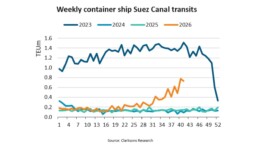
Suez Canal container ship transits exceed 50% of pre-disruption levels "During the first two weeks of October, weekly container ship capacity…
Subscribe to our newsletter!
if you dont want to swim alone in the ocean of news, sign up for the newsletter, and you will receive daily all the important news of world shipping!
