Japan emerging as early adopter of advanced fire detection on RoRo vessels, inspection data shows


Japan is emerging as an early adopter of advanced fire detection systems on RoRo vessels, according to inspection data from Idwal, the global vessel condition specialist.
While fire safety on RoRo vessels has come under increasing scrutiny, particularly as electric vehicles enter the cargo mix in greater numbers, Idwal’s inspections show that adoption of advanced fire detection technology across the global fleet remains uneven. Japanese owned and operated tonnage is increasingly standing out as an early mover, often installing more advanced detection systems ahead of regulatory requirements.
Much of today’s RoRo and car carrier fleet was built long before electric vehicle related fire risk became a central consideration. As a result, retrofitting advanced systems such as AI enabled camera detection or linear heat detection is often difficult to justify commercially on older vessels where existing detection arrangements remain compliant and operational.
Where advanced detection systems are being installed, they are most commonly observed on newbuilds and on Japanese owned or operated vessels. Recent LNG fuelled car carriers delivered to Japanese operators have been among the first to feature integrated camera-based detection systems designed to identify abnormal heat signatures at an early stage.
Despite this progress, these vessels still represent a relatively small proportion of the global RoRo fleet.
Across the wider industry, investment in new safety technology continues to be shaped by regulatory certainty. Historically, shipowners have tended to adopt new systems once expectations are clearly defined by regulators, and fire detection on RoRo decks is following this same pattern.
The absence of a consistent or internationally agreed approach to fighting electric vehicle fires at sea also continues to influence decision making. While detection technology is advancing, firefighting strategies remain fragmented, leading many owners to question the operational value of installing advanced detection systems without clarity on the appropriate response or longterm compliance requirements.
John Nicholson, Idwal’s Head of Technical, said, “What we are seeing during inspections is a clear difference in how owners are approaching fire detection on RoRo vessels. Japanese operators, particularly on newbuild tonnage, are more willing to invest early in advanced detection systems, even where regulations are still evolving. Across much of the fleet, however, owners remain understandably cautious until there is greater clarity around regulatory expectations and firefighting strategies.”
This position is expected to change over the coming years as new regulatory measures begin to take effect. Requirements under MSC.555 are expected to bring greater definition to fire safety expectations for RoRo vessels, particularly those carrying alternative fuel vehicles.
Idwal’s CEO, Nick Owens, added: “As frameworks become clearer, advanced fire detection is likely to move from being a differentiator to an expectation, especially on newbuilds. Japan may be moving first, but regulation will ultimately determine how quickly the rest of the industry follows.”



Related News.

Navigating the Multi-Orbit Era: In Conversation with Intellian’s Jon Harrison at SMM 2026
At SMM 2026 in Hamburg, the rapid evolution of maritime satellite communications took centre stage. Across the exhibition halls, discussions among…
Cyprus ports need joint energy and investment strategy, shipping agents chief says
Cyprus needs a coordinated strategy for shipping, energy and environmental protection to support port investment and modernisation, Cyprus shipping…

MASO Public Affairs introduces MASO Regulatory Intelligence
A new subscription service helping businesses understand what is changing and what it means for them MASO Public Affairs introduces MASO Regulatory…
Anglo-Eastern helps turn CMBTECH’s ammonia ambition into an operational reality
From early feasibility study and risk-based design to newbuilding supervision, crew readiness and technical management, Anglo-Eastern drew on its…

Escalation of attacks threatens to derail recovery in Middle East oil exports
World oil demand is forecast to fall by 2.5 mb/d y-o-y in 4Q26 and 2.6 mb/d on average in 2026. As the Iran war manifests itself through restricted…
New study finds shipping pays twice its share to EU ETS earmarked revenues should triple to help build market for sustainable fuels and technologies
Shipping is responsible for around 10% of EU ETS emissions but pays almost 20% of the ETS bill. Unlike other sectors, it has never received free…

MSARC strengthens maritime mass rescue readiness through training and national live exercise off Dakar, Senegal
Joint MSARC–FHAS programme combines three days of SAR training with a national multi-agency live exercise The Maritime Search and Rescue Council ,…

Sogese report deliveries are still being delayed as container freight rates fluctuate
FOR IMPORTERS Spot rates into the Mediterranean are back at January levels, Far East to Europe reliability sits at pandemic lows, and nearly…
Glencore begins trading on Australian Securities Exchange
Glencore has begun trading on the Australian Securities Exchange under the ASX code GLC. Gary Nagle, Glencore’s CEO, said it was an exciting day for…
BIMCO Shipping Number of the Week
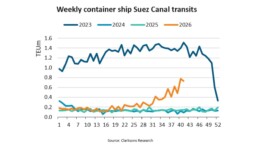
Suez Canal container ship transits exceed 50% of pre-disruption levels "During the first two weeks of October, weekly container ship capacity…
Subscribe to our newsletter!
if you dont want to swim alone in the ocean of news, sign up for the newsletter, and you will receive daily all the important news of world shipping!
