Korea and Japan race to lead liquefied hydrogen carriers
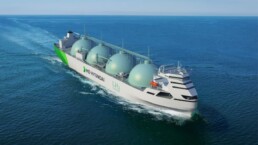

Seoul and Tokyo intensify bids for cryogenic hydrogen ships as Korea mounts joint push to close Japan’s early lead
Korean and Japanese shipbuilders are competing to get a head start in the market for liquefied hydrogen carriers, regarded as next-generation ships. As hydrogen use expands worldwide, many expect the market for liquefied hydrogen carriers to grow quickly.
According to the shipbuilding industry on the 19th, Japan’s Kawasaki Heavy Industries recently signed a contract with Japan Suiso Energy (JSE) to build a 40,000㎥ liquefied hydrogen carrier. Backed by the Japanese government, JSE plans to complete demonstrations on the operation and handling technology of liquefied hydrogen carriers by Mar. 2031.
Kawasaki Heavy Industries built the world’s first 1,250㎥ liquefied hydrogen carrier in 2021. After the vessel completed an operational demonstration from Japan to Australia, Kawasaki Heavy Industries was evaluated to have secured the world’s most advanced liquefied hydrogen carrier construction technology.
Liquefied hydrogen carriers are high value-added vessels that require more advanced technology than liquefied natural gas (LNG) carriers, a market led by Korean shipbuilders. To transport natural gas in liquefied form, the ship’s temperature must be maintained at minus 163 degrees Celsius, while hydrogen must be kept 90 degrees lower, at minus 253 degrees Celsius.
Also, because even strong materials can fracture easily at cryogenic temperatures, it is much harder to build tanks for liquefied hydrogen carriers, and the way insulation and thermal barriers are used differs from LNG carriers. In addition, hydrogen’s properties make the risk of explosion high, which is cited as another reason why building liquefied hydrogen carriers is difficult.
Korea has recently been accelerating efforts to tap the liquefied hydrogen carrier market. The Ministry of Trade, Industry and Resources formed a public-private task force on liquefied hydrogen carriers last May with major shipbuilders including HD Hyundai Heavy Industries, Hanwha Ocean and Samsung Heavy Industries.
The task force plans to complete the development of a 2,000㎥ liquefied hydrogen carrier by 2028. Because the project requires advanced technology, 101 institutions are participating to carry out 43 research and development projects. The budget投入 for liquefied hydrogen carrier development last year reached 55.5 billion won.
The recent joint push by the public and private sectors into liquefied hydrogen carrier technology stems from the judgment that this market is highly likely to become one of the main revenue sources for the Korean shipbuilding industry going forward.
According to the International Energy Agency (IEA), global hydrogen demand reached 100 million tons last year. Hydrogen is mainly transported from commodity-exporting countries such as Australia, South America and the Middle East to manufacturing-centered countries such as Korea, Japan and China.
Because liquefied hydrogen shrinks to one-800th the volume of gaseous hydrogen, making it more economical, demand for liquefied hydrogen carriers increases as the hydrogen economy ecosystem becomes more active. The IEA projected that the total number of liquefied hydrogen carriers built by 2050 would reach around 200.
Another reason Korean shipbuilders are focusing on localizing liquefied hydrogen carrier technology is to save on hefty licensing fees paid to foreign firms.
Korean shipbuilders currently cannot independently produce all of the cargo tanks (storage tanks for cooled natural gas) installed on LNG carriers, and pay royalties each year to France’s GTT, which provides the technology. In 2024, the LNG cargo tank royalties the three Korean shipbuilders paid to GTT totaled 995.4 billion won.
An industry official said, “It is true that Japan is about a half-step ahead in liquefied hydrogen carrier construction capabilities, but it has not yet secured technology at a perfect level.” The official added, “As everything from design to equipment development and production is being built from scratch, both Korea and Japan will go through multiple trials and errors,” and “we believe we can catch up sufficiently.”
Source: Chosun Biz



Related News.
Hong Kong Global Maritime Trade Summit to return for third edition
The International Chamber of Shipping, in collaboration with the Transport and Logistics Bureau of the Government of Hong Kong and the Hong Kong…

Appetite for US crude oil exports climbs despite high freight
South Korea tops US crude destinations at 568,600 b/d VLCC rates to Asia double, closing arbitrage window European refining margins…
Shipping stocks Rally as Hormuz Traffic plunges 75%
Ship traffic through the Strait of Hormuz — a critical chokepoint handling about 20% of global crude oil and liquefied natural gas shipments — has…
Diana Shipping announces Time Charter Contract for m/v G P Zafirakis with Classic Maritime
Diana Shipping, a global shipping company specializing in the ownership and bareboat charter-in of dry bulk vessels, announced that, through a…
New IMO ESP Code framework for Remote Inspection Techniques
The International Maritime Organisation, through Resolution MSC.584(111) , has adopted amendments to the International Code on the Enhanced…
ABS opens Offshore & Marine Support Center in Bergen
ABS has expanded its capabilities in the Norwegian maritime market with the opening of a cutting-edge support center in Bergen, bringing advanced…
MOL holds giant step memorial ceremony and beach cleanup at Kashima Coast
Memorial and Reflection 20 Years After the Accident: Learning from the Past to Foster an Even Stronger Safety Culture Mitsui O.S.K. Lines, announced…
KEZAD-based Arabian Gulf Steel Industries achieves lowest verified Carbon Footprint for Rebar
CARES UK verified Environmental Product Declaration confirms 139 kg CO₂e per tonne for rebar produced at AGSI’s KEZAD Abu Dhabi facility Arabian…
Indian Register of Shipping announces launch of first fleet support ship INS Surya
Indian Register of Shipping continues to strengthen its role in supporting the Indian Navy and India’s naval shipbuilding capabilities through the…

VLCCs Climbing the Record Charts
LR2 The TC1 75kt MEG/Japan index decreased by only a single point this week to WS928. The corresponding Baltic round-trip TCE fell by $2,000 to…
Subscribe to our newsletter!
if you dont want to swim alone in the ocean of news, sign up for the newsletter, and you will receive daily all the important news of world shipping!
