UK-led Maritime Consortium sets out plan for nuclear-powered fleet
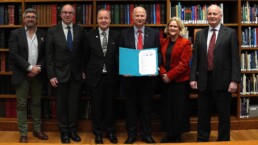

Lloyd’s Register convenes leading partners to deliver safe, secure and sustainable nuclear-powered ships for a net zero ocean economy
The UK is taking a decisive step towards leading the global race to decarbonise shipping with the launch of the Maritime Nuclear Consortium.
Convened by Lloyd’s Register (LR), the group unites leading expertise from the nuclear, maritime, insurance and regulatory sectors to set the highest international standards for safe, secure and commercially viable nuclear-powered ships.
Maritime nuclear power is a proven, advanced and safe energy source that can tackle one of the toughest challenges in the energy transition. The next generation of advanced modular reactors (AMRs) will allow ships to sail for years without refuelling, with zero carbon emissions and rigorous safety built in from the start.
Nuclear produces no CO₂. Reactors run for years, not weeks. With no need to trade efficiency for emissions standards, ships can run at full design speed instead of slow steaming.
The core membership includes:
- Lloyd’s Register (Lead, Safety & Secretariat)
- Rolls-Royce (Reactor Design)
- Babcock International Group (Ship Design, Construction and Support)
- Global Nuclear Security Partners (Security & Safeguards)
- Stephenson Harwood (Legal & Regulatory)
- NorthStandard (Insurance)
The UK has a long history of leading maritime innovation and is now in a strong position to support the safe adoption of maritime nuclear power. With trusted regulators, world-class engineering and shipbuilding, and decades of naval nuclear experience, it has the credibility to shape international standards from the start.
From London’s capital markets to northern engineering hubs, the UK also offers a complete ecosystem to support nuclear shipping – covering design, regulation, finance and insurance.
But the window for leadership is narrowing. Other nations are moving quickly to set their own standards and develop technology. Without coordinated UK action, the chance to define the rules, create high-skilled jobs and anchor a global supply chain could be lost to faster competitors.
Acting now would give the UK first-mover advantage, and ensure those standards, jobs and supply chains are built here.
The consortium’s first programme will:
- Demonstrate a Statement of Design Acceptability (SODA) for a generic, site-licensed advanced modular reactor.
- Develop a class certification framework integrating nuclear and maritime regulation.
- Define a security and safeguards architecture to meet regulatory requirements.
- Establish insurability pathways for nuclear-powered vessels.
- Publish guidance for industry and government to accelerate safe adoption.
Nick Brown, CEO of Lloyd’s Register, said: “Decarbonisation demands cleaner power, higher standards and a duty to the generations that follow. Nuclear is ready to meet that test.
“Used safely in naval fleets for decades, the next generation of advanced modular reactors brings tougher safeguards and the chance to bring nuclear power into everyday commercial shipping.
“If the UK leads on global standards, nuclear will mean more than zero-carbon ships. It will mean work in British shipyards, new business in the City, and lasting jobs for those who build, insure and sail the world’s fleet.”
Jake Thompson, Director, Rolls-Royce Advanced Modular Reactors, said: “Energy transition is a growing priority across multiple industries and nuclear is increasingly seen as part of the solution.
“We believe that the multi-sector collaboration from the Nuclear Maritime Consortium is a critical first step in the UK leading the development of the future international code for nuclear-powered vessels.
“Rolls-Royce is one of the world’s only nuclear reactor vendors with full lifecycle experience and end-to-end capability to credibly deliver these advanced technologies; based on proven, reliable power solutions in use across our business today.”
Mike Salthouse, Head of External Affairs, NorthStandard, said: “Insurance plays a critical role managing the risks associated with, and fostering confidence in, new technologies. At the heart of that confidence are people. By bringing deep expertise in risk assessment, safety, and regulatory compliance, NorthStandard can provide industry with the assurance it needs to explore the potential of innovative new applications for technologies such as civil nuclear marine.
“Through our participation in the Maritime Nuclear Consortium, we will contribute not only technical knowledge but also human insight. We are helping shape the future of nuclear-powered shipping with a focus on safety, security, and accountability.
“With the right people applying the right standards and joined up regulation, maritime nuclear power can become a transformative force – advancing decarbonisation, supporting commercial viability, and guiding the shipping industry towards net-zero emissions.”
Nick Tomkinson, Senior Partner at GNSP, said: “Maritime nuclear will only succeed when safety, security and safeguards are considered together from the start.
“This guidance document helps first movers align maritime and nuclear frameworks, apply goal-based approaches where prescriptive rules are absent, and build the confidence required by regulators, insurers and the public. GNSP is proud to contribute to this important step for the sector.”
Kirsti Massie, Partner at Stephenson Harwood, added: “Nuclear power has the potential to turbo-charge the UK’s energy transition and efforts to reduce carbon emissions. By bringing this Consortium together the UK has the opportunity to turn that potential into progress and set the global standards that can be used for generations to come.”
More than 700 marine nuclear reactors are in operation in naval fleets worldwide. The challenge is to adapt that technology for commercial use. By shaping rules for emerging reactor designs, the UK aims to position itself as a leading developer of maritime nuclear power and contribute to the net zero ocean economy.
Maria Taboada, Babcock’s Marine Engineering Director, said: “The transition to nuclear-powered shipping is not just as a technological advancement, but a strategic move to secure the UK’s maritime leadership. Babcock is one of the core members of the consortium bringing decades of experience from naval nuclear programmes and will be responsible for the engineering and integration of nuclear technologies into a maritime vessel.
“We are proud to contribute to a team that’s actively building the future of maritime nuclear power working to define the future of clean shipping through UK-led innovation.”



Related News.
Hong Kong Global Maritime Trade Summit to return for third edition
The International Chamber of Shipping, in collaboration with the Transport and Logistics Bureau of the Government of Hong Kong and the Hong Kong…

Appetite for US crude oil exports climbs despite high freight
South Korea tops US crude destinations at 568,600 b/d VLCC rates to Asia double, closing arbitrage window European refining margins…
Shipping stocks Rally as Hormuz Traffic plunges 75%
Ship traffic through the Strait of Hormuz — a critical chokepoint handling about 20% of global crude oil and liquefied natural gas shipments — has…
Diana Shipping announces Time Charter Contract for m/v G P Zafirakis with Classic Maritime
Diana Shipping, a global shipping company specializing in the ownership and bareboat charter-in of dry bulk vessels, announced that, through a…
New IMO ESP Code framework for Remote Inspection Techniques
The International Maritime Organisation, through Resolution MSC.584(111) , has adopted amendments to the International Code on the Enhanced…

ABS opens Offshore & Marine Support Center in Bergen
ABS has expanded its capabilities in the Norwegian maritime market with the opening of a cutting-edge support center in Bergen, bringing advanced…

MOL holds giant step memorial ceremony and beach cleanup at Kashima Coast
Memorial and Reflection 20 Years After the Accident: Learning from the Past to Foster an Even Stronger Safety Culture Mitsui O.S.K. Lines, announced…
KEZAD-based Arabian Gulf Steel Industries achieves lowest verified Carbon Footprint for Rebar
CARES UK verified Environmental Product Declaration confirms 139 kg CO₂e per tonne for rebar produced at AGSI’s KEZAD Abu Dhabi facility Arabian…
Indian Register of Shipping announces launch of first fleet support ship INS Surya
Indian Register of Shipping continues to strengthen its role in supporting the Indian Navy and India’s naval shipbuilding capabilities through the…
VLCCs Climbing the Record Charts
LR2 The TC1 75kt MEG/Japan index decreased by only a single point this week to WS928. The corresponding Baltic round-trip TCE fell by $2,000 to…
Subscribe to our newsletter!
if you dont want to swim alone in the ocean of news, sign up for the newsletter, and you will receive daily all the important news of world shipping!
