East Asian refiners show little interest in Venezuelan crude but watch for steep discounts


East Asian refiners unfamiliar with Merey, Boscan grades
Light sweet US crude grades still preferred
$5-$10/b discounts may prompt sample testing, trading analysis
East Asian refiners, traditionally favoring light, sweet US crude from the Americas and lacking refinery setups for heavy, sour Venezuelan grades like Merey and Boscan, remain largely uninterested in Venezuela’s crude for now, but steep spot discounts may prompt future trading analysis, feedstock managers at South Korean, Thai and Japanese refiners said over Jan. 6-8.
Apart from Chinese refiners, crude importers across East Asia are not familiar with Venezuela’s flagship export crude grades, including Merey and Boscan, feedstock managers and trading strategists at Thai, South Korean and Japanese refiners, including PTT, S-Oil and ENEOS, told Platts, part of S&P Global Energy.
Refinery configurations do not suit heavy, sour Venezuelan grades, while the superior quality of light, sweet US crudes like WTI Midland and West Texas Light keep them as the most preferred long-haul Americas-East Asia arbitrage feedstock options for now, the feedstock managers and trading strategists said.
Feedstock managers at several refiners requested anonymity due to the sensitive nature of spot crude cargo commercial trades.
On Jan. 7, US Energy Secretary Chris Wright said the US is planning to lift its oil embargo on Venezuela, and the oil will be sold to US refineries and to buyers around the world.
However, Japanese refiners are unlikely to show immediate or near-term interest in Venezuelan crude due to limited knowledge of the specifications and distillation cut yields of Merey and Boscan, feedstock managers and traders at two major Japanese refiners, including ENEOS, told Platts over Jan. 6-8.
Japan would prefer to actively purchase light, sweet US crude as part of the refining industry’s efforts to reduce its high reliance on sour crude suppliers. WTI Midland and WTL are considered the most ideal feedstocks among non-Persian Gulf crude, and it may take some time to become familiar with the heavy, sour Venezuelan grades, a feedstock manager at ENEOS said Jan. 6.
Meanwhile, South Korea’s reliance on Venezuelan crude has historically been negligible, with refiners showing little interest in the Latin American grade even before the imposition of US sanctions.
South Korea last imported Venezuelan crude in 2001, totaling 1.5 million barrels. The only other purchase before that was in 1982, when less than 1 million barrels were imported, a senior market research analyst at the Korea Petroleum Association said, citing data from state-run Korea National Oil Corp.
South Korea typically imports about 1 billion barrels of crude oil annually, so the sporadic purchase of Venezuelan crude — such as the 1.5 million barrels in 2001 — represents a tiny fraction of the country’s overall feedstock needs, highlighting the limited role Venezuelan crude has played in its energy mix, the KPA analyst told Platts on Jan. 7.
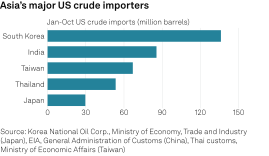
South Korea is Asia’s third-largest crude buyer and the region’s largest customer of US crude. For long-haul procurement from the Americas to the Far East, selecting high-quality crude that maximizes middle distillate production — such as WTI Midland and WTL — is preferred. Merey and Boscan do not fit this long-haul arbitrage feedstock trading strategy, a feedstock manager at a major South Korean refiner in Ulsan told Platts on Jan. 8.
In Thailand, a feedstock strategist at state-run PTT said that Venezuelan crude has never been part of the refiner’s feedstock blend and that it would take months to fully reconfigure its crude distillation unit to handle the heavy, sour Venezuelan grades.
“At least in the near term and over the next few quarters, it would be extremely difficult to consider purchasing Merey and Boscan crudes. While samples and testing might be possible, light, sweet US crude will remain the best feedstock choice from the Americas region,” the feedstock strategist at PTT told Platts.
Price, margin analysis
Unless Merey and Boscan are offered at a $5-$10/b discount at least to other flagship Middle Eastern medium and heavy sour grades, the refining and logistical economics would not be viable, refinery feedstock managers and traders based in Singapore said.
However, if heavy, sour Venezuelan grades were offered at steep discounts in the Asian market, some samples would be requested for testing, while new linear programming models and refining economics would be assessed for potential future purchases, feedstock managers at three Japanese and South Korean refiners said.
South Korea’s major refiners operate highly sophisticated facilities and are fully capable of efficiently cracking some of the heaviest crude grades, such as Mexican Maya crude.
While Merey and Boscan crudes are not expected to yield significant jet fuel or kerosene, Japan typically requires regular volumes of heavy, sour crude for power generation during peak summer and winter seasons. As such, a few cargoes of heavy, sour Venezuelan crude may serve that purpose, a senior market analyst at major Japanese integrated trading house Mitsui in Tokyo said.
Source: Platts



Related News.
Hong Kong Global Maritime Trade Summit to return for third edition
The International Chamber of Shipping, in collaboration with the Transport and Logistics Bureau of the Government of Hong Kong and the Hong Kong…

Appetite for US crude oil exports climbs despite high freight
South Korea tops US crude destinations at 568,600 b/d VLCC rates to Asia double, closing arbitrage window European refining margins…

Shipping stocks Rally as Hormuz Traffic plunges 75%
Ship traffic through the Strait of Hormuz — a critical chokepoint handling about 20% of global crude oil and liquefied natural gas shipments — has…

Diana Shipping announces Time Charter Contract for m/v G P Zafirakis with Classic Maritime
Diana Shipping, a global shipping company specializing in the ownership and bareboat charter-in of dry bulk vessels, announced that, through a…

New IMO ESP Code framework for Remote Inspection Techniques
The International Maritime Organisation, through Resolution MSC.584(111) , has adopted amendments to the International Code on the Enhanced…

ABS opens Offshore & Marine Support Center in Bergen
ABS has expanded its capabilities in the Norwegian maritime market with the opening of a cutting-edge support center in Bergen, bringing advanced…
MOL holds giant step memorial ceremony and beach cleanup at Kashima Coast
Memorial and Reflection 20 Years After the Accident: Learning from the Past to Foster an Even Stronger Safety Culture Mitsui O.S.K. Lines, announced…

KEZAD-based Arabian Gulf Steel Industries achieves lowest verified Carbon Footprint for Rebar
CARES UK verified Environmental Product Declaration confirms 139 kg CO₂e per tonne for rebar produced at AGSI’s KEZAD Abu Dhabi facility Arabian…

Indian Register of Shipping announces launch of first fleet support ship INS Surya
Indian Register of Shipping continues to strengthen its role in supporting the Indian Navy and India’s naval shipbuilding capabilities through the…

VLCCs Climbing the Record Charts
LR2 The TC1 75kt MEG/Japan index decreased by only a single point this week to WS928. The corresponding Baltic round-trip TCE fell by $2,000 to…
Subscribe to our newsletter!
if you dont want to swim alone in the ocean of news, sign up for the newsletter, and you will receive daily all the important news of world shipping!
