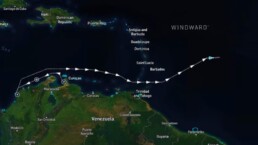

Bella 1 Reflags to Russia to Avoid U.S. Interception
Runaway Venezuela-trading tanker Bella 1 (IMO 9230880) painted a Russian flag on its hull, changed its name, and reflagged to Russia mid-voyage last week to avoid capture by the U.S. Coast Guard in the Atlantic Ocean.
But Bella 1, now known as Marinera, is not alone. The very large crude carrier is joining a growing fleet of Western-sanctioned tankers seeking protection under Russia’s national flag.
Over the past six months, a dozen or more of the darkest tankers operating globally have switched from open registries to Russia. This trend accelerated in December as the flag state emerged as a critical shield against drone strikes and vessel seizures.
Windward identified two additional Western-sanctioned tankers currently in Venezuelan waters that reflagged to Russia over the past 12 days to prevent U.S. naval interception.
Hyperion (IMO 9322968) departed Venezuela on January 1, flying the Russian flag, while Premier(IMO 9577082) signaled via AIS that it had changed its flag from Gambia to Russia on December 22. The vessel remains at José Terminal in Venezuela.
Stateless Tankers and the Legal Basis for Seizure
Gambia removed both Hyperion and Premier, along with another 70 sanctioned dark fleet tankers, from its registry in late November after declaring their maritime certificates fraudulent. This action left the vessels falsely flagged and effectively stateless.
Under international maritime conventions, stateless vessels can be boarded in international waters. This legal framework was used by the U.S. to seize two other tankers, Skipper and Centuries.
Both Hyperion and Premier discharged cargoes of Russian naphtha at José Terminal in mid-December and had effectively been stranded there since.
Drone Attacks Accelerate Reflagging to Russia
High-profile reflagging to Russia has also followed Ukrainian drone attacks on falsely flagged tankers in the Black Sea.
Prometey (IMO 9832559), formerly known as Virat, was reported sold to undisclosed Russian interests in maritime databases in mid-December, a week after it was struck by Ukrainian drones in the Black Sea. The vessel subsequently reflagged to Russia from Gambia, where it had been falsely flagged.
Virat was one of three falsely flagged tankers targeted by Ukrainian drones.
These attacks appear to have prompted swift action by other anonymous owners. The Benin-flagged tanker Danshul (IMO 9589750) was reported sold to Russian interests just days later while waiting in the Sea of Marmara for its Bosporus transit. Benin is considered a fraudulent registry.

By the time the Western-sanctioned tanker entered the Bosporus Strait on December 29, it had a freshly painted Cyrillic name, Strateg, and was flying the Russian flag.
From Open Registries to State-Backed Protection
Until recently, Russia played only a limited role in the dark fleet, aside from a small number of tankers owned by Russian-based companies such as Sovcomflot. A defining feature of the sanctions-evasion fleet built over the past six years was its reliance on open registries, with anonymous owners cycling through permissive jurisdictions.
Gabon, the Cook Islands, Barbados, Palau, Gambia, Sierra Leone, San Marino, and Guinea-Bissau were among the lesser-known registries targeted. These registries were privately operated companies contracted by governments with limited maritime experience and minimal oversight capacity.
Offering weak technical and regulatory supervision, these registries were widely used by vessels shipping Russian, Venezuelan, and Iranian oil.
As hundreds of tankers trading with Russia and Iran were sanctioned over the past 18 months, these flag states came under growing pressure to clean up their registries.
Tankers then turned to approximately 18 fraudulent registries that the International Maritime Organization determined did not exist, rendering the vessels falsely flagged and stateless. By August, at least two-thirds of sanctioned crude tankers were falsely flagged, according to Windward data.
A Shift Toward State Protection
With the legal vulnerabilities of stateless tankers now being exploited by both Ukraine and the U.S., Russia appears to be reconsidering how it manages its maritime logistics chain to keep oil flows moving.
The reflagging of sanctioned tankers to Russia was first observed as early as August. Windward tracked the reflagging of Novator (IMO 9297357) that month, making it the first sanctioned tanker without clear Russian ownership to switch to the national registry.
Others soon followed, including Lider (IMO 9321706). The Suezmax tanker reflagged to Russia in November after being among 60 vessels declared fraudulently flagged by the Comoros registry during a governance cleanup.
Developments over the past two weeks indicate a clear shift from opportunistic flag hopping to deliberate, state-backed protection. Russia is folding the most exposed elements of its dark fleet into its national flag, shielding its oil supply chain from interception and attack on the high seas.
Source: Windward



Related News.
Hong Kong Global Maritime Trade Summit to return for third edition
The International Chamber of Shipping, in collaboration with the Transport and Logistics Bureau of the Government of Hong Kong and the Hong Kong…

Appetite for US crude oil exports climbs despite high freight
South Korea tops US crude destinations at 568,600 b/d VLCC rates to Asia double, closing arbitrage window European refining margins…
Shipping stocks Rally as Hormuz Traffic plunges 75%
Ship traffic through the Strait of Hormuz — a critical chokepoint handling about 20% of global crude oil and liquefied natural gas shipments — has…
Diana Shipping announces Time Charter Contract for m/v G P Zafirakis with Classic Maritime
Diana Shipping, a global shipping company specializing in the ownership and bareboat charter-in of dry bulk vessels, announced that, through a…
New IMO ESP Code framework for Remote Inspection Techniques
The International Maritime Organisation, through Resolution MSC.584(111) , has adopted amendments to the International Code on the Enhanced…
ABS opens Offshore & Marine Support Center in Bergen
ABS has expanded its capabilities in the Norwegian maritime market with the opening of a cutting-edge support center in Bergen, bringing advanced…
MOL holds giant step memorial ceremony and beach cleanup at Kashima Coast
Memorial and Reflection 20 Years After the Accident: Learning from the Past to Foster an Even Stronger Safety Culture Mitsui O.S.K. Lines, announced…

KEZAD-based Arabian Gulf Steel Industries achieves lowest verified Carbon Footprint for Rebar
CARES UK verified Environmental Product Declaration confirms 139 kg CO₂e per tonne for rebar produced at AGSI’s KEZAD Abu Dhabi facility Arabian…

Indian Register of Shipping announces launch of first fleet support ship INS Surya
Indian Register of Shipping continues to strengthen its role in supporting the Indian Navy and India’s naval shipbuilding capabilities through the…

VLCCs Climbing the Record Charts
LR2 The TC1 75kt MEG/Japan index decreased by only a single point this week to WS928. The corresponding Baltic round-trip TCE fell by $2,000 to…
Subscribe to our newsletter!
if you dont want to swim alone in the ocean of news, sign up for the newsletter, and you will receive daily all the important news of world shipping!
