
In situ machining of bolt holes for fitting of a new shaft line coupling
The cargo ship M/V Polaris Liberty, a 140-meter-long vehicle carrier, was in dry dock at a shipyard in Klaipeda, Lithuania, for repairs, including the installation of a new hydraulic shaft coupling.
During disassembly, scoring was observed in the fitted bolt holes connecting the intermediate shaft and the coupling.

MarineShaft was brought in to resolve the issue by supplying 14 new bolts for the flange connection and performing in-situ machining of the damaged holes.
We manufactured 14 bolts with dimensions Ø95 x 289 mm, featuring oversized bolt bodies to accommodate the re-machined holes. The bolts were made from 42CrMo4 steel and delivered with a 3.2 LR certificate.


Our portable machining equipment was sent to the shipyard, and two of our service engineers carried out the in-situ machining of 12 bolt holes on the coupling and intermediate shaft flange.
Final machining of the bolt diameters to match the repaired hole dimensions was performed by the shipyard.
The in-situ work was completed within just 3 days.


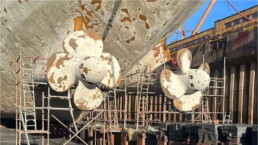
On-site repair of high-strength fixed-pitch propellers
We recently completed an on-site propeller repair assignment for a vessel during its
dry-docking at Oresund Drydocks in Sweden.
The vessel was equipped with four fixed-pitch propellers – two aft and two forward – operating under conditions that require highly durable propulsion components.
All four propellers had sustained edge damage.
We mobilized a service team of four certified welders who carried out
manual metal arc (MMA/stick) welding on the high-strength steel propellers,
designed to operate in ice water.
MarineShaft has a wide range of class-approved welding procedures
Our repair scope included:
• Grinding of the damaged areas to prepare for welding
• Controlled preheating before welding
• Welding of new material, shaped to match the original blade geometry
• Slow cooling to ensure structural integrity and prevent stress
• Liquid penetrant inspection (LPI) of all welded areas
• Final inspection and approval by the classification society DNV



Related News.

Hong Kong Global Maritime Trade Summit to return for third edition
The International Chamber of Shipping, in collaboration with the Transport and Logistics Bureau of the Government of Hong Kong and the Hong Kong…

Appetite for US crude oil exports climbs despite high freight
South Korea tops US crude destinations at 568,600 b/d VLCC rates to Asia double, closing arbitrage window European refining margins…

Shipping stocks Rally as Hormuz Traffic plunges 75%
Ship traffic through the Strait of Hormuz — a critical chokepoint handling about 20% of global crude oil and liquefied natural gas shipments — has…

Diana Shipping announces Time Charter Contract for m/v G P Zafirakis with Classic Maritime
Diana Shipping, a global shipping company specializing in the ownership and bareboat charter-in of dry bulk vessels, announced that, through a…
New IMO ESP Code framework for Remote Inspection Techniques
The International Maritime Organisation, through Resolution MSC.584(111) , has adopted amendments to the International Code on the Enhanced…

ABS opens Offshore & Marine Support Center in Bergen
ABS has expanded its capabilities in the Norwegian maritime market with the opening of a cutting-edge support center in Bergen, bringing advanced…

MOL holds giant step memorial ceremony and beach cleanup at Kashima Coast
Memorial and Reflection 20 Years After the Accident: Learning from the Past to Foster an Even Stronger Safety Culture Mitsui O.S.K. Lines, announced…

KEZAD-based Arabian Gulf Steel Industries achieves lowest verified Carbon Footprint for Rebar
CARES UK verified Environmental Product Declaration confirms 139 kg CO₂e per tonne for rebar produced at AGSI’s KEZAD Abu Dhabi facility Arabian…

Indian Register of Shipping announces launch of first fleet support ship INS Surya
Indian Register of Shipping continues to strengthen its role in supporting the Indian Navy and India’s naval shipbuilding capabilities through the…

VLCCs Climbing the Record Charts
LR2 The TC1 75kt MEG/Japan index decreased by only a single point this week to WS928. The corresponding Baltic round-trip TCE fell by $2,000 to…
Subscribe to our newsletter!
if you dont want to swim alone in the ocean of news, sign up for the newsletter, and you will receive daily all the important news of world shipping!
