Frostabåten: A real-world testbed for the future of autonomous maritime travel
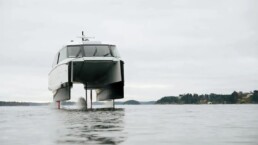

What happens when a ferry starts taking over some of the tasks we normally associate with a crew, like navigation, monitoring and system checks, but still has a trained operator in control? And how will passengers feel when boarding such a vessel for the first time?
These questions are at the heart of new research carried out on Frostabåten, an electric hydrofoil that will begin test sailings on the Trondheim Fjord in December. This initiative offers a unique opportunity to study human–autonomy interaction in real operational conditions, complementing prior laboratory-based research.
A flying boat on the fjord
Frostabåten uses the Candela P-12, an electric hydrofoil that lifts its hull out of the water as it gains speed. With less drag, the vessel becomes extremely energy-efficient, up to 80% lower consumption than traditional hulls, and can cruise quietly at 25 knots.
For the Trondheim Fjord, this technology is a game-changer. It makes it possible to run routes that would be too small for large ferries, and it cuts travel time between Frosta and Trondheim to just 25 minutes.
Studying the future passenger
Alongside the technical testing, NTNU’s Department of Design is exploring one of the most often overlooked aspects of autonomy: the passenger experience.
This part of the research was carried out as a master’s thesis project by master’s students Ane Solbakken-Melleby and Michelle Lous. Both completed their Master of Industrial Design at NTNU with a specialization in interaction design in the spring of 2025.
Their study, “Designing Passenger Touchpoints for an Autonomous Ferry Service” (Solbakken-Melleby, Lous & Alsos, 2025), investigates how passengers respond when tasks normally handled by crew are automated or when no crew are immediately visible.
“We mapped the entire travel experience, not just the journey from quay to quay, but from the moment passengers considered booking a trip to the moment they arrived at their final destination,” says Ane Solbakken-Melleby.
They found that when passengers cannot rely on crew for guidance, the design of the environment itself takes on a critical role.
Clear signage, intuitive wayfinding, and simple boarding processes become essential, while displays showing route information, vessel status, and safety instructions help build trust. Consistent and predictable interactions throughout the journey reduce uncertainty, creating a sense of reliability. In effect, thoughtful design becomes the passengers’ digital crew, guiding and reassuring them at every step.
 Michelle Lous.
“One of the key findings was that passengers have very different perceptions of autonomy and different levels of trust in the technology. Trust is essential, and it must be built through elements that compensate for the lack of direct human contact on board,” explains Lous.
“We saw that strong, consistent information flow throughout the customer journey was particularly effective. By identifying the points where trust needs are highest, we could focus our design efforts there, while acknowledging that these measures may only be a small part of a longer-term strategy to make autonomous services feel like a natural part of everyday travel,” Solbakken-Melleby adds.
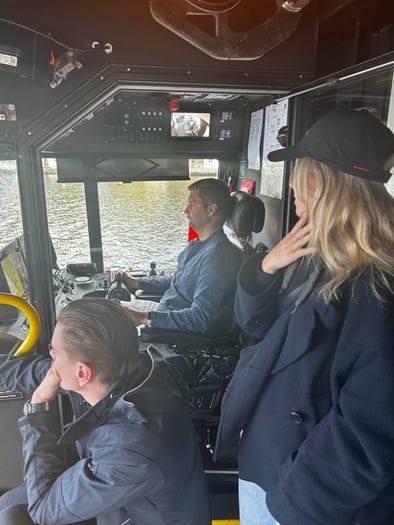 Research during test-sailing in Stockholm Photo: Ane Solbakken-Melleby
Autonomous functions – with a human in charge
A key part of Frostabåten is the testing of autonomous navigation support, energy optimization, and situational awareness tools. These systems are intended to make operations safer and more efficient—especially in winter conditions.
But one point cannot be emphasized enough: The vessel is not crewless. A trained operator is always at the helm. Autonomous systems support decision-making; they do not replace the human.
To study this, NTNU and the Shore Control Lab will stream high-quality video from the vessel to a shore-based control room. This allows researchers to explore long-term possibilities for remote monitoring, improved situational awareness, and new ways of supporting the operator during complex conditions.
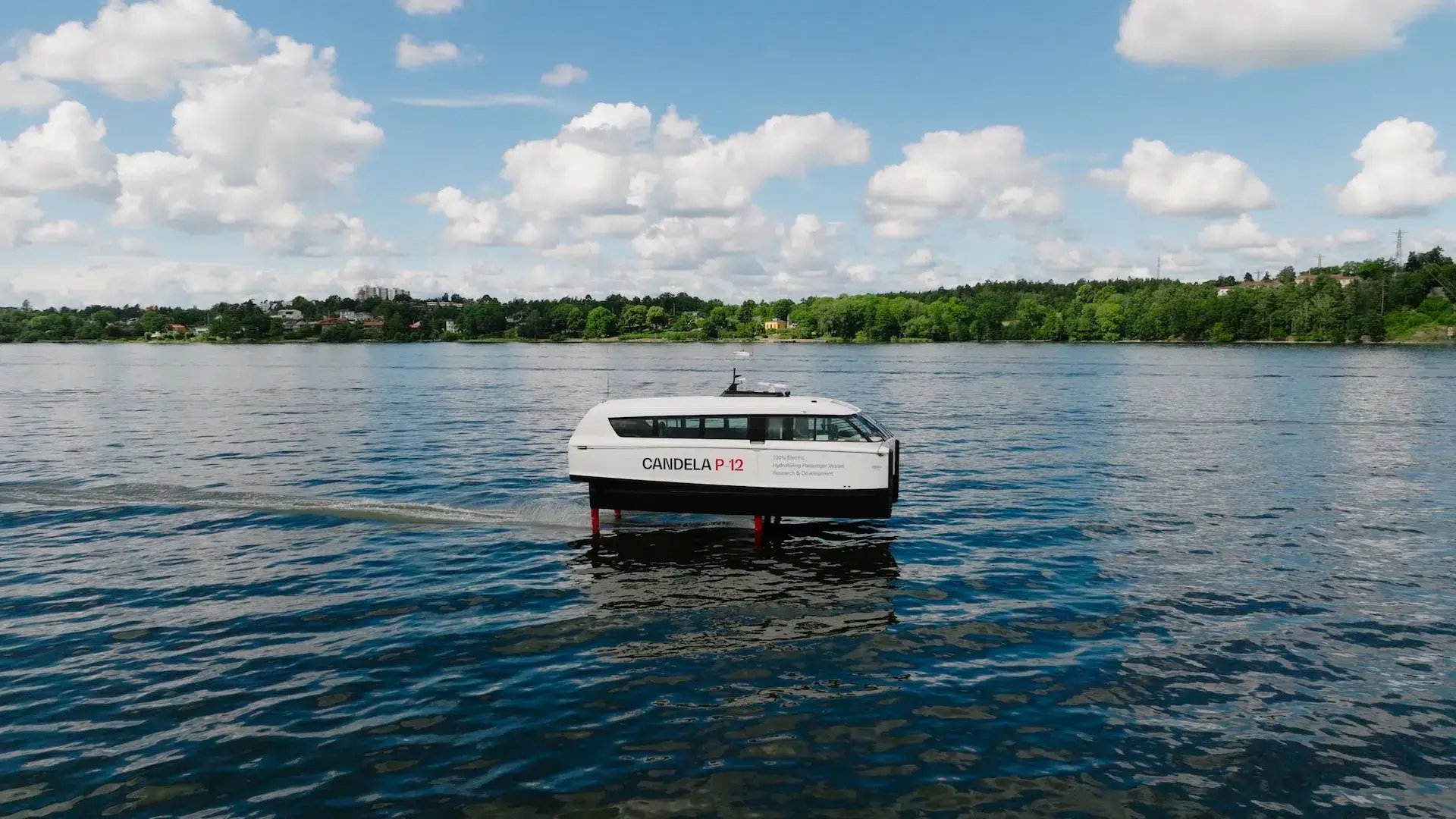 Candela P-12, hydrofoil ferry. Photo: Candela
A collaborative test arena
Frostabåten is more than a single vessel. It is a shared test arena for Norway’s autonomous maritime community. The project brings together technology companies, designers, researchers and operators through partners such as the Ocean Autonomy Cluster, MIDAS, Trondheim Port, Frosta Brygge, FI Ocean Space Incubator, and Maritime Robotics.
For Ocean Autonomy Cluster, the project offers valuable insight into how autonomous functions can be introduced safely, gradually and in ways that benefit both operators and passengers.
.jpg?width=6000&height=4000&name=Nordic%205%20Tech%20Foto%20Lars%20Bugge%20Aarset%20-%20Ocean%20Autonomy%20Cluster%20(80).jpg) NTNU Shore Control Lab. Photo: Lars Bugge Aarset/Fremtidens Industri
NTNU Shore Control Lab. Photo: Lars Bugge Aarset/Fremtidens Industri
Toward new fjord mobility
The long-term ambition is to establish a scalable model for emission-free, fast ferry routes that can serve commuters, tourists, and coastal communities, first in Norway, and eventually internationally.
As project manager Linda Cathrine Hald puts it, Frostabåten is “only the beginning.” The knowledge gained—from hydrofoil performance in rough conditions to how passengers respond to autonomy, will shape how future ferry services are designed.
And perhaps most importantly, Frostabåten shows that even small vessels can become floating laboratories, helping Norway stay at the forefront of autonomous maritime innovation.
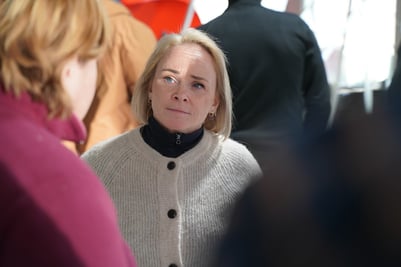 Linda Cathrine Hald, Project leader for Frostabåten from FI Ocean Space Incubator. Photo: Lars Bugge Aarset/Fremtidens Industri



Related News.

Navigating the Multi-Orbit Era: In Conversation with Intellian’s Jon Harrison at SMM 2026
At SMM 2026 in Hamburg, the rapid evolution of maritime satellite communications took centre stage. Across the exhibition halls, discussions among…

Cyprus ports need joint energy and investment strategy, shipping agents chief says
Cyprus needs a coordinated strategy for shipping, energy and environmental protection to support port investment and modernisation, Cyprus shipping…

MASO Public Affairs introduces MASO Regulatory Intelligence
A new subscription service helping businesses understand what is changing and what it means for them MASO Public Affairs introduces MASO Regulatory…

Anglo-Eastern helps turn CMBTECH’s ammonia ambition into an operational reality
From early feasibility study and risk-based design to newbuilding supervision, crew readiness and technical management, Anglo-Eastern drew on its…

Escalation of attacks threatens to derail recovery in Middle East oil exports
World oil demand is forecast to fall by 2.5 mb/d y-o-y in 4Q26 and 2.6 mb/d on average in 2026. As the Iran war manifests itself through restricted…

New study finds shipping pays twice its share to EU ETS earmarked revenues should triple to help build market for sustainable fuels and technologies
Shipping is responsible for around 10% of EU ETS emissions but pays almost 20% of the ETS bill. Unlike other sectors, it has never received free…

MSARC strengthens maritime mass rescue readiness through training and national live exercise off Dakar, Senegal
Joint MSARC–FHAS programme combines three days of SAR training with a national multi-agency live exercise The Maritime Search and Rescue Council ,…

Sogese report deliveries are still being delayed as container freight rates fluctuate
FOR IMPORTERS Spot rates into the Mediterranean are back at January levels, Far East to Europe reliability sits at pandemic lows, and nearly…

Glencore begins trading on Australian Securities Exchange
Glencore has begun trading on the Australian Securities Exchange under the ASX code GLC. Gary Nagle, Glencore’s CEO, said it was an exciting day for…

BIMCO Shipping Number of the Week
Suez Canal container ship transits exceed 50% of pre-disruption levels "During the first two weeks of October, weekly container ship capacity…
Subscribe to our newsletter!
if you dont want to swim alone in the ocean of news, sign up for the newsletter, and you will receive daily all the important news of world shipping!
