

War risk premiums decrease in Red Sea amid ceasefire
Black Sea premiums rise due to Ukraine attacks
Volatile security dynamics impact shipping markets, routes
Marine insurance rates have fallen significantly for Red Sea transits while rising for transits in the Black Sea, several insurance and security sources told Platts, highlighting changing security dynamics in the regions.
Following the latest Israel-Hamas ceasefire in early October, Yemen-based Houthis have paused attacks on merchant ships in the Red Sea and surrounding waters and released 11 crew and security personnel from the Eternity C, held by the militant group for nearly five months.
The de-escalation suggests operational risks for shipping companies without Israel exposure have become “tolerable” in the waterway, security advisory Ambrey said, while suggesting the Houthis have also “likely” suspended attacks on Israel-affiliated shipping.
The additional war risk premium, or AWRP, for a ship sailing through the Red Sea is now at the lowest level since November 2023, the month after the war in Gaza broke out, according to Marcus Baker, head of marine at brokerage Marsh.
The rate has fallen to around 0.2% of hull value from 0.5% before the ceasefire, a UK-based insurance source told Platts, part of S&P Global Energy.
“We do not view this [ceasefire] as a return to normality in the Red Sea, but as a temporary pause in a conflict that still has plenty of room to flare up again,” Munro Anderson, head of operations at marine war risk and insurance specialist Vessel Protect, part of Pen Underwriting, said.
AWRPs are usually on the charterer’s account in spot freight deals. Some sources said more charterers are requesting Red Sea transits amid falling insurance costs. But shipowners are demanding a premium for transit risks.
Platts assessed the Long Range 1 rate for transporting 65,000 metric tons of clean petroleum products from the Arab Gulf to the UK/Continent at $52.31/mt via the Red Sea and at $50.77/mt via the Cape of Good Hope, a longer route with higher bunker consumption and costs, on Dec. 4.
“This [Red Sea] region is very volatile and attacks could happen at any time regardless of what the Houthis put out through media,” Corey Ranselm, CEO of security consultancy Dryad Global, said.
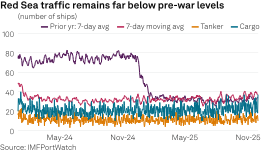
Average daily ship transits via the Bab al-Mandab Strait stood at 37 in the week ended Nov. 30, up from 34 a year ago, but down from the usual level of over 70 before the war in Gaza, according to IMF PortWatch data.
“It is up to the individual ship managers to establish the criteria to be met for them to conclude that it is safe to resume sailing in the Red Sea,” shipping industry group BIMCO’s chief security officer, Jakob Larsen, said. “The ceasefire in Gaza remains fragile, and the security situation could change at short notice.”
Black Sea conflicts
The ARWP for Black Sea voyages in moving in the other direction amid increasing frequency of Ukrainian attacks on Russia’s marine infrastructure.
Dylan Mortimer, Marine Hull UK War Leader of Marsh, said the rate of a ship sailing to Russia’s Black Sea ports has surged by 250% from the mid-November level of 0.25%-0.30% of hull value.
Platts assessed the AWRP for crude oil at 85 cents/b on Dec. 4, up from 65 cents/b on Oct. 31.
Since Nov. 28, Turkish authorities have reported that three tankers with frequent calls to Russian ports were attacked off the country’s northern coast. Ukraine confirmed drone operations on the sanctioned Suezmax Kairos and the Aframax Virat to some media outlets, but denied any involvement in operations on the small tanker Midvolga-2, which is not sanctioned.
Ukrainian government officials did not respond to emails seeking further comments.
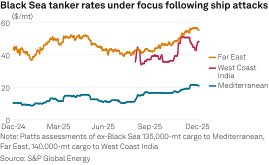
The Suezmax rate for transporting 140,000 mt of Russian crude from the Black Sea to West Coast India increased to $48.21/mt on Dec. 3 from $42.86/mt on Nov. 27, according to Platts assessments.
“It appears the increase in threat is affecting ships … navigating the Black Sea and thus within surface drone strike of mainland Ukraine,” Larsen told Platts.
Russian President Vladimir Putin told reporters on Dec. 2 that Russia would retaliate by attacking Ukraine’s port infrastructure and ships entering Ukrainian ports and consider reciprocal strikes against the ships of countries assisting Ukraine in the recent operations, without naming any country.
“Threat levels for tankers calling Russian ports and vessels calling Ukrainian ports have significantly increased, driven by both operational activity and strategic ambiguity,” security advisory Ambrey said in a recent note.
A London-based underwriting source told Platts the AWRP for ships destined for Ukrainian ports is around 0.8%-1%. The rate was 0.4% in late November, according to some media reports.
Higher insurance premiums would add to logistics costs of the countries’ seaborne trades. Russia has exported nearly 1.44 million b/d of crude and condensate so far this year from the Black Sea, while agribulk shipments from Ukraine have reached 25.9 million mt, according to data from S&P Global Commodities at Sea.



Related News.

Hong Kong Global Maritime Trade Summit to return for third edition
The International Chamber of Shipping, in collaboration with the Transport and Logistics Bureau of the Government of Hong Kong and the Hong Kong…

Appetite for US crude oil exports climbs despite high freight
South Korea tops US crude destinations at 568,600 b/d VLCC rates to Asia double, closing arbitrage window European refining margins…
Shipping stocks Rally as Hormuz Traffic plunges 75%
Ship traffic through the Strait of Hormuz — a critical chokepoint handling about 20% of global crude oil and liquefied natural gas shipments — has…
Diana Shipping announces Time Charter Contract for m/v G P Zafirakis with Classic Maritime
Diana Shipping, a global shipping company specializing in the ownership and bareboat charter-in of dry bulk vessels, announced that, through a…
New IMO ESP Code framework for Remote Inspection Techniques
The International Maritime Organisation, through Resolution MSC.584(111) , has adopted amendments to the International Code on the Enhanced…

ABS opens Offshore & Marine Support Center in Bergen
ABS has expanded its capabilities in the Norwegian maritime market with the opening of a cutting-edge support center in Bergen, bringing advanced…

MOL holds giant step memorial ceremony and beach cleanup at Kashima Coast
Memorial and Reflection 20 Years After the Accident: Learning from the Past to Foster an Even Stronger Safety Culture Mitsui O.S.K. Lines, announced…

KEZAD-based Arabian Gulf Steel Industries achieves lowest verified Carbon Footprint for Rebar
CARES UK verified Environmental Product Declaration confirms 139 kg CO₂e per tonne for rebar produced at AGSI’s KEZAD Abu Dhabi facility Arabian…

Indian Register of Shipping announces launch of first fleet support ship INS Surya
Indian Register of Shipping continues to strengthen its role in supporting the Indian Navy and India’s naval shipbuilding capabilities through the…

VLCCs Climbing the Record Charts
LR2 The TC1 75kt MEG/Japan index decreased by only a single point this week to WS928. The corresponding Baltic round-trip TCE fell by $2,000 to…
Subscribe to our newsletter!
if you dont want to swim alone in the ocean of news, sign up for the newsletter, and you will receive daily all the important news of world shipping!
